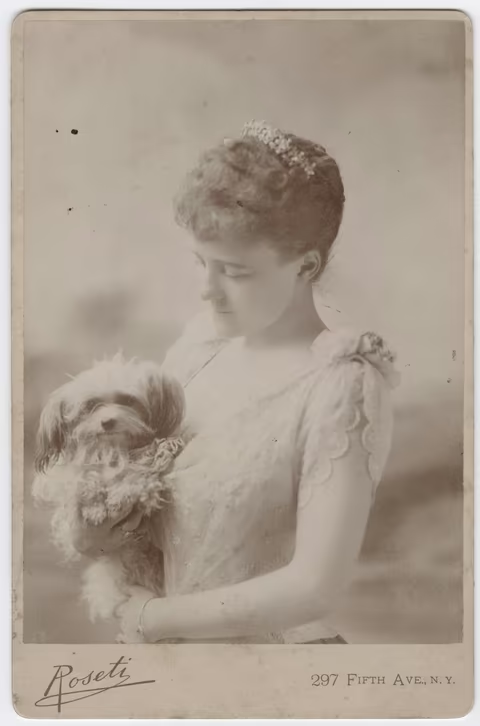
Quick Facts
Edith Newbold Jones
Born: January 24, 1862
Died: August 11, 1937
Nationality: American
Genres: Realism, Literary Criticism, Modernism
Notable Works: The Age of Innocence, The House of Mirth, Ethan Frome, The Custom of the Country, Summer
👶 Early Life and Education
Edith Wharton was born Edith Newbold Jones on January 24, 1862, in New York City to one of the city's most prominent old-money families — one of her biographers claims that the phrase "keeping up with the Joneses" derives from her father's family. The Joneses spent much of Edith's childhood traveling through Europe, where she became fluent in French, German, and Italian. At age nine, she nearly died of typhoid fever while the family was staying in the Black Forest.
Edith was educated by governesses and her father's private library, though her mother discouraged novel-reading as unsuitable for a young woman. Despite this, she began writing stories and poems in her teens and privately published a volume of verse, Verses, at age sixteen. She made her society debut in 1879 and soon entered the marriage market of Gilded Age New York.
🏡 Personal Life
In 1885, Edith married Edward "Teddy" Wharton, a Boston sportsman twelve years her senior. The marriage was largely loveless — Wharton later wrote in her private diary that their intimacy effectively ended within weeks of the wedding. Teddy suffered from what was then called neurasthenia, and eventually embezzled funds from Edith's trust. They divorced in 1913. The Whartons had no children.
In 1902, Wharton designed and built The Mount, her estate in Lenox, Massachusetts, which she considered her "first real home." Modeled on 17th-century English country houses, it reflected the design principles she had outlined in her first major book, The Decoration of Houses (1897). The Mount is now a National Historic Landmark and museum. Between 1907 and 1910, Wharton had a passionate love affair with the journalist W. Morton Fullerton, introduced to her by Henry James. The relationship profoundly influenced her later fiction, including the novel Summer (1917).
📖 Career and Literary Contributions
Wharton published her first major short story, Mrs. Manstey's View, in 1891. Her first story collection, The Greater Inclination (1899), established her as a serious literary voice, and she quickly rose to prominence with her breakthrough novel The House of Mirth (1905), a devastating portrait of a beautiful woman destroyed by the social machinery of old New York.
Over the next three decades, Wharton published more than forty books — novels, novellas, short story collections, poetry, travel writing, and literary criticism. Her friend and mentor Henry James was a profound influence; both wrote novels of manners dissecting upper-class society, though Wharton resented the constant comparisons, believing her work was more emotionally direct.
🌿 Writing Style and Themes
Wharton wrote with precision, satiric wit, and moral seriousness. Her prose style is controlled and elegant, with vivid settings and carefully chosen imagery that serve structural purposes beyond mere description. She was a master of irony, using it to expose the gap between social surfaces and the turmoil beneath.
Her central themes revolve around the conflict between individual desire and social convention — the crushing weight of propriety on women especially, the tension between old money and new, and the emotional costs of maintaining appearances in Gilded Age America. Stories like Souls Belated and The Other Two dissect the institution of marriage with surgical precision, while her novels anatomize the entire social ecosystem of old New York.
✒️ Notable Works
The House of Mirth (1905) remains one of the great American novels about the destructive power of social aspiration. Ethan Frome (1911), her stark novella of thwarted love in wintry New England, is widely studied in classrooms around the world. The Custom of the Country (1913) is often considered her most ambitious social satire, tracing a ruthless social climber through multiple marriages.
The Age of Innocence (1920) earned Wharton the Pulitzer Prize for Fiction in 1921 — making her the first woman ever to receive that honor. The novel portrays the stifling conventions of 1870s New York high society through a love triangle of painful restraint. Among her other important works are Summer (1917), The Bunner Sisters (1916), and her autobiography A Backward Glance (1934).
👻 Ghost Stories
Wharton was a master of the supernatural tale, writing ghost stories throughout her career from 1893 to 1937. She once famously declared, "I don't believe in ghosts, but I'm afraid of them." Her ghost fiction — including Afterward, The Lady's Maid's Bell, Kerfol, and The Triumph of Night — uses the supernatural to explore repression, guilt, and the secrets hidden beneath polished social surfaces. We feature her work in our collection of Gothic, Ghost, Horror & Weird Fiction.
🇫🇷 World War I and Life in France
After her divorce in 1913, Wharton settled permanently in France. When World War I broke out, she threw herself into relief work with extraordinary energy — organizing workrooms for unemployed women, opening refugee hostels, and caring for more than 600 war orphans. In 1916, France awarded her its highest honor, the Chevalier of the Legion of Honour, for her wartime service. We feature her work in our collection of World War I Literature.
✨ Legacy and Significance
Wharton received an honorary Doctorate of Letters from Yale University in 1923 — the first woman to receive that distinction. She was nominated for the Nobel Prize in Literature in 1927, 1928, and 1930, and was inducted into the National Women's Hall of Fame in 1996. Her friend Sinclair Lewis dedicated his novel Babbitt to her, and F. Scott Fitzgerald counted her as both friend and inspiration. She died of a stroke on August 11, 1937, at her home near Paris, and is buried in the Cimetière des Gonards in Versailles, France. We feature Wharton in our collection of Pulitzer Prize Winners.
⭐ Interesting Facts
- The phrase "keeping up with the Joneses" is believed to derive from her father's wealthy New York family.
- She designed her own house, The Mount, based on the principles in her book on interior decoration.
- She wrote her manuscripts in bed each morning, dropping finished pages on the floor for her secretary to collect.
- Her close friendship with Henry James lasted over twenty years, during which they exchanged hundreds of letters.
- She was one of only three women nominated for the Nobel Prize in Literature before 1940.
Frequently Asked Questions about Edith Wharton
Where can I find study guides for Edith Wharton's stories?
We offer free interactive study guides for the following Edith Wharton stories:
- Afterward — comprehension questions, vocabulary review, and discussion prompts
- Souls Belated — comprehension questions, vocabulary review, and discussion prompts
- The Other Two — comprehension questions, vocabulary review, and discussion prompts
What is Edith Wharton most famous for?
Edith Wharton is best known for her novels dissecting the social mores of Gilded Age New York, particularly The House of Mirth (1905), Ethan Frome (1911), and The Age of Innocence (1920). She was the first woman to win the Pulitzer Prize for Fiction, awarded for The Age of Innocence in 1921.
Was Edith Wharton the first woman to win the Pulitzer Prize?
Yes. In 1921, Edith Wharton became the first woman to win the Pulitzer Prize for Fiction for her novel The Age of Innocence. She was also the first woman to receive an honorary Doctorate of Letters from Yale University in 1923, and was nominated for the Nobel Prize in Literature in 1927, 1928, and 1930.
What was Edith Wharton's writing style?
Wharton wrote with precision, satiric wit, and moral seriousness. Her prose is controlled and elegant, using vivid settings and irony to expose the gap between polished social surfaces and the turmoil beneath. Her central themes include individual desire versus social convention, the crushing weight of propriety on women, and the tension between old money and new in Gilded Age America.
Who was Edith Wharton's husband?
Edith married Edward "Teddy" Wharton, a Boston sportsman twelve years her senior, in 1885. The marriage was largely loveless; Teddy suffered from manic depression and eventually embezzled funds from Edith's trust. They divorced in 1913, and Wharton spent the rest of her life in France.
Did Edith Wharton have children?
No. Edith Wharton and her husband Teddy had no children. After her divorce in 1913, Wharton lived in France, surrounded by a close circle of literary friends including Henry James.
How did Edith Wharton die?
Edith Wharton suffered a heart attack on June 1, 1937, and died of a stroke on August 11, 1937, at her home, Le Pavillon Colombe, in Saint-Brice-sous-Forêt near Paris. She was 75 years old and is buried in the Cimetière des Gonards in Versailles, France.
What are Edith Wharton's best short stories?
Among Wharton's most acclaimed short stories are The Other Two, Souls Belated, Xingu, and Afterward. Her ghost stories, including The Lady's Maid's Bell and Kerfol, are particularly admired.
Did Edith Wharton write ghost stories?
Yes. Wharton was a master of the supernatural tale, writing ghost stories from 1893 to 1937. She famously said, "I don't believe in ghosts, but I'm afraid of them." Her best-known ghost stories include Afterward, The Lady's Maid's Bell, and Kerfol.