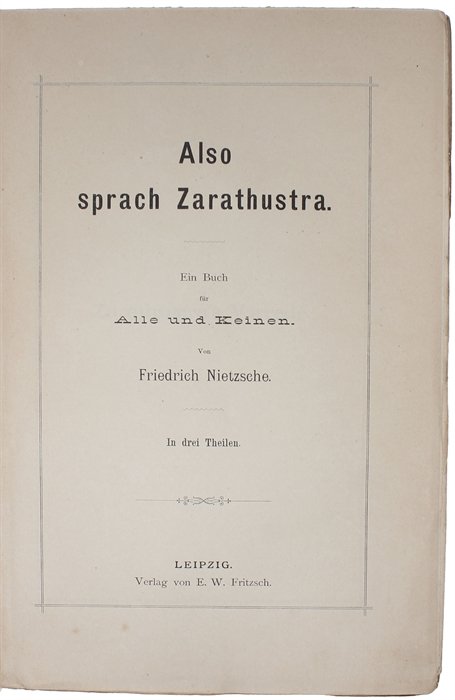
Thus Spake Zarathustra
Thus Spake Zarathustra (1883–1885) is Friedrich Nietzsche’s most celebrated and ambitious work—a philosophical novel written in a lyrical, prophetic style inspired by the Bible and Persian scripture. The book follows the wanderings of Zarathustra, a sage who descends from his mountain solitude after ten years to share his wisdom with humanity. Through a series of discourses, parables, and encounters, Zarathustra proclaims Nietzsche’s most revolutionary ideas: the death of God, the Übermensch (the overman or superman) as humanity’s next aspiration, the eternal recurrence of all things, and the will to power as the fundamental drive of life.
Structured in four parts, the work traces Zarathustra’s repeated cycles of descent into the world and retreat to his cave. He preaches to crowds who misunderstand him, gathers disciples only to send them away, confronts his own deepest fears and doubts, and ultimately embraces the terrifying idea that every moment of existence will recur infinitely. Part philosophical treatise, part prose poem, part spiritual autobiography, the book defies easy classification—Nietzsche himself called it the deepest book humanity possesses.
Written in an ecstatic, aphoristic prose that oscillates between tenderness and ferocity, Thus Spake Zarathustra remains one of the most influential works of modern philosophy, shaping existentialism, postmodernism, and twentieth-century thought. Its vision of self-overcoming and radical affirmation of life continues to challenge and inspire readers.