The Revenge
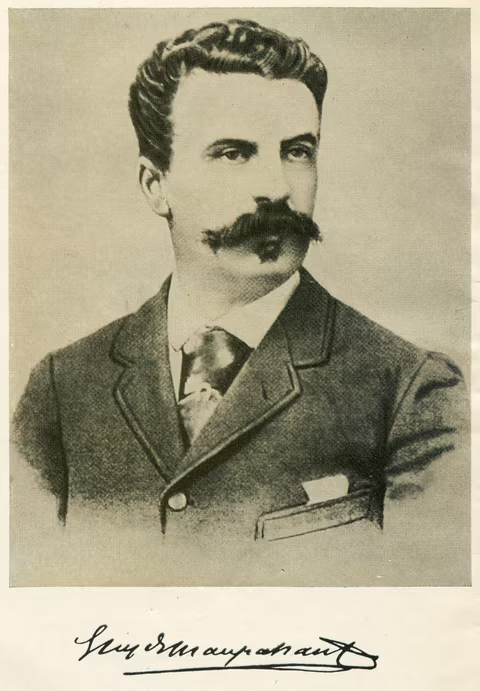
by Guy de Maupassant
Scene I
M. de Garelle, alone, lying back in an armchair.
Here I am at Cannes, a gay bachelor, which is humorous enough. I’m a bachelor. At Paris I hardly realised it. Away from home, it’s another thing. Upon my word, I’m not complaining about it.
And my wife is married again!
I wonder if my successor is happy, happier than I am. What sort of a fool must he be to have married her after me! For the matter of that, I was no less a fool for marrying her first. She had her points, however, certain good points … physical ones … quite remarkably good, but she had serious moral blemishes too.
What a sly wench, what a liar, what a flirt she was, and how attractive to men who were not her husband! Was I a cuckold? God, it’s sheer torture to be wondering that from morning to evening, and never to know for sure.
What plots and counterplots I laid to watch her, without learning anything! In any case, if I was a cuckold, I’m one no longer, thanks to Naquet. How easy divorce is after all! It cost me ten francs for a riding-whip, and a stiffness in my right arm, not counting the pleasure it gave me to lay on to my heart’s content on a woman whom I strongly suspect of deceiving me.
What a thrashing, what a thrashing I gave her! …
He stands up, laughing, takes a few steps, and sits down again.
True, the verdict was given in her favour and against me … but what a thrashing!
Now I am spending the winter in the South, a gay bachelor. What luck! It’s delightful to travel when you can always hope to meet a new love round every corner. Whom shall I meet, in this hotel, now, or on the Croisette, or perhaps in the street? Where is she, the woman who will love me tomorrow and whose lover I shall be? What will her eyes be like, her lips, her hair, her smile? What will she be like, the first woman who will give me her mouth and be folded in my arms? Dark or fair? Tall or short? Gay or grave? Plump or … ? She will be plump!
Oh! how I pity people who don’t know, people who no longer know the exquisite pleasure of anticipation! The woman I really love is the Unknown, the Hoped-for, the Desired, she who haunts my heart, whom my eyes have never seen in the flesh, she whose charms are augmented by every ideal perfection. Where is she? In this hotel, behind this door? In one of the rooms of this house, quite near, or still far away? What matter, so long as I desire her, so long as I am certain of meeting her! And I shall assuredly meet her, today or tomorrow, this week or the next, sooner or later; it is absolutely inevitable that I shall find her.
And I shall have, in all their charm, the divine joy of the first kiss, the first caresses, all the maddening ecstasy of lovers’ discoveries, all the mystery of the unexplored, as desirable the first day as a conquered maidenhood. Oh! the fools who do not understand the adorable sensation of veils raised for the first time! Oh, the fools who marry … since … the said veils … ought not to be raised too often … on the same sight! …
Here comes a woman.
A woman crosses the far end of the corridor, elegant, slender, with a tapering waist.
Damn her, she has a figure, and an air. Let’s try to catch sight of … her face.
She passes near him without seeing him, buried in the depths of the armchair. He murmurs:
Hell, it’s my wife! My wife, or rather not my wife, Chantever’s wife. What a charming hussy she is, after all! …
Am I going to want to marry her again now? … Good, she’s sitting down and she’s reading Gil Blas. I’ll lie low.
My wife! What a queer feeling it gives me! My wife! As a matter of fact, it’s a year, more than a year, since she ceased to be my wife. … Yes, she had her points, physically speaking … very fine ones; what a leg! It makes me tremble only to think of it. And what a bosom, oh, perfect! Ouf! In the old days we used to play at drill, left—right—left—right—what a bosom! Left or right, it was superb.
But what a holy terror … where her morals were concerned!
Has she had lovers? What I suffered from that suspicion! Now, pouf! It doesn’t worry me in the least.
I have never seen a more seductive creature when she was getting into bed. She had a way of jumping up and slipping between the sheets …
Good, I am going to fall in love with her again. …
Suppose I spoke to her? … But what shall I say to her?
And then she would shout for help, because of the thrashing she got. What a thrashing! Perhaps I was a little brutal after all.
Suppose I speak to her? That would be amusing and rather an achievement after all. Damn it, yes, I’ll speak to her, and perhaps if I do it very well … We shall soon see. …
Scene II
| He approaches the young woman, who is deep in the study of Gil Blas, and in a sweet voice: | |
| M. de Garelle | Will you allow me, madame, to recall myself to your memory? |
| Mme. de Chantever lifts her head sharply, cries out, and starts to run away. He bars her way, and says humbly: | |
| M. de Garelle | You have nothing to fear, madame. I am not your husband now. |
| Mme. de Chantever | Oh, you dare! After … after what has happened! |
| M. de Garelle | I dare … and I daren’t. … You see. … Explain it to please yourself. When I caught sight of you, I found it impossible not to come and speak to you. |
| Mme. de Chantever | I hope this joke may now be considered at an end? |
| M. de Garelle | It is not a joke. |
| Mme. de Chantever | A bet, then, unless it’s merely a piece of insolence. Besides, a man who strikes a woman is capable of anything. |
| M. de Garelle | You are hard, madame. It seems to me, however, that you ought not to reproach me today for an outburst that—moreover—I regret. On the contrary, I was, I confess, expecting to be thanked by you. |
| Mme. de Chantever | Astonished. What? You must be mad! Or else you’re making fun of me as if I were a little girl from the country. |
| M. de Garelle | Not at all, madame, and if you don’t understand me, you must be very unhappy. |
| Mme. de Chantever | What do you mean? |
| M. de Garelle | That if you were happy with the man who has taken my place, you would be grateful to me for the violence that allowed you to make this new union. |
| Mme. de Chantever | You are pushing the joke too far, sir. Please leave me alone. |
| M. de Garelle | But, madame, think of it! If I had not committed the infamous crime of striking you, we should still be dragging our chains today. |
| Mme. de Chantever | Wounded. The fact is that you did me a service by your cruelty. |
| M. de Garelle | I did, didn’t I? A service that deserves better than your recent greeting. |
| Mme. de Chantever | Possibly. But your face is so disagreeable to me … |
| M. de Garelle | I will not say the same of yours. |
| Mme. de Chantever | Your compliments are as distasteful to me as your brutalities. |
| M. de Garelle | Well, what am I to do, madame? I have lost the right to beat you: I am compelled to make myself agreeable. |
| Mme. de Chantever | Well, that’s at least frank. But if you want to be really agreeable, you will go away. |
| M. de Garelle | I’m not carrying my wish to please you to those lengths yet. |
| Mme. de Chantever | Then what is it you expect of me? |
| M. de Garelle | To redress my wrongs by admitting that I had wrongs. |
| Mme. de Chantever | Indignant. What? By admitting that you have had them? You must be losing your wits. You thrashed me cruelly and perhaps you consider that you behaved towards me in the most suitable manner possible. |
| M. de Garelle | Perhaps I did! |
| Mme. de Chantever | What? Perhaps you did? |
| M. de Garelle | Yes, madame. You know the comedy called the Mari Cocu, Battu et Content. Very well, was I or was I not a cuckold?—that’s the whole question! In any case, it is you who were beaten, and not happy … |
| Mme. de Chantever | Getting up. Sir, you insult me. |
| M. de Garelle | Eagerly. I implore you to listen to me a moment. I was jealous, very jealous, which proves that I loved you. I beat you, which is a still stronger proof of it, and beat you severely, which proves it up to the hilt. Very well, if you were faithful, and beaten, you have real grounds for complaint, indisputably real, I confess, and … |
| Mme. de Chantever | Don’t pity me. |
| M. de Garelle | What do you mean by that? It can be taken in two ways. Either you mean that you scorn my pity or that it is undeserved. Very well, if the pity of which I acknowledge you to be worthy is undeserved, then the blows … the violent blows you have had from me were more than deserved. |
| Mme. de Chantever | Take it as you please. |
| M. de Garelle | Good, I understand. So, when I was your husband, madame, I was a cuckold. |
| Mme. de Chantever | I’m not saying that. |
| M. de Garelle | You leave it to be understood. |
| Mme. de Chantever | I am leaving it to be understood that I don’t want your pity. |
| M. de Garelle | Don’t quibble, confess honestly that I was … |
| Mme. de Chantever | Don’t say that shameful word, which revolts and disgusts me. |
| M. de Garelle | I’ll let you off the word, but you must acknowledge the thing itself. |
| Mme. de Chantever | Never, it’s not true. |
| M. de Garelle | Then, I pity you with all my heart, and the suggestion I was going to make to you has now no possible justification. |
| Mme. de Chantever | What suggestion? |
| M. de Garelle | It’s no use telling you about it, since it’s only feasible if you did deceive me. |
| Mme. de Chantever | Well, suppose for a moment that I did deceive you. |
| M. de Garelle | That’s not sufficient. You must confess it. |
| Mme. de Chantever | I confess it. |
| M. de Garelle | That’s not sufficient. I must have proof. |
| Mme. de Chantever | Smiling. You’re asking too much now. |
| M. de Garelle | No, madame. As I have said, I was going to make a very serious suggestion to you, very serious; if I hadn’t intended to do so, I should not have come in search of you like this after what we have done to each other, what you did to me in the first place, and I to you afterwards. This suggestion, which can have the most serious consequences, for us both, is worthless if you did not deceive me. |
| Mme. de Chantever | You are an amazing man. But what more do you want? I have deceived you—there. |
| M. de Garelle | I must have proof. |
| Mme. de Chantever | But what proofs do you want me to give you? I haven’t them on me, or rather I no longer have them. |
| M. de Garelle | It doesn’t matter where they are. I must have them. |
| Mme. de Chantever | But one can’t keep proof of things of that kind … and … or, at any rate, of a flagrant délit. After a pause. I think my word ought to be enough for you. |
| M. de Garelle | Bowing. Then, you are ready to swear to it. |
| Mme. de Chantever | Lifting her hand. I swear it. |
| M. de Garelle | Gravely. I believe you, madame. And with whom did you deceive me? |
| Mme. de Chantever | Oh, but now you’re asking too much. |
| M. de Garelle | It is absolutely necessary that I know his name. |
| Mme. de Chantever | It is impossible to give it to you. |
| M. de Garelle | Why? |
| Mme. de Chantever | Because I am a married woman. |
| M. de Garelle | Well? |
| Mme. de Chantever | And in the case of a professional secret? |
| M. de Garelle | You’re quite right. |
| Mme. de Chantever | Besides, it was with M. de Chantever that I deceived you. |
| M. de Garelle | That’s not true. |
| Mme. de Chantever | Why not? |
| M. de Garelle | Because he would not have married you. |
| Mme. de Chantever | Insolent creature! And this suggestion? … |
| M. de Garelle | It’s this. You have just confessed that, thanks to you, I was one of those ridiculous creatures, always regarded as laughingstocks whatever they do—comic if they keep their mouths shut, and more grotesque still if they show their resentment—that people call deceived husbands. Well, madame, it is beyond question that the number of cuts with a riding-whip you received are far from being an adequate compensation for the outrage and the conjugal injury I have experienced by your act, and it is no less beyond question that you owe me a more substantial compensation and a compensation of a different nature, now that I am no longer your husband. |
| Mme. de Chantever | You’re losing your senses. What do you mean? |
| M. de Garelle | I mean, madame, that you ought to restore to me today the delightful hours you stole from me when I was your husband to offer them to I don’t know whom. |
| Mme. de Chantever | You’re mad. |
| M. de Garelle | Not at all. Your love belonged to me, didn’t it? Your kisses were owing to me, all your kisses, without exception. Isn’t that so? You diverted a part of them for the benefit of another man. Well, it’s a matter of the utmost importance to me now that restitution should be made, made without any scandal, secret restitution, as free from scandal and as secret as were the shameless thefts. |
| Mme. de Chantever | What do you take me for? |
| M. de Garelle | For the wife of M. de Chantever. |
| Mme. de Chantever | Upon my word, this is too bad. |
| M. de Garelle | Pardon me, the man with whom you deceived me must have taken you for the wife of M. de Garelle. It’s only just that my turn should come. What is too bad is to refuse to restore what is legitimately due. |
| Mme. de Chantever | And if I said yes … you would … |
| M. de Garelle | Certainly. |
| Mme. de Chantever | Then, what purpose would the device have served? |
| M. de Garelle | The revival of our love. |
| Mme. de Chantever | You never loved me. |
| M. de Garelle | I am giving you the strongest possible proof of it, however. |
| Mme. de Chantever | In what way? |
| M. de Garelle | You ask me in what way. When a man is fool enough to offer himself to a woman first as her husband and then as her lover, it proves that he loves her, or I don’t know anything about love. |
| Mme. de Chantever | Oh, don’t let us confuse two different things. To marry a woman is a proof either of love or desire, but to make her your mistress is a proof of nothing but … scorn. In the first case, a man undertakes all the expense, all the tediums, all the responsibilities of love; in the second case, he leaves those burdens to the legitimate owner and keeps only the pleasure, with the privilege of disappearing the moment the woman ceases to please. The two cases are hardly on a par. |
| M. de Garelle | My dear girl, your logic is very weak. When a man loves a woman, he ought not to marry her, because if he marries her he can be sure she will deceive him, as you did, in my case. There’s the proof. While it’s incontestable that a mistress remains faithful to the lover with the same desperate intensity of purpose she adopts to deceive her husband. Isn’t it so? If you want to create an indissoluble bond between a woman and yourself, arrange for another man to marry her, marriage is only a slender thread to be cut at will, and become that woman’s lover: free love is a chain that is never broken—we have cut the thread, I offer you the chain. |
| Mme. de Chantever | You’re very amusing. But I refuse. |
| M. de Garelle | Then, I shall warn M. de Chantever. |
| Mme. de Chantever | You will warn him of what? |
| M. de Garelle | I shall tell him that you deceived me. |
| Mme. de Chantever | That I deceived you. … You … |
| M. de Garelle | Yes, when you were my wife. |
| Mme. de Chantever | Well? |
| M. de Garelle | Well, he’ll never forgive you for it. |
| Mme. de Chantever | He? |
| M. de Garelle | Well, dammit, it’s not the sort of thing to reassure him. |
| Mme. de Chantever | Laughing. Don’t do that, Henry. |
| A voice on the staircase calling: “Mathilde!” | |
| Mme. de Chantever | Softly. My husband! Goodbye. |
| M. de Garelle | Getting up. I am going to escort you to him and introduce myself. |
| Mme. de Chantever | Don’t do that. |
| M. de Garelle | You watch me. |
| Mme. de Chantever | Please don’t. |
| M. de Garelle | You accept the chain? |
| The Voice | Mathilde! |
| Mme. de Chantever | Please go. |
| M. de Garelle | When shall I see you again? |
| Mme. de Chantever | Here—this evening—after dinner. |
| M. de Garelle | Kissing her hand. I love you. … |
| She runs away. | |
| M. de Garelle returns calmly to his armchair and sinks into it. | |
| M. de Garelle | Well, it’s true. I like this role better than the previous one. She’s charming, quite charming, and far more charming still since I have heard M. de Chantever’s voice calling her “Mathilde” like that, in the proprietary tone that husbands have. |