The Storyteller
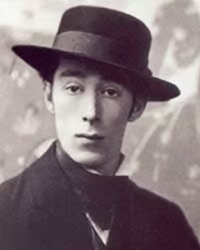
by H.H. Munro (SAKI)
The Storyteller (1914) is a delightful tale in which a bachelor on a train captivates three bored children with a story about a girl who was "horribly good" — and whose virtue leads to a memorably improper ending. "She was so good that she won several medals for goodness."
It was a hot afternoon, and the railway carriage was correspondingly sultry, and the next stop was at Templecombe, nearly an hour ahead. The occupants of the carriage were a small girl, and a smaller girl, and a small boy. An aunt belonging to the children occupied one corner seat, and the further corner seat on the opposite side was occupied by a bachelor who was a stranger to their party, but the small girls and the small boy emphatically occupied the compartment. Both the aunt and the children were conversational in a limited, persistent way, reminding one of the attentions of a housefly that refuses to be discouraged. Most of the aunt's remarks seemed to begin with "Don't," and nearly all of the children's remarks began with "Why?" The bachelor said nothing out loud. "Don't, Cyril, don't," exclaimed the aunt, as the small boy began smacking the cushions of the seat, producing a cloud of dust at each blow.
"Come and look out of the window," she added.
The child moved reluctantly to the window. "Why are those sheep being driven out of that field?" he asked.
"I expect they are being driven to another field where there is more grass," said the aunt weakly.
"But there is lots of grass in that field," protested the boy; "there's nothing else but grass there. Aunt, there's lots of grass in that field."
"Perhaps the grass in the other field is better," suggested the aunt fatuously.
"Why is it better?" came the swift, inevitable question.
"Oh, look at those cows!" exclaimed the aunt. Nearly every field along the line had contained cows or bullocks, but she spoke as though she were drawing attention to a rarity.
"Why is the grass in the other field better?" persisted Cyril.
The frown on the bachelor's face was deepening to a scowl. He was a hard, unsympathetic man, the aunt decided in her mind. She was utterly unable to come to any satisfactory decision about the grass in the other field.
The smaller girl created a diversion by beginning to recite "On the Road to Mandalay." She only knew the first line, but she put her limited knowledge to the fullest possible use. She repeated the line over and over again in a dreamy but resolute and very audible voice; it seemed to the bachelor as though some one had had a bet with her that she could not repeat the line aloud two thousand times without stopping. Whoever it was who had made the wager was likely to lose his bet.
"Come over here and listen to a story," said the aunt, when the bachelor had looked twice at her and once at the communication cord.
The children moved listlessly towards the aunt's end of the carriage. Evidently her reputation as a story- teller did not rank high in their estimation.
In a low, confidential voice, interrupted at frequent intervals by loud, petulant questionings from her listeners, she began an unenterprising and deplorably uninteresting story about a little girl who was good, and made friends with every one on account of her goodness, and was finally saved from a mad bull by a number of rescuers who admired her moral character.
"Wouldn't they have saved her if she hadn't been good?" demanded the bigger of the small girls. It was exactly the question that the bachelor had wanted to ask.
"Well, yes," admitted the aunt lamely, "but I don't think they would have run quite so fast to her help if they had not liked her so much."
"It's the stupidest story I've ever heard," said the bigger of the small girls, with immense conviction.
"I didn't listen after the first bit, it was so stupid," said Cyril.
The smaller girl made no actual comment on the story, but she had long ago recommenced a murmured repetition of her favourite line.
"You don't seem to be a success as a story-teller," said the bachelor suddenly from his corner.
The aunt bristled in instant defence at this unexpected attack.
"It's a very difficult thing to tell stories that children can both understand and appreciate," she said stiffly.
"I don't agree with you," said the bachelor.
"Perhaps you would like to tell them a story," was the aunt's retort.
"Tell us a story," demanded the bigger of the small girls.
"Once upon a time," began the bachelor, "there was a little girl called Bertha, who was extra-ordinarily good."
The children's momentarily-aroused interest began at once to flicker; all stories seemed dreadfully alike, no matter who told them.
"She did all that she was told, she was always truthful, she kept her clothes clean, ate milk puddings as though they were jam tarts, learned her lessons perfectly, and was polite in her manners."
"Was she pretty?" asked the bigger of the small girls.
"Not as pretty as any of you," said the bachelor, "but she was horribly good."
There was a wave of reaction in favour of the story; the word horrible in connection with goodness was a novelty that commended itself. It seemed to introduce a ring of truth that was absent from the aunt's tales of infant life.
"She was so good," continued the bachelor, "that she won several medals for goodness, which she always wore, pinned on to her dress. There was a medal for obedience, another medal for punctuality, and a third for good behaviour. They were large metal medals and they clicked against one another as she walked. No other child in the town where she lived had as many as three medals, so everybody knew that she must be an extra good child."
"Horribly good," quoted Cyril.
"Everybody talked about her goodness, and the Prince of the country got to hear about it, and he said that as she was so very good she might be allowed once a week to walk in his park, which was just outside the town. It was a beautiful park, and no children were ever allowed in it, so it was a great honour for Bertha to be allowed to go there."
"Were there any sheep in the park?" demanded Cyril.
"No;" said the bachelor, "there were no sheep."
"Why weren't there any sheep?" came the inevitable question arising out of that answer.
The aunt permitted herself a smile, which might almost have been described as a grin.
"There were no sheep in the park," said the bachelor, "because the Prince's mother had once had a dream that her son would either be killed by a sheep or else by a clock falling on him. For that reason the Prince never kept a sheep in his park or a clock in his palace."
The aunt suppressed a gasp of admiration.
"Was the Prince killed by a sheep or by a clock?" asked Cyril.
"He is still alive, so we can't tell whether the dream will come true," said the bachelor unconcernedly; "anyway, there were no sheep in the park, but there were lots of little pigs running all over the place."
"What colour were they?"
"Black with white faces, white with black spots, black all over, grey with white patches, and some were white all over."
The storyteller paused to let a full idea of the park's treasures sink into the children's imaginations; then he resumed:
"Bertha was rather sorry to find that there were no flowers in the park. She had promised her aunts, with tears in her eyes, that she would not pick any of the kind Prince's flowers, and she had meant to keep her promise, so of course it made her feel silly to find that there were no flowers to pick."
"Why weren't there any flowers?"
"Because the pigs had eaten them all," said the bachelor promptly. "The gardeners had told the Prince that you couldn't have pigs and flowers, so he decided to have pigs and no flowers."
There was a murmur of approval at the excellence of the Prince's decision; so many people would have decided the other way.
"There were lots of other delightful things in the park. There were ponds with gold and blue and green fish in them, and trees with beautiful parrots that said clever things at a moment's notice, and humming birds that hummed all the popular tunes of the day. Bertha walked up and down and enjoyed herself immensely, and thought to herself: 'If I were not so extraordinarily good I should not have been allowed to come into this beautiful park and enjoy all that there is to be seen in it,' and her three medals clinked against one another as she walked and helped to remind her how very good she really was. Just then an enormous wolf came prowling into the park to see if it could catch a fat little pig for its supper."
"What colour was it?" asked the children, amid an immediate quickening of interest.
"Mud-colour all over, with a black tongue and pale grey eyes that gleamed with unspeakable ferocity. The first thing that it saw in the park was Bertha; her pinafore was so spotlessly white and clean that it could be seen from a great distance. Bertha saw the wolf and saw that it was stealing towards her, and she began to wish that she had never been allowed to come into the park. She ran as hard as she could, and the wolf came after her with huge leaps and bounds. She managed to reach a shrubbery of myrtle bushes and she hid herself in one of the thickest of the bushes. The wolf came sniffing among the branches, its black tongue lolling out of its mouth and its pale grey eyes glaring with rage. Bertha was terribly frightened, and thought to herself: 'If I had not been so extraordinarily good I should have been safe in the town at this moment.' However, the scent of the myrtle was so strong that the wolf could not sniff out where Bertha was hiding, and the bushes were so thick that he might have hunted about in them for a long time without catching sight of her, so he thought he might as well go off and catch a little pig instead. Bertha was trembling very much at having the wolf prowling and sniffing so near her, and as she trembled the medal for obedience clinked against the medals for good conduct and punctuality. The wolf was just moving away when he heard the sound of the medals clinking and stopped to listen; they clinked again in a bush quite near him. He dashed into the bush, his pale grey eyes gleaming with ferocity and triumph, and dragged Bertha out and devoured her to the last morsel. All that was left of her were her shoes, bits of clothing, and the three medals for goodness."
"Were any of the little pigs killed?"
"No, they all escaped."
"The story began badly," said the smaller of the small girls, "but it had a beautiful ending."
"It is the most beautiful story that I ever heard," said the bigger of the small girls, with immense decision.
"It is the only beautiful story I have ever heard," said Cyril.
A dissentient opinion came from the aunt.
"A most improper story to tell to young children! You have undermined the effect of years of careful teaching."
"At any rate," said the bachelor, collecting his belongings preparatory to leaving the carriage, "I kept them quiet for ten minutes, which was more than you were able to do."
"Unhappy woman!" he observed to himself as he walked down the platform of Templecombe station; "for the next six months or so those children will assail her in public with demands for an improper story!"
Frequently Asked Questions about The Storyteller
What is "The Storyteller" by Saki about?
"The Storyteller" takes place in a railway carriage where a bachelor shares a compartment with an aunt and three restless children. When the aunt fails to quiet the children with a bland moral tale about a good girl, the bachelor steps in with his own story: the tale of Bertha, a girl who is "horribly good" and wins three medals for her virtue. Bertha is eventually devoured by a wolf in a prince's park because her clinking medals give away her hiding place. The children adore the story while the aunt is scandalized, and the bachelor departs satisfied that he kept them quiet—something the aunt could not manage. It was first published in the Morning Post and collected in 's 1914 anthology Beasts and Super-Beasts.
What are the main themes in "The Storyteller" by Saki?
The central themes include:
- Storytelling and truth — The story is a meta-narrative that critiques moralistic children's tales. The bachelor's unconventional story captivates because it contains a "ring of truth" that the aunt's sanitized version lacks.
- Pride and the danger of goodness — Bertha's medals for obedience, punctuality, and good conduct literally betray her to the wolf, suggesting that pride in one's virtue can be self-destructive.
- Childhood curiosity vs. adult authority — The children's relentless "Why?" questions expose the aunt's shallow answers, while the bachelor engages their curiosity with vivid, honest storytelling.
- Reality vs. idealism — suggests that virtue does not guarantee reward, a theme he explores throughout his work, including in The Open Window and The Lumber Room.
What is the irony in "The Storyteller" by Saki?
"The Storyteller" employs multiple layers of irony:
- Situational irony — Bertha's goodness, which earns her the privilege of entering the prince's park, is the very thing that kills her. Her medals for virtue clink together and alert the wolf to her hiding place.
- Verbal irony — The phrase "horribly good" yokes together contradictory ideas. The children instantly recognize its truthfulness, while the aunt misses the point entirely.
- Dramatic irony — The reader and the bachelor understand that the aunt's moralistic storytelling is counterproductive, but the aunt remains convinced she holds the moral high ground even after the children reject her story.
This layered irony is a hallmark of 's satirical style, seen also in stories like Tobermory and Sredni Vashtar.
What is the moral of "The Storyteller" by Saki?
Rather than offering a straightforward moral, subverts the very idea of moralistic storytelling. The aunt's tale—where a good girl is rewarded for her virtue—bores the children because it feels dishonest. The bachelor's story, in which goodness leads to death, captivates them because it acknowledges a truth children intuitively grasp: the world does not always reward virtue. If there is a "moral," it is that honest, engaging storytelling matters more than preachy lessons, and that children deserve stories that respect their intelligence rather than condescend to them. This anti-didactic stance echoes the work of writers like and anticipates later authors such as .
Who are the main characters in "The Storyteller" by Saki?
The story has five characters, none of whom are given full names:
- The Bachelor — A stranger in the railway carriage who tells the unconventional story of Bertha. He is witty, observant, and unsentimental—qualities typical of 's narrators and protagonists.
- The Aunt — The children's guardian, who represents conventional Edwardian morality. She tells a bland story about a good girl rewarded for her goodness, then is outraged by the bachelor's "improper" alternative.
- Cyril — The small boy, who persistently asks "Why?" and is the most vocal of the three children.
- The Bigger Girl and The Smaller Girl — Cyril's sisters. The bigger girl pronounces the aunt's story "the stupidest" and the bachelor's "the most beautiful." The smaller girl endlessly recites "On the Road to Mandalay."
What literary devices does Saki use in "The Storyteller"?
employs several literary devices:
- Frame narrative (story within a story) — The bachelor's tale of Bertha is embedded within the larger railway carriage scene, creating a meta-commentary on storytelling itself.
- Satire — The aunt's moralistic tale parodies the Victorian and Edwardian tradition of didactic children's literature, while the bachelor's counter-story demolishes its assumptions.
- Irony — Situational, verbal, and dramatic irony permeate both the frame story and the inner tale.
- Symbolism — Bertha's three medals symbolize the rewards of conformity, while the wolf represents the indifferent dangers of the real world.
- Wit and understatement — The bachelor's dry final observation—that the children will torment the aunt with demands for "an improper story" for six months—is classic Saki deadpan humor.
What is the story within a story in "The Storyteller" by Saki?
The inner story, told by the bachelor, concerns Bertha, a girl who is "horribly good." She earns three medals—for obedience, punctuality, and good behavior—and is rewarded by a prince who allows her to walk in his private park. The park contains pigs, fish, parrots, and humming birds, but no flowers (the pigs ate them) and no sheep (the prince's mother dreamed he'd be killed by one). When a wolf enters the park, Bertha hides in myrtle bushes. The scent of the myrtle masks her, but her medals clink together and betray her location. The wolf drags her out and devours her, leaving only her shoes, scraps of clothing, and the three medals for goodness. The children find this ending "beautiful"—a verdict that horrifies the aunt but delights the bachelor.
How does "The Storyteller" compare to other Saki stories?
"The Storyteller" shares several hallmarks with 's best-known work:
- Like The Open Window, it features a character who uses storytelling to manipulate an audience, though the bachelor's intent is entertainment rather than mischief.
- Like The Lumber Room, it pits a clever, imaginative figure against a well-meaning but obtuse adult authority, with the adult losing the contest.
- Like The Toys of Peace, it satirizes the Edwardian impulse to impose morality on children who instinctively resist it.
- Like Tobermory, it uses wit and ironic reversal to expose social hypocrisy.
All four stories appear in the collection Beasts and Super-Beasts (1914).
Why do the children prefer the bachelor's story to the aunt's in "The Storyteller"?
The children reject the aunt's story because it is predictable, dishonest, and condescending. Her tale of a good girl rescued by admirers follows a formula the children have heard before—goodness is rewarded, badness is punished—and they see through its artificiality. The bigger girl's question, "Wouldn't they have saved her if she hadn't been good?" exposes the story's logical flaw. By contrast, the bachelor's story works because:
- The phrase "horribly good" introduces novelty and paradox.
- The vivid details—pigs of every color, talking parrots, a wolf with a black tongue—engage the children's imaginations.
- The dark ending feels true to life in a way the aunt's sanitized tale does not.
argues that children are natural literary critics who value authenticity over moral instruction, an insight shared by and .
When was "The Storyteller" by Saki written and published?
"The Storyteller" was first published in the Morning Post, a London newspaper, and was collected in 's anthology Beasts and Super-Beasts in 1914. This collection, one of Saki's most celebrated, also includes The Open Window, Sredni Vashtar, and Tobermory. Saki (the pen name of Hector Hugh Munro, 1870–1916) was a British writer known for his witty, often darkly comic short stories that satirized Edwardian society. He was killed in action during World War I at the Battle of the Ancre in November 1916.
Save stories, build your reading list, and access all study tools — completely free.
Save The Storyteller to your library — it's free!Need help with The Storyteller?
Study tools to help with homework, prepare for quizzes, and deepen your understanding.
Flashcards →