A Telephonic Conversation
by Mark Twain
A Telephonic Conversation is Twain's humorous sketch about the maddening experience of hearing only one side of a telephone call — an experience that was brand new in the late 1870s and feels timeless today. "Then silence. Then one sweet thank-you."
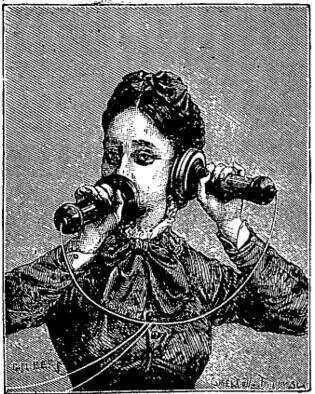
Consider that a conversation by telephone--when you are simply sitting by and not taking any part in that conversation--is one of the solemnest curiosities of modern life. Yesterday I was writing a deep article on a sublime philosophical subject while such a conversation was going on in the room. I notice that one can always write best when somebody is talking through a telephone close by. Well, the thing began in this way. A member of our household came in and asked me to have our house put into communication with Mr. Bagley's downtown. I have observed, in many cities, that the sex always shrink from calling up the central office themselves. I don't know why, but they do. So I touched the bell, and this talk ensued:
CENTRAL OFFICE. (gruffy.) Hello!
I. Is it the Central Office?
C. O. Of course it is. What do you want?
I. Will you switch me on to the Bagleys, please?
C. O. All right. Just keep your ear to the telephone.
Then I heard k-look, k-look, k'look--klook-klook-klook-look-look! then a horrible "gritting" of teeth, and finally a piping female voice: Y-e-s? (rising inflection.) Did you wish to speak to me?
Without answering, I handed the telephone to the applicant, and sat down. Then followed that queerest of all the queer things in this world-- a conversation with only one end of it. You hear questions asked; you don't hear the answer. You hear invitations given; you hear no thanks in return. You have listening pauses of dead silence, followed by apparently irrelevant and unjustifiable exclamations of glad surprise or sorrow or dismay. You can't make head or tail of the talk, because you never hear anything that the person at the other end of the wire says. Well, I heard the following remarkable series of observations, all from the one tongue, and all shouted-- for you can't ever persuade the sex to speak gently into a telephone:
Yes? Why, how did that happen?
Pause.
What did you say?
Pause.
Oh no, I don't think it was.
Pause.
No! Oh no, I didn't mean that. I meant, put it in while it is still boiling--or just before it comes to a boil.
Pause.
What?
Pause.
I turned it over with a backstitch on the selvage edge.
Pause.
Yes, I like that way, too; but I think it's better to baste it on with Valenciennes or bombazine, or something of that sort. It gives it such an air--and attracts so much noise.
Pause.
It's forty-ninth Deuteronomy, sixty-forth to ninety-seventh inclusive. I think we ought all to read it often.
Pause.
Perhaps so; I generally use a hair pin.
Pause.
What did you say? (aside.) Children, do be quiet!
Pause
Oh! B flat! Dear me, I thought you said it was the cat!
Pause.
Since when?
Pause.
Why, I never heard of it.
Pause.
You astound me! It seems utterly impossible!
Pause.
Who did?
Pause.
Good-ness gracious!
Pause.
Well, what is this world coming to? Was it right in church?
Pause.
And was her mother there?
Pause.
Why, Mrs. Bagley, I should have died of humiliation! What did they do?
Long pause.
I can't be perfectly sure, because I haven't the notes by me; but I think it goes something like this: te-rolly-loll-loll, loll lolly-loll-loll, O tolly-loll-loll-lee-ly-li-I-do! And then repeat, you know.
Pause.
Yes, I think it is very sweet--and very solemn and impressive, if you get the andantino and the pianissimo right.
Pause.
Oh, gum-drops, gum-drops! But I never allow them to eat striped candy. And of course they can't, till they get their teeth, anyway.
Pause.
What?
Pause.
Oh, not in the least--go right on. He's here writing--it doesn't bother him.
Pause.
Very well, I'll come if I can. (aside.) Dear me, how it does tire a person's arm to hold this thing up so long! I wish she'd--
Pause.
Oh no, not at all; I like to talk--but I'm afraid I'm keeping you from your affairs.
Pause.
Visitors?
Pause.
No, we never use butter on them.
Pause.
Yes, that is a very good way; but all the cook-books say they are very unhealthy when they are out of season. And he doesn't like them, anyway--especially canned.
Pause.
Oh, I think that is too high for them; we have never paid over fifty cents a bunch.
Pause.
Must you go? Well, good-by.
Pause.
Yes, I think so. Good-by.
Pause.
Four o'clock, then--I'll be ready. Good-by.
Pause.
Thank you ever so much. Good-by.
Pause.
Oh, not at all!--just as fresh--which? Oh, I'm glad to hear you say that. Good-by.
(Hangs up the telephone and says, "Oh, it does tire a person's arm so!")
A man delivers a single brutal "Good-by," and that is the end of it. Not so with the gentle sex--I say it in their praise; they cannot abide abruptness.
This story is featured in our collection of Short-Short Stories to read when you have five minutes to spare.
Frequently Asked Questions about A Telephonic Conversation
What is "A Telephonic Conversation" by Mark Twain about?
A Telephonic Conversation is a comic sketch in which the narrator — clearly himself — sits trying to write a "deep article on a sublime philosophical subject" while his wife conducts a lengthy phone call in the same room. The humor comes from hearing only one side of the conversation: the wife's responses jump bewilderingly from boiling instructions to Bible verses, from sewing terminology to B-flat on the piano, from gumdrops to a scandal that happened "right in church." The reader, like the narrator, is left to imagine what could possibly connect these wildly unrelated fragments. The piece ends with Twain observing that a man delivers "a single brutal 'Good-by' and that is the end of it" — while his wife requires seven separate goodbyes to hang up the phone.
What is the theme of "A Telephonic Conversation"?
The central theme is the absurdity and disorientation of modern communication technology. Written in 1880, only four years after the telephone's public debut, the sketch captures the genuinely strange experience of a new invention that lets you hear a voice but not the person speaking, creating a conversation that sounds like nonsense to anyone not holding the receiver. A secondary theme is the comedy of domestic life and gender dynamics. Twain affectionately satirizes the difference between male and female conversation styles — the man's curt efficiency versus the woman's elaborate, digressive sociability. While the gender humor is of its era, the core observation about one-sided phone calls remains instantly recognizable to anyone who has ever overheard a phone conversation.
When was "A Telephonic Conversation" written?
A Telephonic Conversation was written and published in 1880, making it one of the earliest literary works about the telephone. Alexander Graham Bell had demonstrated the telephone at the Philadelphia Centennial Exposition only four years earlier, in 1876, and by 1880 wealthier American families were beginning to install the devices in their homes. was among the first private citizens in Hartford, Connecticut, to have a telephone, and his early adoption gave him firsthand material for the sketch. The piece captures a moment when the telephone was genuinely novel — its sounds, its etiquette, and its social disruptions were all being discovered in real time.
What literary devices does Mark Twain use in "A Telephonic Conversation"?
The most distinctive device is selective omission — by presenting only one side of the phone call, Twain forces the reader to fill in the gaps, turning each pause into a comic mystery. Juxtaposition creates the humor: Bible references collide with hairpin tips, musical notes crash into gum-drop debates, and cooking advice segues into church scandals. Hyperbole amplifies the portrait of telephone behavior — the claim that women always shout into the phone and require seven goodbyes to hang up. The piece also uses dramatic format, presenting the phone exchange as a quasi-theatrical script, which emphasizes the performative absurdity of the new medium. The opening line about writing best "when somebody is talking through a telephone close by" is classic Twain ironic understatement.
Why is "A Telephonic Conversation" historically significant?
The sketch is one of the earliest pieces of literature to engage with the telephone as a social phenomenon. Written just four years after the phone's invention, it captures anxieties and amusements about new technology that echo across every subsequent wave of innovation — from radio to television to the internet to smartphones. Twain identified something fundamental: that communication technology doesn't just transmit conversations, it transforms them. The one-sided phone call was a brand-new form of social experience in 1880, and Twain was the first major writer to find its comic potential. The piece has been studied in MIT media courses and by communication scholars as an early example of how literature processes technological change.
What does "A Telephonic Conversation" say about gender?
The sketch contains observations about gender and conversation that are both humorous and very much of their time. Twain notes that "the sex always shrink from calling up the central office themselves" and that "you can't ever persuade the sex to speak gently into a telephone." The wife's rambling, topic-hopping call is contrasted with the narrator's clipped, efficient phone manner. The extended seven-goodbye ending is presented as a gendered trait: "A man delivers a single brutal 'Good-by,' and that is the end of it. Not so with the gentle sex." While these observations traffic in Victorian stereotypes, Twain frames them with affection rather than malice, and the wife's call — with its dizzying range of topics — actually suggests a richness and complexity of social engagement that the narrator's work on his "sublime philosophical subject" lacks.
Is "A Telephonic Conversation" a short story or an essay?
It is best described as a humorous sketch or comic essay rather than a short story. There is no plot in the conventional sense — no rising action, conflict, or resolution. Instead, the piece is structured as an observation: Twain sets up the premise (one-sided phone calls are bizarre), provides an extended example (his wife's call), and closes with a comic generalization (the gender difference in saying goodbye). This form — the short comic sketch built around a single everyday observation — was a staple of 19th-century American newspaper humor, and Twain was its undisputed master. Like About Barbers and My Watch, it finds universal comedy in a mundane experience.
What are the funniest lines in "A Telephonic Conversation"?
Several lines have become favorites among Twain readers. The wild juxtapositions in the wife's call provide the biggest laughs: "It's forty-ninth Deuteronomy, sixty-fourth to ninety-seventh inclusive. I think we ought all to read it often" — followed immediately by "Perhaps so; I generally use a hair pin." The moment when music collides with misunderstanding — "Oh! B flat! Dear me, I thought you said it was the cat!" — is perfectly timed. And the string of seven goodbyes at the end, each more elaborate than the last ("Oh, not at all! — just as fresh — which? Oh, I'm glad to hear you say that. Good-by."), captures the universal experience of a phone call that won't end. But the real comic achievement is structural: every pause is funnier than the words around it, because the reader's imagination fills the gap with something even more absurd.
Save stories, build your reading list, and access all study tools — completely free.
Save A Telephonic Conversation to your library — it's free!Need help with A Telephonic Conversation?
Study tools to help with homework, prepare for quizzes, and deepen your understanding.
Flashcards →