Journalism In Tennessee
by Mark Twain
Journalism in Tennessee is a wildly exaggerated account of frontier newspaper warfare, where editors settle disputes with pistols, bowie knives, and hand grenades — all before lunch. "The chief editor had been there once. That was all."
[Written about 1871.]
The editor of the Memphis Avalanche swoops thus mildly down upon a correspondent who posted him as a Radical:--"While he was writing the first word, the middle, dotting his i's, crossing his t's, and punching his period, he knew he was concocting a sentence that was saturated with infamy and reeking with falsehood."--Exchange.
I was told by the physician that a Southern climate would improve my health, and so I went down to Tennessee, and got a berth on the Morning Glory and Johnson County War-Whoop as associate editor. When I went on duty I found the chief editor sitting tilted back in a three-legged chair with his feet on a pine table. There was another pine table in the room and another afflicted chair, and both were half buried under newspapers and scraps and sheets of manuscript. There was a wooden box of sand, sprinkled with cigar stubs and "old soldiers," and a stove with a door hanging by its upper hinge. The chief editor had a long-tailed black cloth frock-coat on, and white linen pants. His boots were small and neatly blacked. He wore a ruffled shirt, a large seal-ring, a standing collar of obsolete pattern, and a checkered neckerchief with the ends hanging down. Date of costume about 1848. He was smoking a cigar, and trying to think of a word, and in pawing his hair he had rumpled his locks a good deal. He was scowling fearfully, and I judged that he was concocting a particularly knotty editorial. He told me to take the exchanges and skim through them and write up the "Spirit of the Tennessee Press," condensing into the article all of their contents that seemed of interest.
I wrote as follows:
SPIRIT OF THE TENNESSEE PRESS
The editors of the Semi-Weekly Earthquake evidently labor under a misapprehension with regard to the Dallyhack railroad. It is not the object of the company to leave Buzzardville off to one side. On the contrary, they consider it one of the most important points along the line, and consequently can have no desire to slight it. The gentlemen of the Earthquake will, of course, take pleasure in making the correction.
John W. Blossom, Esq., the able editor of the Higginsville Thunderbolt and Battle Cry of Freedom, arrived in the city yesterday. He is stopping at the Van Buren House.
We observe that our contemporary of the Mud Springs Morning Howl has fallen into the error of supposing that the election of Van Werter is not an established fact, but he will have discovered his mistake before this reminder reaches him, no doubt. He was doubtless misled by incomplete election returns.
It is pleasant to note that the city of Blathersville is endeavoring to contract with some New York gentlemen to pave its well-nigh impassable streets with the Nicholson pavement. The Daily Hurrah urges the measure with ability, and seems confident of ultimate success.
I passed my manuscript over to the chief editor for acceptance, alteration, or destruction. He glanced at it and his face clouded. He ran his eye down the pages, and his countenance grew portentous. It was easy to see that something was wrong. Presently he sprang up and said:
"Thunder and lightning! Do you suppose I am going to speak of those cattle that way? Do you suppose my subscribers are going to stand such gruel as that? Give me the pen!"
I never saw a pen scrape and scratch its way so viciously, or plow through another man's verbs and adjectives so relentlessly. While he was in the midst of his work, somebody shot at him through the open window, and marred the symmetry of my ear.
"Ah," said he, "that is that scoundrel Smith, of the Moral Volcano--he was due yesterday." And he snatched a navy revolver from his belt and fired--Smith dropped, shot in the thigh. The shot spoiled Smith's aim, who was just taking a second chance and he crippled a stranger. It was me. Merely a finger shot off.
Then the chief editor went on with his erasure; and interlineations. Just as he finished them a hand grenade came down the stove-pipe, and the explosion shivered the stove into a thousand fragments. However, it did no further damage, except that a vagrant piece knocked a couple of my teeth out.
"That stove is utterly ruined," said the chief editor.
I said I believed it was.
"Well, no matter--don't want it this kind of weather. I know the man that did it. I'll get him. Now, here is the way this stuff ought to be written."
I took the manuscript. It was scarred with erasures and interlineations till its mother wouldn't have known it if it had had one. It now read as follows:
SPIRIT OF THE TENNESSEE PRESS
The inveterate liars of the Semi-Weekly Earthquake are evidently endeavoring to palm off upon a noble and chivalrous people another of their vile and brutal falsehoods with regard to that most glorious conception of the nineteenth century, the Ballyhack railroad. The idea that Buzzardville was to be left off at one side originated in their own fulsome brains--or rather in the settlings which they regard as brains. They had better, swallow this lie if they want to save their abandoned reptile carcasses the cowhiding they so richly deserve.
That ass, Blossom, of the Higginsville Thunderbolt and Battle Cry of Freedom, is down here again sponging at the Van Buren.
We observe that the besotted blackguard of the Mud Springs Morning Howl is giving out, with his usual propensity for lying, that Van Werter is not elected. The heaven-born mission of journalism is to disseminate truth; to eradicate error; to educate, refine, and elevate the tone of public morals and manners, and make all men more gentle, more virtuous, more charitable, and in all ways better, and holier, and happier; and yet this blackhearted scoundrel degrades his great office persistently to the dissemination of falsehood, calumny, vituperation, and vulgarity.
Blathersville wants a Nicholson pavement--it wants a jail and a poorhouse more. The idea of a pavement in a one-horse town composed of two gin-mills, a blacksmith shop, and that mustard-plaster of a newspaper, the Daily Hurrah! The crawling insect, Buckner, who edits the Hurrah, is braying about his business with his customary imbecility, and imagining that he is talking sense.
"Now that is the way to write--peppery and to the point. Mush-and-milk journalism gives me the fan-tods."
About this time a brick came through the window with a splintering crash, and gave me a considerable of a jolt in the back. I moved out of range --I began to feel in the way.
The chief said, "That was the Colonel, likely. I've been expecting him for two days. He will be up now right away."
He was correct. The Colonel appeared in the door a moment afterward with a dragoon revolver in his hand.
He said, "Sir, have I the honor of addressing the poltroon who edits this mangy sheet?"
"You have. Be seated, sir. Be careful of the chair, one of its legs is gone. I believe I have the honor of addressing the putrid liar, Colonel Blatherskite Tecumseh?"
"Right, Sir. I have a little account to settle with you. If you are at leisure we will begin."
"I have an article on the 'Encouraging Progress of Moral and Intellectual Development in America' to finish, but there is no hurry. Begin."
Both pistols rang out their fierce clamor at the same instant. The chief lost a lock of his hair, and the Colonel's bullet ended its career in the fleshy part of my thigh. The Colonel's left shoulder was clipped a little. They fired again. Both missed their men this time, but I got my share, a shot in the arm. At the third fire both gentlemen were wounded slightly, and I had a knuckle chipped. I then said, I believed I would go out and take a walk, as this was a private matter, and I had a delicacy about participating in it further. But both gentlemen begged me to keep my seat, and assured me that I was not in the way.
They then talked about the elections and the crops while they reloaded, and I fell to tying up my wounds. But presently they opened fire again with animation, and every shot took effect--but it is proper to remark that five out of the six fell to my share. The sixth one mortally wounded the Colonel, who remarked, with fine humor, that he would have to say good morning now, as he had business uptown. He then inquired the way to the undertaker's and left.
The chief turned to me and said, "I am expecting company to dinner, and shall have to get ready. It will be a favor to me if you will read proof and attend to the customers."
I winced a little at the idea of attending to the customers, but I was too bewildered by the fusillade that was still ringing in my ears to think of anything to say.
He continued, "Jones will be here at three--cowhide him. Gillespie will call earlier, perhaps--throw him out of the window. Ferguson will be along about four--kill him. That is all for today, I believe. If you have any odd time, you may write a blistering article on the police--give the chief inspector rats. The cowhides are under the table; weapons in the drawer--ammunition there in the corner--lint and bandages up there in the pigeonholes. In case of accident, go to Lancet, the surgeon, down- stairs. He advertises--we take it out in trade."
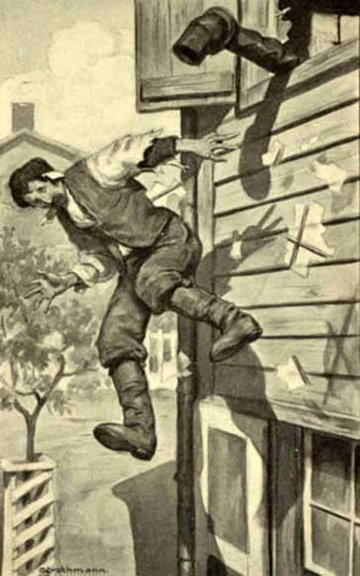
He was gone. I shuddered. At the end of the next three hours I had been through perils so awful that all peace of mind and all cheerfulness were gone from me. Gillespie had called and thrown me out of the window. Jones arrived promptly, and when I got ready to do the cowhiding he took the job off my hands. In an encounter with a stranger, not in the bill of fare, I had lost my scalp. Another stranger, by the name of Thompson, left me a mere wreck and ruin of chaotic rags. And at last, at bay in the corner, and beset by an infuriated mob of editors, blacklegs, politicians, and desperadoes, who raved and swore and flourished their weapons about my head till the air shimmered with glancing flashes of steel, I was in the act of resigning my berth on the paper when the chief arrived, and with him a rabble of charmed and enthusiastic friends. Then ensued a scene of riot and carnage such as no human pen, or steel one either, could describe. People were shot, probed, dismembered, blown up, thrown out of the window. There was a brief tornado of murky blasphemy, with a confused and frantic war-dance glimmering through it, and then all was over. In five minutes there was silence, and the gory chief and I sat alone and surveyed the sanguinary ruin that strewed the floor around us.
He said, "You'll like this place when you get used to it."
I said, "I'll have to get you to excuse me; I think maybe I might write to suit you after a while; as soon as I had had some practice and learned the language I am confident I could. But, to speak the plain truth, that sort of energy of expression has its inconveniences, and a, man is liable to interruption.
"You see that yourself. Vigorous writing is calculated to elevate the public, no doubt, but then I do not like to attract so much attention as it calls forth. I can't write with comfort when I am interrupted so much as I have been to-day. I like this berth well enough, but I don't like to be left here to wait on the customers. The experiences are novel, I grant you, and entertaining, too, after a fashion, but they are not judiciously distributed. A gentleman shoots at you through the window and cripples me; a bombshell comes down the stovepipe for your gratification and sends the stove door down my throat; a friend drops in to swap compliments with you, and freckles me with bullet-holes till my skin won't hold my principles; you go to dinner, and Jones comes with his cowhide, Gillespie throws me out of the window, Thompson tears all my clothes off, and an entire stranger takes my scalp with the easy freedom of an old acquaintance; and in less than five minutes all the blackguards in the country arrive in their war-paint, and proceed to scare the rest of me to death with their tomahawks. Take it altogether, I never had such a spirited time in all my life as I have had to-day. No; I like you, and I like your calm unruffled way of explaining things to the customers, but you see I am not used to it. The Southern heart is too impulsive; Southern hospitality is too lavish with the stranger. The paragraphs which I have written to-day, and into whose cold sentences your masterly hand has infused the fervent spirit of Tennesseean journalism, will wake up another nest of hornets. All that mob of editors will come--and they will come hungry, too, and want somebody for breakfast. I shall have to bid you adieu. I decline to be present at these festivities. I came South for my health, I will go back on the same errand, and suddenly. Tennesseean journalism is too stirring for me."
After which we parted with mutual regret, and I took apartments at the hospital.
Frequently Asked Questions about Journalism In Tennessee
What is "Journalism in Tennessee" by Mark Twain about?
Journalism in Tennessee is a wildly exaggerated comic sketch about a mild-mannered Northern journalist who takes a job as associate editor at a Southern newspaper called the Morning Glory and Johnson County War-Whoop. On his first day, he writes a polite, even-tempered column reviewing the local press — which the chief editor promptly rewrites into a barrage of personal insults. The rest of the day escalates into slapstick violence: rival editors burst through the door with pistols, a brick crashes through the window, a hand grenade rolls across the floor, and the narrator is shot, stabbed, scalped, and thrown out a window. By day's end, the battered narrator announces that "Tennesseean journalism is too stirring for me" and resigns, listing his injuries as he goes.
What is the theme of "Journalism in Tennessee"?
The central theme is the gap between journalism's ideals and its practice. The story opens with a lofty epigraph about journalism's "heaven-born mission" to "disseminate truth" and "elevate the tone of public morals" — then immediately demonstrates a newspaper culture based entirely on personal attacks, feuds, and physical violence. satirizes the frontier press tradition where editors routinely insulted their rivals in print and sometimes settled disputes with weapons. A secondary theme is the clash between Northern civility and Southern pugnacity: the narrator's polite, restrained prose style is treated as a form of incompetence, while the chief editor's vicious rewrites — calling competitors "besotted blackguards" and "degraded reptiles" — represent what passes for journalism in this world.
What are the newspaper names in "Journalism in Tennessee"?
The absurd newspaper names are one of the story's finest comic touches. The narrator works at the Morning Glory and Johnson County War-Whoop. Rival papers include the Semi-Weekly Earthquake, the Higginsville Thunderbolt and Battle Cry of Freedom, the Mud Springs Morning Howl, the Daily Hurrah, the Moral Volcano, the War-Whoop, and the Daily Gazette. Each name parodies the grandiose naming conventions of 19th-century frontier newspapers, which genuinely did sport names like the Tombstone Epitaph and the Dodge City Globe. pushes the convention to absurdity — names like "Semi-Weekly Earthquake" and "Moral Volcano" suggest publications that are as volatile and destructive as the editors who run them.
What literary devices does Mark Twain use in "Journalism in Tennessee"?
deploys a concentrated arsenal of comic techniques. Hyperbole is the dominant device — the violence escalates from a single gunshot to brick-throwing, bowie knives, a hand grenade, and finally the narrator being hurled out a third-story window, with each escalation treated as routine. Contrast drives the comedy: the narrator's mild, careful prose is juxtaposed against the chief editor's volcanic rewrites, and the narrator's shock is set against the editor's complete nonchalance about violence. Understatement generates some of the best lines — after being shot at, the editor calmly remarks, "Ah, that is that scoundrel Smith, of the Moral Volcano — he was due yesterday." Catalog technique appears in the narrator's final resignation speech, where he lists his injuries with deadpan precision. The first-person perspective of a bewildered outsider creates dramatic irony, as the reader shares his horror while finding the situation hilarious.
When was "Journalism in Tennessee" written?
Journalism in Tennessee was first published in September 1869 in the Buffalo Express, which was then co-owner and editor of. It was later collected in Sketches, New and Old (1875). The story draws on Twain's extensive firsthand experience with frontier journalism — he had worked as a printer's apprentice, reporter, and editor in Missouri, Nevada, and California throughout the 1850s and 1860s. While the story's violence is comically exaggerated, the combative editorial culture it satirizes was real: editors in the antebellum and Reconstruction South frequently exchanged insults in print and occasionally settled matters with firearms. Twain may also have drawn on his time working in a Nashville print shop in the 1850s.
How does the chief editor rewrite the narrator's column?
The contrast between the narrator's original column and the chief editor's rewrite is the story's comic centerpiece. Where the narrator writes diplomatically that rival editors "evidently labor under a misapprehension," the chief editor transforms this into calling them "besotted blackguards" and "degraded reptiles." A polite note that a colleague has "arrived in the city" becomes a declaration that the man is a "blistering idiot" who "stole his great-grandmother's cat." The narrator's mild observation about street paving becomes a demand that the "pusillanimous Poltroon" responsible be "horsewhipped." The rewrite demonstrates the editorial culture's fundamental principle: restraint is weakness, and the more extravagant the insult, the better the journalism. The editor is genuinely appalled by the narrator's civility: "Thunder and lightning! Do you suppose I am going to speak of those cattle that way?"
What injuries does the narrator suffer in "Journalism in Tennessee"?
The narrator's injuries accumulate throughout the story in a running gag of escalating physical destruction. He is shot through the arm by a rival editor; has his ear nicked by a bullet; is hit in the back by a thrown stool; receives a brick through the window that shatters his elbow; is scalped by a bowie knife; gets caught in a hand grenade explosion; has a finger shot off; and is finally thrown out a window by Colonel Blatherskite Tecumseh. In his resignation letter, the narrator methodically catalogs: "I came South for my health, I will go back on the same errand, and suddenly. Tennesseean journalism is too stirring for me." He then lists each injury with deadpan precision — the calm enumeration of catastrophic violence being perhaps the funniest passage in the entire piece.
Is "Journalism in Tennessee" based on real events?
While the story is wildly exaggerated, it is rooted in the real culture of 19th-century frontier journalism. Newspaper editors in the antebellum and Reconstruction-era South genuinely did trade scathing personal insults in print, and physical violence between editors was not uncommon. Duels, fistfights, and even shootings arising from editorial feuds were documented throughout the period. had firsthand experience with combative journalism during his years as a reporter in Nevada and California, where he was once challenged to a duel (which he avoided) over a satirical article. The Tennessee setting may have been inspired by his time working in a Nashville print shop as a young man in the 1850s. The story takes real editorial conventions — grandiose newspaper names, inflammatory language, personal attacks — and pushes them to their absurd logical conclusion.
Save stories, build your reading list, and access all study tools — completely free.
Save Journalism In Tennessee to your library — it's free!Need help with Journalism In Tennessee?
Study tools to help with homework, prepare for quizzes, and deepen your understanding.
Flashcards →