The Ambitious Guest
by Nathaniel Hawthorne
Often described as Hawthorne's scariest story... see if you agree. "Is not the kindred of a common fate a closer tie than that of birth?"
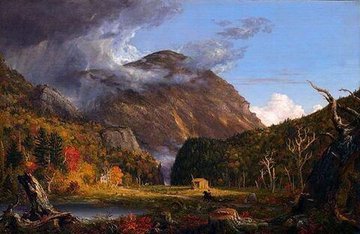
ONE SEPTEMBER NIGHT a family had gathered round their hearth, and piled it high with the driftwood of mountain streams, the dry cones of the pine, and the splintered ruins of great trees that had come crashing down the precipice. Up the chimney roared the fire, and brightened the room with its broad blaze. The faces of the father and mother had a sober gladness; the children laughed; the eldest daughter was the image of Happiness at seventeen; and the aged grandmother, who sat knitting in the warmest place, was the image of Happiness grown old. They had found the "herb, heart's-ease," in the bleakest spot of all New England. This family were situated in the Notch of the White Hills, where the wind was sharp throughout the year, and pitilessly cold in the winter--giving their cottage all its fresh inclemency before it descended on the valley of the Saco. They dwelt in a cold spot and a dangerous one; for a mountain towered above their heads, so steep, that the stones would often rumble down its sides and startle them at midnight.
The daughter had just uttered some simple jest that filled them all with mirth, when the wind came through the Notch and seemed to pause before their cottage--rattling the door, with a sound of wailing and lamentation, before it passed into the valley. For a moment it saddened them, though there was nothing unusual in the tones. But the family were glad again when they perceived that the latch was lifted by some traveller, whose footsteps had been unheard amid the dreary blast which heralded his approach, and wailed as he was entering, and went moaning away from the door.
Though they dwelt in such a solitude, these people held daily converse with the world. The romantic pass of the Notch is a great artery, through which the life-blood of internal commerce is continually throbbing between Maine, on one side, and the Green Mountains and the shores of the St. Lawrence, on the other. The stage-coach always drew up before the door of the cottage. The way-farer, with no companion but his staff, paused here to exchange a word, that the sense of loneliness might not utterly overcome him ere he could pass through the cleft of the mountain, or reach the first house in the valley. And here the teamster, on his way to Portland market, would put up for the night; and, if a bachelor, might sit an hour beyond the usual bedtime, and steal a kiss from the mountain maid at parting. It was one of those primitive taverns where the traveller pays only for food and lodging, but meets with a homely kindness beyond all price. When the footsteps were heard, therefore, between the outer door and the inner one, the whole family rose up, grandmother, children, and all, as if about to welcome someone who belonged to them, and whose fate was linked with theirs.
The door was opened by a young man. His face at first wore the melancholy expression, almost despondency, of one who travels a wild and bleak road, at nightfall and alone, but soon brightened up when he saw the kindly warmth of his reception. He felt his heart spring forward to meet them all, from the old woman, who wiped a chair with her apron, to the little child that held out its arms to him. One glance and smile placed the stranger on a footing of innocent familiarity with the eldest daughter.
"Ah, this fire is the right thing!" cried he; "especially when there is such a pleasant circle round it. I am quite benumbed; for the Notch is just like the pipe of a great pair of bellows; it has blown a terrible blast in my face all the way from Bartlett."
"Then you are going towards Vermont?" said the master of the house, as he helped to take a light knapsack off the young man's shoulders.
"Yes; to Burlington, and far enough beyond," replied he. "I meant to have been at Ethan Crawford's tonight; but a pedestrian lingers along such a road as this. It is no matter; for, when I saw this good fire, and all your cheerful faces, I felt as if you had kindled it on purpose for me, and were waiting my arrival. So I shall sit down among you, and make myself at home."
The frank-hearted stranger had just drawn his chair to the fire when something like a heavy footstep was heard without, rushing down the steep side of the mountain, as with long and rapid strides, and taking such a leap in passing the cottage as to strike the opposite precipice. The family held their breath, because they knew the sound, and their guest held his by instinct.
"The old mountain has thrown a stone at us, for fear we should forget him," said the landlord, recovering himself. "He sometimes nods his head and threatens to come down; but we are old neighbors, and agree together pretty well upon the whole. Besides we have a sure place of refuge hard by if he should be coming in good earnest."
Let us now suppose the stranger to have finished his supper of bear's meat; and, by his natural felicity of manner, to have placed himself on a footing of kindness with the whole family, so that they talked as freely together as if he belonged to their mountain brood. He was of a proud, yet gentle spirit--haughty and reserved among the rich and great; but ever ready to stoop his head to the lowly cottage door, and be like a brother or a son at the poor man's fireside. In the household of the Notch he found warmth and simplicity of feeling, the pervading intelligence of New England, and a poetry of native growth, which they had gathered when they little thought of it from the mountain peaks and chasms, and at the very threshold of their romantic and dangerous abode. He had travelled far and alone; his whole life, indeed, had been a solitary path; for, with the lofty caution of his nature, he had kept himself apart from those who might otherwise have been his companions. The family, too, though so kind and hospitable, had that consciousness of unity among themselves, and separation from the world at large, which, in every domestic circle, should still keep a holy place where no stranger may intrude. But this evening a prophetic sympathy impelled the refined and educated youth to pour out his heart before the simple mountaineers, and constrained them to answer him with the same free confidence. And thus it should have been. Is not the kindred of a common fate a closer tie than that of birth?
The secret of the young man's character was a high and abstracted ambition. He could have borne to live an undistinguished life, but not to be forgotten in the grave. Yearning desire had been transformed to hope; and hope, long cherished, had become like certainty, that, obscurely as he journeyed now, a glory was to beam on all his pathway- though not, perhaps, while he was treading it. But when posterity should gaze back into the gloom of what was now the present, they would trace the brightness of his footsteps, brightening as meaner glories faded, and confess that a gifted one had passed from his cradle to his tomb with none to recognize him.
"As yet," cried the stranger--his cheek glowing and his eye flashing with enthusiasm--"as yet, I have done nothing. Were I to vanish from the earth tomorrow, none would know so much of me as you: that a nameless youth came up at nightfall from the valley of the Saco, and opened his heart to you in the evening, and passed through the Notch by sunrise, and was seen no more. Not a soul would ask, 'Who was he? Whither did the wanderer go?' But I cannot die till I have achieved my destiny. Then, let Death come! I shall have built my monument!"
There was a continual flow of natural emotion, gushing forth amid abstracted reverie, which enabled the family to understand this young man's sentiments, though so foreign from their own. With quick sensibility of the ludicrous, he blushed at the ardor into which he had been betrayed.
"You laugh at me," said he, taking the eldest daughter's hand, and laughing himself. "You think my ambition as nonsensical as if I were to freeze myself to death on the top of Mount Washington, only that people might spy at me from the country round about. And, truly, that would be a noble pedestal for a man's statue!"
"It is better to sit here by this fire," answered the girl, blushing, "and be comfortable and contented, though nobody thinks about us."
"I suppose," said her father, after a fit of musing, "there is something natural in what the young man says; and if my mind had been turned that way, I might have felt just the same. It is strange, wife, how his talk has set my head running on things that are pretty certain never to come to pass."
"Perhaps they may," observed the wife. "Is the man thinking what he will do when he is a widower?"
"No, no!" cried he, repelling the idea with reproachful kindness. "When I think of your death, Esther, I think of mine, too. But I was wishing we had a good farm in Bartlett, or Bethlehem, or Littleton, or some other township round the White Mountains; but not where they could tumble on our heads. I should want to stand well with my neighbors and be called Squire, and sent to General Court for a term or two; for a plain, honest man may do as much good there as a lawyer. And when I should be grown quite an old man, and you an old woman, so as not to be long apart, I might die happy enough in my bed, and leave you all crying around me. A slate gravestone would suit me as well as a marble one--with just my name and age, and a verse of a hymn, and something to let people know that I lived an honest man and died a Christian."
"There now!" exclaimed the stranger; "it is our nature to desire a monument, be it slate or marble, or a pillar of granite, or a glorious memory in the universal heart of man."
"We're in a strange way, tonight," said the wife, with tears in her eyes. "They say it's a sign of something, when folks' minds go a-wandering so. Hark to the children!"
They listened accordingly. The younger children had been put to bed in another room, but with an open door between, so that they could be heard talking busily among themselves. One and all seemed to have caught the infection from the fireside circle, and were outvying each other in wild wishes, and childish projects, of what they would do when they came to be men and women. At length a little boy, instead of addressing his brothers and sisters, called out to his mother.
"I'll tell you what I wish, mother," cried he. "I want you and father and grandma'm, and all of us, and the stranger too, to start right away, and go and take a drink out of the basin of the Flume!"
Nobody could help laughing at the child's notion of leaving a warm bed, and dragging them from a cheerful fire, to visit the basin of the Flume--a brook, which tumbles over the precipice, deep within the Notch. The boy had hardly spoken when a wagon rattled along the road, and stopped a moment before the door. It appeared to contain two or three men, who were cheering their hearts with the rough chorus of a song, which resounded, in broken notes, between the cliffs, while the singers hesitated whether to continue their journey or put up here for the night.
"Father," said the girl, "they are calling you by name."
But the good man doubted whether they had really called him, and was unwilling to show himself too solicitous of gain by inviting people to patronize his house. He therefore did not hurry to the door; and the lash being soon applied, the travellers plunged into the Notch, still singing and laughing, though their music and mirth came back drearily from the heart of the mountain.
"There, mother!" cried the boy, again. "They'd have given us a ride to the Flume."
Again they laughed at the child's pertinacious fancy for a night ramble. But it happened that a light cloud passed over the daughter's spirit; she looked gravely into the fire, and drew a breath that was almost a sigh. It forced its way, in spite of a little struggle to repress it. Then starting and blushing, she looked quickly round the circle, as if they had caught a glimpse into her bosom. The stranger asked what she had been thinking of.
"Nothing," answered she, with a downcast smile. "Only I felt lonesome just then."
"Oh, I have always had a gift of feeling what is in other people's hearts," said he, half seriously. "Shall I tell the secrets of yours? For I know what to think when a young girl shivers by a warm hearth, and complains of lonesomeness at her mother's side. Shall I put these feelings into words?"
"They would not be a girl's feelings any longer if they could be put into words," replied the mountain nymph, laughing, but avoiding his eye.
All this was said apart. Perhaps a germ of love was springing in their hearts, so pure that it might blossom in Paradise, since it could not be matured on earth; for women worship such gentle dignity as his; and the proud, contemplative, yet kindly soul is oftenest captivated by simplicity like hers. But while they spoke softly, and he was watching the happy sadness, the lightsome shadows, the shy yearnings of a maiden's nature, the wind through the Notch took a deeper and drearier sound. It seemed, as the fanciful stranger said, like the choral strain of the spirits of the blast, who in old Indian times had their dwelling among these mountains, and made their heights and recesses a sacred region. There was a wail along the road, as if a funeral were passing. To chase away the gloom, the family threw pine branches on their fire, till the dry leaves crackled and the flame arose, discovering once again a scene of peace and humble happiness. The light hovered about them fondly, and caressed them all. There were the little faces of the children, peeping from their bed apart, and here the father's frame of strength, the mother's subdued and careful mien, the high-browed youth, the budding girl, and the good old grandam, still knitting in the warmest place. The aged woman looked up from her task, and, with fingers ever busy, was the next to speak.
"Old folks have their notions," said she, "as well as young ones. You've been wishing and planning; and letting your heads run on one thing and another, till you've set my mind a-wandering too. Now what should an old woman wish for, when she can go but a step or two before she comes to her grave? Children, it will haunt me night and day till I tell you."
"What is it, mother?" cried the husband and wife at once.
Then the old woman, with an air of mystery which drew the circle closer round the fire, informed them that she had provided her grave-clothes some years before--a nice linen shroud, a cap with a muslin ruff, and everything of a finer sort than she had worn since her wedding day. But this evening an old superstition had strangely recurred to her. It used to be said, in her younger days, that if anything were amiss with a corpse, if only the ruff were not smooth, or the cap did not set right, the corpse in the coffin and beneath the clods would strive to put up its cold hands and arrange it. The bare thought made her nervous.
"Don't talk so, grandmother!" said the girl, shuddering.
"Now," continued the old woman, with singular earnestness, yet smiling strangely at her own folly, "I want one of you, my children- when your mother is dressed and in the coffin--I want one of you to hold a looking-glass over my face. Who knows but I may take a glimpse at myself, and see whether all's right?"
"Old and young, we dream of graves and monuments," murmured the stranger youth. "I wonder how mariners feel when the ship is sinking, and they, unknown and undistinguished, are to be buried together in the ocean--that wide and nameless sepulchre?"
For a moment, the old woman's ghastly conception so engrossed the minds of her hearers that a sound abroad in the night, rising like the roar of a blast, had grown broad, deep, and terrible, before the fated group were conscious of it. The house and all within it trembled; the foundations of the earth seemed to be shaken, as if this awful sound were the peal of the last trump. Young and old exchanged one wild glance, and remained an instant, pale, affrighted, without utterance, or power to move. Then the same shriek burst simultaneously from all their lips.
"The Slide! The Slide!"
The simplest words must intimate, but not portray, the unutterable horror of the catastrophe. The victims rushed from their cottage, and sought refuge in what they deemed a safer spot--where, in contemplation of such an emergency, a sort of barrier had been reared. Alas! they had quitted their security, and fled right into the pathway of destruction. Down came the whole side of the mountain, in a cataract of ruin. Just before it reached the house, the stream broke into two branches--shivered not a window there, but overwhelmed the whole vicinity, blocked up the road, and annihilated everything in its dreadful course. Long ere the thunder of the great Slide had ceased to roar among the mountains, the mortal agony had been endured, and the victims were at peace. Their bodies were never found.
The next morning, the light smoke was seen stealing from the cottage chimney up the mountain side. Within, the fire was yet smouldering on the hearth, and the chairs in a circle round it, as if the inhabitants had but gone forth to view the devastation of the Slide, and would shortly return, to thank Heaven for their miraculous escape. All had left separate tokens, by which those who had known the family were made to shed a tear for each. Who has not heard their name? The story has been told far and wide, and will forever be a legend of these mountains. Poets have sung their fate.
There were circumstances which led some to suppose that a stranger had been received into the cottage on this awful night, and had shared the catastrophe of all its inmates. Others denied that there were sufficient grounds for such a conjecture. Wo for the high-souled youth, with his dream of Earthly Immortality! His name and person utterly unknown; his history, his way of life, his plans, a mystery never to be solved, his death and his existence equally a doubt! Whose was the agony of that death moment?
Try Hawthorne's other scary story, Rappaccini's Daughter
Frequently Asked Questions about The Ambitious Guest
What is "The Ambitious Guest" about?
"The Ambitious Guest" by Nathaniel Hawthorne tells the story of a young traveler who stops for the night at a family's cottage in the Notch of the White Mountains in New Hampshire. The stranger reveals his burning ambition to achieve fame and leave a lasting monument to his name, though he has accomplished nothing yet. His passionate talk of legacy inspires each family member to share their own secret wishes — the father dreams of a good farm and political respect, the grandmother worries about her burial clothes, and the eldest daughter hints at unspoken longings. As they sit together sharing these dreams, a catastrophic landslide roars down the mountain. The family and their guest rush outside to a shelter they had prepared, but they flee directly into the path of destruction and are killed. Ironically, the cottage itself is left undamaged, and the guest's very existence at the scene is doubted by those who find the aftermath.
What is the theme of "The Ambitious Guest"?
The central theme of "The Ambitious Guest" is the futility of earthly ambition in the face of mortality. The young stranger yearns for fame and a lasting monument, yet he dies unknown and unmourned, his very presence at the cottage doubted. Hawthorne contrasts the guest's grand aspirations with the family's simpler wishes to suggest that contentment and domestic happiness are more valuable than the pursuit of glory. A closely related theme is the unpredictability of fate — no amount of planning or ambition can protect against the sudden, indifferent forces of nature. The story also explores how ambition can be contagious: the guest's restless desires disrupt the family's peace and draw them into expressing their own hidden longings, ultimately leading them all to abandon the safety of their hearth. Hawthorne frames this as a characteristically Dark Romantic meditation on the limits of human will.
What is the moral of "The Ambitious Guest"?
The moral of "The Ambitious Guest" is that the relentless pursuit of fame and legacy can blind us to the value of the life we already have. The young stranger is so consumed by his desire to be remembered that he cannot appreciate the warmth, love, and hospitality right in front of him. The family, too, is drawn away from their contentment by his talk of ambition. Hawthorne reinforces this lesson through the story's devastating irony: the family had a safe refuge from landslides, but in their panic they abandoned it and ran into the avalanche's path — while their cottage survived untouched. The message is clear: those who chase after grand destinies may lose the simple blessings they already possess. As the stranger himself unknowingly prophesies, he vanishes from the earth with "none to recognize him."
What is the irony in "The Ambitious Guest"?
"The Ambitious Guest" is built on multiple layers of dramatic and situational irony. The most striking irony is that the guest desperately wants to be remembered after death, yet he dies completely unknown — people even doubt he existed. His worst fear, stated explicitly in the story, comes true: he vanishes "from the earth tomorrow" and "not a soul would ask, 'Who was he?'" A second layer of irony involves the family's escape plan. They had built a shelter specifically for landslides, but when the avalanche strikes, they flee into its path, while their cottage is left perfectly intact. Had they simply stayed inside by the fire, they would have survived. There is also irony in the fact that the humble family gains the lasting fame the guest craved — as Hawthorne writes, "Who has not heard their name? The story has been told far and wide, and will forever be a legend of these mountains. Poets have sung their fate." The ambitious guest, who wanted glory, gets nothing; the contented family, who wanted nothing, gets immortality.
What is the setting of "The Ambitious Guest"?
"The Ambitious Guest" is set in the Notch of the White Mountains (Crawford Notch) in New Hampshire, on a September night. The family lives in a cottage that serves as a primitive tavern along the mountain pass, a major route connecting Maine to the Green Mountains and the St. Lawrence River. Hawthorne describes the location as "a cold spot and a dangerous one," where the wind blows sharp year-round and stones regularly tumble down the steep mountainside. The setting is based on the real Willey House tragedy of August 28, 1826, when the Willey family was killed by an avalanche in Crawford Notch while their house survived unharmed. The remote, perilous setting is essential to the story's meaning: it creates the constant threat of the landslide and symbolizes humanity's vulnerability in the face of nature's power. The warm hearth inside contrasts with the cold, dangerous mountain outside, mirroring the tension between domestic contentment and reckless ambition.
What does the landslide symbolize in "The Ambitious Guest"?
The landslide in "The Ambitious Guest" symbolizes the sudden, indifferent power of fate and nature over human ambition. Throughout the story, Hawthorne uses the mountain and its falling rocks as a persistent reminder that the family lives at nature's mercy. The father dismisses the danger with familiarity — "The old mountain has thrown a stone at us, for fear we should forget him" — but this casual attitude toward the mountain's warnings proves fatal. On a deeper level, the avalanche represents the inevitability of death that renders all human striving uncertain. No matter how grand the guest's ambitions or how modest the father's wishes, the mountain makes no distinction between them. The landslide also symbolizes how nature punishes those who abandon their secure position: the family leaves the safety of their cottage to seek an external refuge and dies, while the hearth they abandoned survives intact. This mirrors the story's broader moral about abandoning contentment in pursuit of something greater.
Who are the characters in "The Ambitious Guest"?
The characters in "The Ambitious Guest" are deliberately left unnamed, which reinforces the story's themes of anonymity and forgotten legacy. The cast includes: The Ambitious Guest, a young, educated traveler with "a high and abstracted ambition" who dreams of achieving fame before he dies. The Father (called "the landlord" or "the master of the house"), who dreams of owning a good farm in a safer township and being called Squire. The Mother (called Esther by her husband), who is practical and slightly superstitious. The Eldest Daughter, described as "the image of Happiness at seventeen," who shares a tender, unspoken connection with the guest and hints at romantic longing. The Grandmother, who knits in the warmest spot and reveals her anxious wish that her grave-clothes be arranged properly after death. And the younger children, who catch the spirit of wishing and call out their own desires from bed. The wagon passengers who pass by without stopping serve as minor figures whose departure proves fateful.
What is the conflict in "The Ambitious Guest"?
"The Ambitious Guest" operates on several levels of conflict. The primary external conflict is humans versus nature: the family lives beneath a mountain that threatens them with rockslides, and they are ultimately destroyed by the avalanche they have long feared. But the deeper conflict is internal and philosophical — the tension between ambition and contentment. Before the guest arrives, the family is happy and at peace. His passionate talk of fame and legacy disrupts their contentment, awakening suppressed desires in every family member. The father begins wishing for a farm and political standing, the grandmother fixates on her burial arrangements, and even the children start making wild wishes. This internal conflict — the pull between being satisfied with what one has and yearning for something more — is what Hawthorne presents as the real danger. The landslide merely makes the consequences physical and final. The guest himself embodies this conflict: he is "proud, yet gentle" and "haughty and reserved among the rich and great; but ever ready to stoop his head to the lowly cottage door."
How does "The Ambitious Guest" use foreshadowing?
Hawthorne employs extensive foreshadowing throughout "The Ambitious Guest" to create a sense of mounting doom. From the opening paragraph, we learn the family lives in "a cold spot and a dangerous one" where "stones would often rumble down" the mountainside, establishing the ever-present threat. The wind that "came through the Notch" with "a sound of wailing and lamentation" before the guest arrives hints at the sorrow to come. Early in his visit, a stone crashes past the cottage, and the father mentions their "sure place of refuge" — the very shelter that will lure them to their deaths. The grandmother's morbid preoccupation with her grave-clothes and her wish that someone hold a mirror over her face in the coffin foreshadows the death that awaits them all. The stranger's own words are prophetic: he says that if he vanished tomorrow, "not a soul would ask, 'Who was he?'" — which is precisely what happens. Even the wind taking "a deeper and drearier sound" as the evening progresses, compared to "a funeral passing," signals the catastrophe about to unfold. Each of these moments builds toward the devastating final slide.
Is "The Ambitious Guest" based on a true story?
Yes, "The Ambitious Guest" is based on the real Willey House disaster of August 28, 1826, one of the most famous tragedies in New Hampshire history. The Willey family — Samuel Willey, his wife Polly, their five children, and two hired men — lived in a cottage in Crawford Notch in the White Mountains, just as in Hawthorne's story. During a torrential rainstorm, a massive landslide swept down the mountainside. The family apparently fled from the house seeking shelter, and all nine people were killed. In a remarkable parallel to the story, the house itself was left almost unscathed — the avalanche had split around it. Their bodies were found in the debris, but the tragedy captured the public imagination exactly as Hawthorne describes. The event became a sensation in New England and inspired multiple literary works. Hawthorne published his version in The New-England Magazine in June 1835, transforming the historical disaster into an allegory about ambition, mortality, and the indifference of nature. He added the fictional ambitious guest, whose presence at the scene is left uncertain, to deepen the story's thematic resonance.
Save stories, build your reading list, and access all study tools — completely free.
Save The Ambitious Guest to your library — it's free!Need help with The Ambitious Guest?
Study tools to help with homework, prepare for quizzes, and deepen your understanding.
Flashcards →