A Call Loan
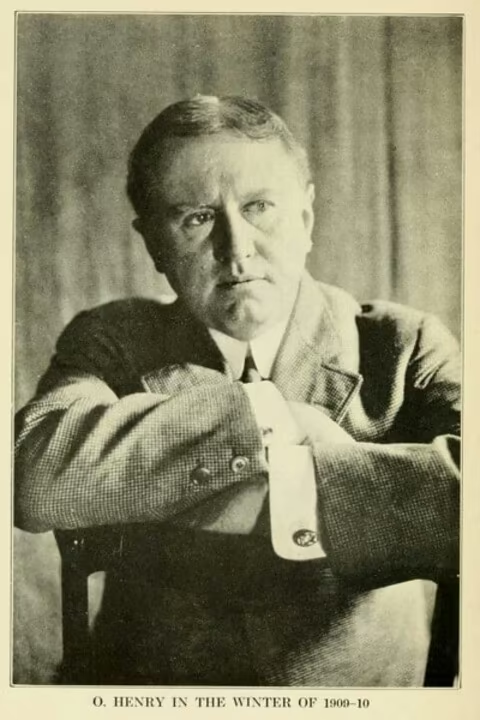
by O. Henry
A Call Loan is a rousing tale of frontier loyalty, in which a Texas cattleman-turned-banker risks everything for a friend's unsecured loanand the friend risks even more to repay the debt. It is a story where a man's word proves more valuable than any collateral. "Somehow, I've always found that when a man's word is good it's the best security there is."
In those days the cattlemen were the anointed. They were the grandees of the grass, kings of the kine, lords of the lea, barons of beef and bone. They might have ridden in golden chariots had their tastes so inclined. The cattleman was caught in a stampede of dollars. It seemed to him that he had more money than was decent. But when he had bought a watch with precious stones set in the case so large that they hurt his ribs, and a California saddle with silver nails and Angora skin suaderos, and ordered everybody up to the bar for whisky--what else was there for him to spend money for?
Not so circumscribed in expedient for the reduction of surplus wealth were those lairds of the lariat who had womenfolk to their name. In the breast of the rib-sprung sex the genius of purse lightening may slumber through years of inopportunity, but never, my brothers, does it become extinct.
So, out of the chaparral came Long Bill Longley from the Bar Circle Branch on the Frio--a wife-driven man--to taste the urban joys of success. Something like half a million dollars he had, with an income steadily increasing.
Long Bill was a graduate of the camp and trail. Luck and thrift, a cool head, and a telescopic eye for mavericks had raised him from cowboy to be a cowman. Then came the boom in cattle, and Fortune, stepping gingerly among the cactus thorns, came and emptied her cornucopia at the doorstep of the ranch.
In the little frontier city of Chaparosa, Longley built a costly residence. Here he became a captive, bound to the chariot of social existence. He was doomed to become a leading citizen. He struggled for a time like a mustang in his first corral, and then he hung up his quirt and spurs. Time hung heavily on his hands. He organised the First National Bank of Chaparosa, and was elected its president.
One day a dyspeptic man, wearing double-magnifying glasses, inserted an official-looking card between the bars of the cashier's window of the First National Bank. Five minutes later the bank force was dancing at the beck and call of a national bank examiner.
This examiner, Mr. J. Edgar Todd, proved to be a thorough one.
At the end of it all the examiner put on his hat, and called the president, Mr. William R. Longley, into the private office.
"Well, how do you find things?" asked Longley, in his slow, deep tones. "Any brands in the round-up you didn't like the looks of?"
"The bank checks up all right, Mr. Longley," said Todd; "and I find your loans in very good shape--with one exception. You are carrying one very bad bit of paper--one that is so bad that I have been thinking that you surely do not realise the serious position it places you in. I refer to a call loan of $10,000 made to Thomas Merwin. Not only is the amount in excess of the maximum sum the bank can loan any individual legally, but it is absolutely without endorsement or security. Thus you have doubly violated the national banking laws, and have laid yourself open to criminal prosecution by the Government. A report of the matter to the Comptroller of the Currency--which I am bound to make--would, I am sure, result in the matter being turned over to the Department of Justice for action. You see what a serious thing it is."
Bill Longley was leaning his lengthy, slowly moving frame back in his swivel chair. His hands were clasped behind his head, and he turned a little to look the examiner in the face. The examiner was surprised to see a smile creep about the rugged mouth of the banker, and a kindly twinkle in his light-blue eyes. If he saw the seriousness of the affair, it did not show in his countenance.
"Of course, you don't know Tom Merwin," said Longley, almost genially. "Yes, I know about that loan. It hasn't any security except Tom Merwin's word. Somehow, I've always found that when a man's word is good it's the best security there is. Oh, yes, I know the Government doesn't think so. I guess I'll see Tom about that note."
Mr. Todd's dyspepsia seemed to grow suddenly worse. He looked at the chaparral banker through his double-magnifying glasses in amazement.
"You see," said Longley, easily explaining the thing away, "Tom heard of 2000 head of two-year-olds down near Rocky Ford on the Rio Grande that could be had for $8 a head. I reckon 'twas one of old Leandro Garcia's outfits that he had smuggled over, and he wanted to make a quick turn on 'em. Those cattle are worth $15 on the hoof in Kansas City. Tom knew it and I knew it. He had $6,000, and I let him have the $10,000 to make the deal with. His brother Ed took 'em on to market three weeks ago. He ought to be back 'most any day now with the money. When he comes Tom'll pay that note."
The bank examiner was shocked. It was, perhaps, his duty to step out to the telegraph office and wire the situation to the Comptroller. But he did not. He talked pointedly and effectively to Longley for three minutes. He succeeded in making the banker understand that he stood upon the border of a catastrophe. And then he offered a tiny loophole of escape.
"I am going to Hilldale's to-night," he told Longley, "to examine a bank there. I will pass through Chaparosa on my way back. At twelve o'clock to-morrow I shall call at this bank. If this loan has been cleared out of the way by that time it will not be mentioned in my report. If not--I will have to do my duty."
With that the examiner bowed and departed.
The President of the First National lounged in his chair half an hour longer, and then he lit a mild cigar, and went over to Tom Merwin's house. Merwin, a ranchman in brown duck, with a contemplative eye, sat with his feet upon a table, plaiting a rawhide quirt.
"Tom," said Longley, leaning against the table, "you heard anything from Ed yet?"
"Not yet," said Merwin, continuing his plaiting. "I guess Ed'll be along back now in a few days."
"There was a bank examiner," said Longley, "nosing around our place to-day, and he bucked a sight about that note of yours. You know I know it's all right, but the thing is against the banking laws. I was pretty sure you'd have paid it off before the bank was examined again, but the son-of-a-gun slipped in on us, Tom. Now, I'm short of cash myself just now, or I'd let you have the money to take it up with. I've got till twelve o'clock to-morrow, and then I've got to show the cash in place of that note or--"
"Or what, Bill?" asked Merwin, as Longley hesitated.
"Well, I suppose it means be jumped on with both of Uncle Sam's feet."
"I'll try to raise the money for you on time," said Merwin, interested in his plaiting.
"All right, Tom," concluded Longley, as he turned toward the door; "I knew you would if you could."
Merwin threw down his whip and went to the only other bank in town, a private one, run by Cooper & Craig.
"Cooper," he said, to the partner by that name, "I've got to have $10,000 to-day or to-morrow. I've got a house and lot there that's worth about $6,000 and that's all the actual collateral. But I've got a cattle deal on that's sure to bring me in more than that much profit within a few days."
Cooper began to cough.
"Now, for God's sake don't say no," said Merwin. "I owe that much money on a call loan. It's been called, and the man that called it is a man I've laid on the same blanket with in cow-camps and ranger-camps for ten years. He can call anything I've got. He can call the blood out of my veins and it'll come. He's got to have the money. He's in a devil of a--Well, he needs the money, and I've got to get it for him. You know my word's good, Cooper."
"No doubt of it," assented Cooper, urbanely, "but I've a partner, you know. I'm not free in making loans. And even if you had the best security in your hands, Merwin, we couldn't accommodate you in less than a week. We're just making a shipment of $15,000 to Myer Brothers in Rockdell, to buy cotton with. It goes down on the narrow-gauge to-night. That leaves our cash quite short at present. Sorry we can't arrange it for you."
Merwin went back to his little bare office and plaited at his quirt again. About four o'clock in the afternoon he went to the First National Bank and leaned over the railing of Longley's desk.
"I'll try to get that money for you to-night--I mean to-morrow, Bill."
"All right, Tom," said Longley quietly.
At nine o'clock that night Tom Merwin stepped cautiously out of the small frame house in which he lived. It was near the edge of the little town, and few citizens were in the neighbourhood at that hour. Merwin wore two six-shooters in a belt, and a slouch hat. He moved swiftly down a lonely street, and then followed the sandy road that ran parallel to the narrow-gauge track until he reached the water- tank, two miles below the town. There Tom Merwin stopped, tied a black silk handkerchief about the lower part of his face, and pulled his hat down low.
In ten minutes the night train for Rockdell pulled up at the tank, having come from Chaparosa.
With a gun in each hand Merwin raised himself from behind a clump of chaparral and started for the engine. But before he had taken three steps, two long, strong arms clasped him from behind, and he was lifted from his feet and thrown, face downward upon the grass. There was a heavy knee pressing against his back, and an iron hand grasping each of his wrists. He was held thus, like a child, until the engine had taken water, and until the train had moved, with accelerating speed, out of sight. Then he was released, and rose to his feet to face Bill Longley.
"The case never needed to be fixed up this way, Tom," said Longley. "I saw Cooper this evening, and he told me what you and him talked about. Then I went down to your house to-night and saw you come out with your guns on, and I followed you. Let's go back, Tom."
They walked away together, side by side.
"'Twas the only chance I saw," said Merwin presently. "You called your loan, and I tried to answer you. Now, what'll you do, Bill, if they sock it to you?"
"What would you have done if they'd socked it to you?" was the answer Longley made.
"I never thought I'd lay in a bush to stick up a train," remarked Merwin; "but a call loan's different. A call's a call with me. We've got twelve hours yet, Bill, before this spy jumps onto you. We've got to raise them spondulicks somehow. Maybe we can--Great Sam Houston! do you hear that?"
Merwin broke into a run, and Longley kept with him, hearing only a rather pleasing whistle somewhere in the night rendering the lugubrious air of "The Cowboy's Lament."
"It's the only tune he knows," shouted Merwin, as he ran. "I'll bet--"
They were at the door of Merwin's house. He kicked it open and fell over an old valise lying in the middle of the floor. A sunburned, firm-jawed youth, stained by travel, lay upon the bed puffing at a brown cigarette.
"What's the word, Ed?" gasped Merwin.
"So, so," drawled that capable youngster. "Just got in on the 9:30. Sold the bunch for fifteen, straight. Now, buddy, you want to quit kickin' a valise around that's got $29,000 in greenbacks in its in'ards."
Frequently Asked Questions about A Call Loan
What is "A Call Loan" by O. Henry about?
"A Call Loan" is set in the frontier town of Chaparosa, Texas, where former cowboy-turned-bank-president Bill Longley faces a crisis when a federal bank examiner discovers he made an illegal $10,000 unsecured loan to his friend Tom Merwin. The examiner gives Longley until noon the next day to clear the loan or face criminal prosecution. Merwin, unable to raise the cash through legitimate means, resorts to a desperate plan to rob a train carrying $15,000. Longley follows him and stops the robbery just in time. The story resolves when Merwin's brother Ed arrives home with $29,000 from selling the cattle that the loan originally financed.
What is a call loan in banking terms?
A call loan is a type of loan that the lender can demand repayment of at any timeit is "callable" on demand with little or no notice. In the story, the $10,000 loan Bill Longley made to Tom Merwin is problematic for two reasons: it exceeds the legal lending limit for a single borrower under national banking laws, and it has no collateral or endorsement backing itonly Merwin's word. uses the banking term as a metaphor for the deeper bonds of personal honor and friendship, where a "call" between true friends carries more weight than any legal security.
What are the main themes in "A Call Loan"?
The story explores several interconnected themes:
Friendship and loyalty Merwin declares that Longley "can call the blood out of my veins and it'll come," illustrating a bond forged through years of shared hardship in cow-camps and ranger-camps.
Honor and keeping one's word Longley trusts Merwin's word as "the best security there is," and Merwin's declaration that "a call's a call with me" shows his absolute commitment to repaying his debts.
Sacrifice and moral limits Merwin is willing to commit armed robbery to honor his obligation, while Longley risks his own freedom to prevent his friend from becoming a criminal.
The frontier code vs. the law The story contrasts the informal honor system of the Texas frontier with the rigid regulations of federal banking law.
Who are the main characters in "A Call Loan"?
Bill Longley (William R. Longley) A former cowboy from the Bar Circle Branch on the Frio who built a fortune in cattle ranching, then founded and became president of the First National Bank of Chaparosa. He is described as a lengthy, slow-moving man with light-blue eyes and a rugged mouth.
Tom Merwin A ranchman and Longley's close friend who received the illegal $10,000 loan to finance a cattle deal. He is a man of deep personal honor who would rather rob a train than break his word.
J. Edgar Todd A dyspeptic national bank examiner who discovers the illegal loan and gives Longley a twelve-hour deadline to resolve it.
Ed Merwin Tom's brother, who arrives just in time with $29,000 from selling the cattle in Kansas City.
What is the surprise ending in "A Call Loan"?
delivers a characteristic twist ending through perfect timing. Just as Longley and Merwin are desperately trying to figure out how to raise $10,000 before the examiner returns at noon, they hear someone whistling "The Cowboy's Lament" in the darkness. Merwin immediately recognizes the tune as his brother Ed's. They rush to the house to find Ed lying on the bed, having just arrived on the 9:30 trainthe very same train Merwin had been about to rob. Ed casually reveals he sold the cattle for $15 a head and that the battered valise on the floor contains $29,000 in greenbacks, more than enough to repay the loan and save both men.
What is the significance of the attempted train robbery in the story?
The attempted train robbery is the story's dramatic climax and reveals the depth of Merwin's character. Having exhausted every legitimate optionthe only other bank in town cannot lend him money because they just shipped $15,000 on the narrow-gauge train to buy cottonMerwin decides to rob that very train. The irony is layered: Merwin, an honest man, is willing to become a criminal to honor a debt of friendship. Meanwhile, Longley proves his own loyalty by following Merwin and physically tackling him to prevent the crime. The scene demonstrates that both men are willing to sacrifice their freedom for each other.
What collection is "A Call Loan" published in?
"A Call Loan" was published in 's collection Heart of the West (1907), which gathers stories set in the American Southwest, particularly Texas. The collection draws on O. Henry's own experiences living in Texas during the 1880s and 1890s, where he worked on a sheep ranch, in a land office, and notably as a bank telleran experience that gave him firsthand knowledge of banking practices and may have directly inspired this story. O. Henry himself faced embezzlement charges related to his work at the First National Bank of Austin, lending the story an autobiographical dimension.
How does "A Call Loan" reflect O. Henry's own life?
The story carries strong autobiographical echoes. (William Sydney Porter) worked as a teller at the First National Bank of Austin, Texas, in the 1890s and was charged with embezzlement of bank funds. He fled to Honduras to avoid trial, but eventually returned, was convicted, and served three years in federal prison. His intimate knowledge of banking regulations, national bank examiners, and the tension between personal relationships and federal law directly informs the story's plot. Like Longley, Porter understood how the informal trust of frontier business could collide with the strict letter of banking law.
What literary devices does O. Henry use in "A Call Loan"?
employs several signature techniques:
Situational irony Merwin plans to rob a train to repay a debt of honor, and the money he needs is already on its way home with his brother. The train he nearly robs may even be the one his brother arrived on.
Regional dialect and imagery The story is rich with Western vernacular ("spondulicks," "mavericks," "chaparral") and metaphors drawn from ranching life, such as describing Longley as a "mustang in his first corral."
The surprise ending O. Henry's trademark twist resolves all tension in a single moment when Ed Merwin arrives with $29,000.
Double meaning in the title "A Call Loan" refers both to the banking term and to the deeper call of friendship that drives the story's action.
What is the setting of "A Call Loan" and why does it matter?
The story is set in Chaparosa, a small frontier town in South Texas, during the cattle boom of the late 19th century. The setting is essential to the story's meaning: in this frontier world, a man's word and personal reputation are the true currency, not legal contracts or bank security. opens with a vivid portrait of cattlemen as "grandees of the grass, kings of the kine, lords of the lea," establishing a world where wealth comes from the land and trust is built through shared hardship. The isolation of the townwith only two banks and a narrow-gauge railroadcreates the pressure-cooker conditions that force Merwin toward his desperate act, while the frontier code of honor provides the moral framework that ultimately resolves the conflict.
Save stories, build your reading list, and access all study tools — completely free.
Save A Call Loan to your library — it's free!Need help with A Call Loan?
Study tools to help with homework, prepare for quizzes, and deepen your understanding.
Flashcards →