A Madison Square Arabian Night
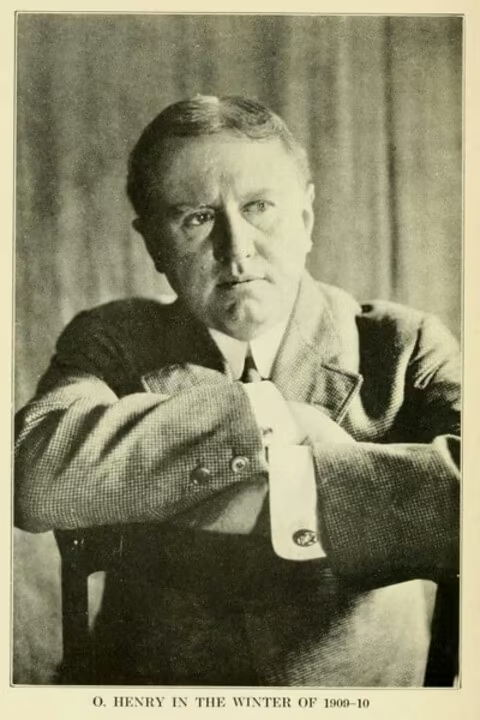
by O. Henry
A Madison Square Arabian Night is a modern retelling of the Caliph's tale, in which a wealthy, heartsick man invites a homeless stranger to dinner and receives in return a story, a pastel sketch, and an answer to the question tormenting his heart. "I'm your Scheherezade all the way to the toothpicks. You're the first Caliph with a genuine Oriental flavor I've struck since frost."
To Carson Chalmers, in his apartment near the square, Phillips brought the evening mail. Beside the routine correspondence there were two items bearing the same foreign postmark.
One of the incoming parcels contained a photograph of a woman. The other contained an interminable letter, over which Chalmers hung, absorbed, for a long time. The letter was from another woman; and it contained poisoned barbs, sweetly dipped in honey, and feathered with innuendoes concerning the photographed woman.
Chalmers tore this letter into a thousand bits and began to wear out his expensive rug by striding back and forth upon it. Thus an animal from the jungle acts when it is caged, and thus a caged man acts when he is housed in a jungle of doubt.
By and by the restless mood was overcome. The rug was not an enchanted one. For sixteen feet he could travel along it; three thousand miles was beyond its power to aid.
Phillips appeared. He never entered; he invariably appeared, like a well-oiled genie.
"Will you dine here, sir, or out?" he asked.
"Here," said Chalmers, "and in half an hour." He listened glumly to the January blasts making an Aeolian trombone of the empty street.
"Wait," he said to the disappearing genie. "As I came home across the end of the square I saw many men standing there in rows. There was one mounted upon something, talking. Why do those men stand in rows, and why are they there?"
"They are homeless men, sir," said Phillips. "The man standing on the box tries to get lodging for them for the night. People come around to listen and give him money. Then he sends as many as the money will pay for to some lodging-house. That is why they stand in rows; they get sent to bed in order as they come."
"By the time dinner is served," said Chalmers, "have one of those men here. He will dine with me."
"W-w-which--," began Phillips, stammering for the first time during his service.
"Choose one at random," said Chalmers. "You might see that he is reasonably sober--and a certain amount of cleanliness will not be held against him. That is all."
It was an unusual thing for Carson Chalmers to play the Caliph. But on that night he felt the inefficacy of conventional antidotes to melancholy. Something wanton and egregious, something high-flavored and Arabian, he must have to lighten his mood.
On the half hour Phillips had finished his duties as slave of the lamp. The waiters from the restaurant below had whisked aloft the delectable dinner. The dining table, laid for two, glowed cheerily in the glow of the pink-shaded candles.
And now Phillips, as though he ushered a cardinal--or held in charge a burglar--wafted in the shivering guest who had been haled from the line of mendicant lodgers.
It is a common thing to call such men wrecks; if the comparison be used here it is the specific one of a derelict come to grief through fire. Even yet some flickering combustion illuminated the drifting hulk. His face and hands had been recently washed--a rite insisted upon by Phillips as a memorial to the slaughtered conventions. In the candle-light he stood, a flaw in the decorous fittings of the apartment. His face was a sickly white, covered almost to the eyes with a stubble the shade of a red Irish setter's coat. Phillips's comb had failed to control the pale brown hair, long matted and conformed to the contour of a constantly worn hat. His eyes were full of a hopeless, tricky defiance like that seen in a cur's that is cornered by his tormentors. His shabby coat was buttoned high, but a quarter inch of redeeming collar showed above it. His manner was singularly free from embarrassment when Chalmers rose from his chair across the round dining table.
"If you will oblige me," said the host, "I will be glad to have your company at dinner."
"My name is Plumer," said the highway guest, in harsh and aggressive tones. "If you're like me, you like to know the name of the party you're dining with."
"I was going on to say," continued Chalmers somewhat hastily, "that mine is Chalmers. Will you sit opposite?"
Plumer, of the ruffled plumes, bent his knee for Phillips to slide the chair beneath him. He had an air of having sat at attended boards before. Phillips set out the anchovies and olives.
"Good!" barked Plumer; "going to be in courses, is it? All right, my jovial ruler of Bagdad. I'm your Scheherezade all the way to the toothpicks. You're the first Caliph with a genuine Oriental flavor I've struck since frost. What luck! And I was forty-third in line. I finished counting, just as your welcome emissary arrived to bid me to the feast. I had about as much chance of getting a bed to-night as I have of being the next President. How will you have the sad story of my life, Mr. Al Raschid--a chapter with each course or the whole edition with the cigars and coffee?"
"The situation does not seem a novel one to you," said Chalmers with a smile.
"By the chin whiskers of the prophet--no!" answered the guest. "Now York's as full of cheap Haroun al Raschids as Bagdad is of fleas. I've been held up for my story with a loaded meal pointed at my head twenty times. Catch anybody in New York giving you something for nothing! They spell curiosity and charity with the same set of building blocks. Lots of 'em will stake you to a dime and chop-suey; and a few of 'em will play Caliph to the tune of a top sirloin; but every one of 'em will stand over you till they screw your autobiography out of you with foot notes, appendix and unpublished fragments. Oh, I know what to do when I see victuals coming toward me in little old Bagdad-on-the-Subway. I strike the asphalt three times with my forehead and get ready to spiel yarns for my supper. I claim descent from the late Tommy Tucker, who was forced to hand out vocal harmony for his pre-digested wheaterina and spoopju."
"I do not ask your story," said Chalmers. "I tell you frankly that it was a sudden whim that prompted me to send for some stranger to dine with me. I assure you you will not suffer through any curiosity of mine."
"Oh, fudge!" exclaimed the guest, enthusiastically tackling his soup; "I don't mind it a bit. I'm a regular Oriental magazine with a red cover and the leaves cut when the Caliph walks abroad. In fact, we fellows in the bed line have a sort of union rate for things of this sort. Somebody's always stopping and wanting to know what brought us down so low in the world. For a sandwich and a glass of beer I tell 'em that drink did it. For corned beef and cabbage and a cup of coffee I give 'em the hard-hearted-landlord--six-months-in-the-hospital-lost-job story. A sirloin steak and a quarter for a bed gets the Wall Street tragedy of the swept-away fortune and the gradual descent. This is the first spread of this kind I've stumbled against. I haven't got a story to fit it. I'll tell you what, Mr. Chalmers, I'm going to tell you the truth for this, if you'll listen to it. It'll be harder for you to believe than the made-up ones."
An hour later the Arabian guest lay back with a sigh of satisfaction while Phillips brought the coffee and cigars and cleared the table.
"Did you ever hear of Sherrard Plumer?" he asked, with a strange smile.
"I remember the name," said Chalmers. "He was a painter, I think, of a good deal of prominence a few years ago."
"Five years," said the guest. "Then I went down like a chunk of lead. I'm Sherrard Plumer! I sold the last portrait I painted for $2,000. After that I couldn't have found a sitter for a gratis picture."
"What was the trouble?" Chalmers could not resist asking.
"Funny thing," answered Plumer, grimly. "Never quite understood it myself. For a while I swam like a cork. I broke into the swell crowd and got commissions right and left. The newspapers called me a fashionable painter. Then the funny things began to happen. Whenever I finished a picture people would come to see it, and whisper and look queerly at one another."
"I soon found out what the trouble was. I had a knack of bringing out in the face of a portrait the hidden character of the original. I don't know how I did it--I painted what I saw--but I know it did me. Some of my sitters were fearfully enraged and refused their pictures. I painted the portrait of a very beautiful and popular society dame. When it was finished her husband looked at it with a peculiar expression on his face, and the next week he sued for divorce."
"I remember one case of a prominent banker who sat to me. While I had his portrait on exhibition in my studio an acquaintance of his came in to look at it. 'Bless me,' says he, 'does he really look like that?" I told him it was considered a faithful likeness. 'I never noticed that expression about his eyes before,' said he; 'I think I'll drop downtown and change my bank account.' He did drop down, but the bank account was gone and so was Mr. Banker.
"It wasn't long till they put me out of business. People don't want their secret meannesses shown up in a picture. They can smile and twist their own faces and deceive you, but the picture can't. I couldn't get an order for another picture, and I had to give up. I worked as a newspaper artist for a while, and then for a lithographer, but my work with them got me into the same trouble. If I drew from a photograph my drawing showed up characteristics and expressions that you couldn't find in the photo, but I guess they were in the original, all right. The customers raised lively rows, especially the women, and I never could hold a job long. So I began to rest my weary head upon the breast of Old Booze for comfort. And pretty soon I was in the free-bed line and doing oral fiction for hand-outs among the food bazaars. Does the truthful statement weary thee, O Caliph? I can turn on the Wall Street disaster stop if you prefer, but that requires a tear, and I'm afraid I can't hustle one up after that good dinner."
"No, no," said Chalmers, earnestly, "you interest me very much. Did all of your portraits reveal some unpleasant trait, or were there some that did not suffer from the ordeal of your peculiar brush?"
"Some? Yes," said Plumer. "Children generally, a good many women and a sufficient number of men. All people aren't bad, you know. When they were all right the pictures were all right. As I said, I don't explain it, but I'm telling you facts."
On Chalmers's writing-table lay the photograph that he had received that day in the foreign mail. Ten minutes later he had Plumer at work making a sketch from it in pastels. At the end of an hour the artist rose and stretched wearily.
"It's done," he yawned. "You'll excuse me for being so long. I got interested in the job. Lordy! but I'm tired. No bed last night, you know. Guess it'll have to be good night now, O Commander of the Faithful!"
Chalmers went as far as the door with him and slipped some bills into his hand.
"Oh! I'll take 'em," said Plumer. "All that's included in the fall. Thanks. And for the very good dinner. I shall sleep on feathers to-night and dream of Bagdad. I hope it won't turn out to be a dream in the morning. Farewell, most excellent Caliph!"
Again Chalmers paced restlessly upon his rug. But his beat lay as far from the table whereon lay the pastel sketch as the room would permit. Twice, thrice, he tried to approach it, but failed. He could see the dun and gold and brown of the colors, but there was a wall about it built by his fears that kept him at a distance. He sat down and tried to calm himself. He sprang up and rang for Phillips.
"There is a young artist in this building," he said. "--a Mr. Reineman--do you know which is his apartment?"
"Top floor, front, sir," said Phillips.
"Go up and ask him to favor me with his presence here for a few minutes."
Reineman came at once. Chalmers introduced himself.
"Mr. Reineman," said he, "there is a little pastel sketch on yonder table. I would be glad if you will give me your opinion of it as to its artistic merits and as a picture."
The young artist advanced to the table and took up the sketch. Chalmers half turned away, leaning upon the back of a chair.
"How--do--you find it?" he asked, slowly.
"As a drawing," said the artist, "I can't praise it enough. It's the work of a master--bold and fine and true. It puzzles me a little; I haven't seen any pastel work near as good in years."
"The face, man--the subject--the original--what would you say of that?"
"The face," said Reineman, "is the face of one of God's own angels. May I ask who--"
"My wife!" shouted Chalmers, wheeling and pouncing upon the astonished artist, gripping his hand and pounding his back. "She is traveling in Europe. Take that sketch, boy, and paint the picture of your life from it and leave the price to me."
Frequently Asked Questions about A Madison Square Arabian Night
What is "A Madison Square Arabian Night" by O. Henry about?
"A Madison Square Arabian Night" tells the story of Carson Chalmers, a wealthy New Yorker tormented by a poisonous letter about his wife who is traveling in Europe. To escape his melancholy, he decides to play the role of a Caliph from the Arabian Nights by inviting a random homeless man from Madison Square to dine with him. The guest turns out to be Sherrard Plumer, a once-celebrated portrait painter whose uncanny ability to reveal the hidden character of his subjects led to his ruin. After dinner, Plumer sketches Chalmers's wife from a photograph, and the portrait reveals her as "one of God's own angels," dispelling Chalmers's fears about her faithfulness.
Who is Sherrard Plumer in "A Madison Square Arabian Night"?
Sherrard Plumer is a formerly prominent portrait painter who has fallen into homelessness. At the height of his career, he sold portraits for $2,000, but he had an uncontrollable talent for revealing the hidden character of his subjects in their portraits. This gift became his curse: sitters were enraged by what they saw, refused their pictures, and eventually no one would sit for him. His story mirrors the artist's dilemma of choosing between truth and commercial success, and his honest art ultimately provides the story's resolution when his sketch reveals the true virtue of Chalmers's wife.
What is the twist ending in "A Madison Square Arabian Night"?
The twist operates on two levels. First, the homeless man Chalmers randomly invited turns out to be Sherrard Plumer, a once-famous portrait painternot the typical down-on-his-luck vagrant Chalmers expected. Second, and more importantly, Plumer's feared ability to reveal hidden character in portraits becomes a blessing rather than a curse: his pastel sketch of Chalmers's wife from a photograph reveals her as having "the face of one of God's own angels," proving her faithfulness and destroying the doubts planted by the poisonous letter. The very talent that ruined Plumer saves Chalmers.
How does O. Henry use the Arabian Nights in this story?
draws a deliberate parallel between Carson Chalmers and Caliph Harun al-Rashid from the One Thousand and One Nights. Just as al-Rashid would disguise himself and wander Baghdad seeking adventures among common people, Chalmers invites a stranger to dinner seeking "something high-flavored and Arabian" to lift his spirits. However, O. Henry adds an ironic twist: unlike the Caliph who went out among the people, Chalmers brings the people to him, never leaving his luxurious apartment. The story also mirrors the Arabian Nights' structure of embedded storytelling, with Plumer telling his life story over dinner much like Scheherazade's tales within tales.
What are the main themes in "A Madison Square Arabian Night"?
The story explores several interconnected themes: Appearance versus reality runs throughout, from the poisonous letter's false portrait of Chalmers's wife to Plumer's hidden identity as a great artist. The power of art is centralPlumer's portraits reveal truth that words cannot, and his honest art both destroys and redeems. Wealth and poverty are juxtaposed as Chalmers and Plumer dine together across a vast social divide. also examines generosity and its motives, questioning whether Chalmers's charity is genuine compassion or merely entertainment for a bored rich man.
What is the significance of Plumer's portrait-painting ability?
Plumer's gift for revealing hidden character in portraits serves as the story's central metaphor. His art is too honest for a society that prefers flattering illusions, which is why his career was destroyedsubjects saw their true selves and recoiled. One society woman's husband "wanted to strangle" Plumer after seeing her portrait. Yet this same ruthless honesty becomes the instrument of salvation when his sketch of Chalmers's wife reveals genuine virtue. suggests that truth-telling is costly but ultimately redemptive, and that real art serves a higher purpose than mere flattery.
What role does Phillips the butler play in the story?
Phillips is Chalmers's impeccable butler, described as appearing "like a well-oiled genie"a deliberate reference to the Arabian Nights that reinforces the story's fairy-tale framing. He serves as the practical mediator between Chalmers's wealthy world and the homeless men of Madison Square. Phillips is unflappable in every situation except when given the unusual order to fetch a homeless man for dinner, causing him to stammer for "the first time during his service." His brief loss of composure highlights just how extraordinary Chalmers's request is, while his efficient execution of it keeps the story's Arabian Nights fantasy grounded in reality.
What is the setting of "A Madison Square Arabian Night"?
The story is set in New York City during a cold January night, specifically in and around Madison Square, which in 's era (early 1900s) was a gathering place for homeless men seeking shelter. The contrast between Chalmers's luxurious apartmentwith its expensive rug, pink-shaded candles, and restaurant-delivered dinnerand the freezing men standing in rows outside creates the story's essential tension. O. Henry transforms this real New York location into a version of Baghdad, with Chalmers's apartment becoming the Caliph's palace and Madison Square becoming the exotic streets where adventures begin.
What collection is "A Madison Square Arabian Night" from?
"A Madison Square Arabian Night" was first published in 1904 and later collected in The Trimmed Lamp and Other Stories (1907). It is one of several stories that draw on Arabian Nights imagery to frame New York City life, including A Bird of Bagdad and "A Night in New Arabia." These stories share O. Henry's signature technique of casting modern New Yorkers as characters from Eastern folklore, with the city's wealthy playing Caliphs and its poor serving as the colorful strangers they encounter on their nocturnal adventures.
Why did Sherrard Plumer become homeless?
Plumer's downfall came from his inability to paint anything but the truth. As a fashionable portrait painter, he had an involuntary knack for revealing the hidden character of his subjects. When people viewed his finished portraits, they would "whisper and look queerly at one another." Sitters grew enragedone society woman's portrait so disturbed her husband that "he wanted to strangle" Plumer. A club man's portrait prompted friends to have him "examined for symptoms." Commissions dried up entirely, and within five years of his peak success, Plumer descended from selling $2,000 portraits to standing in a homeless line at Madison Square.
Save stories, build your reading list, and access all study tools — completely free.
Save A Madison Square Arabian Night to your library — it's free!Need help with A Madison Square Arabian Night?
Study tools to help with homework, prepare for quizzes, and deepen your understanding.
Flashcards →