Little Speck in Garnered Fruit
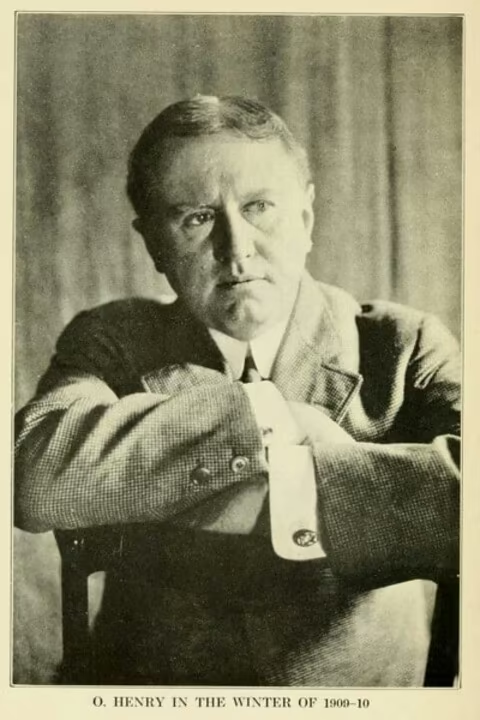
by O. Henry
Little Speck in Garnered Fruit is a comic odyssey in which a champion welterweight braves midnight New York, a police raid, and a cracked rib to fetch his newlywed bride the one thing she craves -- a fresh peach in February. "So rode the knights back to Camelot after perils and high deeds done for their ladies fair."
The honeymoon was at its full. There was a flat with the reddest of new carpets, tasselled portieres and six steins with pewter lids arranged on a ledge above the wainscoting of the dining-room. The won- der of it was yet upon them. Neither of them had ever seen a yellow primrose by the river's brim; but if such a sight had met their eyes at that time it would have seemed like - well, whatever the poet expected the right kind of people to see in it besides a prim- rose.
The bride sat in the rocker with her feet resting upon the world. She was wrapt in rosy dreams and a kimono of the same hue. She wondered what the peo- ple in Greenland and Tasmania and Beloochistan were saying one to another about her marriage to Kid McGarry. Not that it made any difference. There was no welter-weight from London to the Southern Cross that could stand up four hours - no; four rounds - with her bridegroom. And he had been hers for three weeks; and the crook of her little finger could sway him more than the fist of any 142- pounder in the world.
Love, when it is ours, is the other name for self- abnegation and sacrifice. When it belongs to people across the airshaft it means arrogance and self-con- ceit.
The bride crossed her oxfords and looked thought- fully at the distemper Cupids on the ceiling.
"Precious," said she, with the air of Cleopatra asking Antony for Rome done up in tissue paper and delivered at residence, "I think I would like a peach."
Kid McGarry arose and put on his coat and hat. He was serious, shaven, sentimental, and spry.
"All right," said he, as coolly as though be were only agreeing to sign articles to fight the champion of England. "I'll step down and cop one out for you see?"
"Don't be long," said the bride. "I'll be lonesome without my naughty boy. Get a nice, ripe one." After a series of farewells that would have befitted an imminent voyage to foreign parts, the Kid went down to the street.
Here he not unreasonably hesitated, for the season was yet early spring, and there seemed small chance of wresting anywhere from those chill streets and stores the coveted luscious guerdon of summer's golden prime.
At the Italian's fruit-stand on the corner be stopped and cast a contemptuous eye over the dis- play of papered oranges, highly polished apples and wan, sun-hungry bananas.
"Gotta da peach?" asked the Kid in the tongue of Dante, the lover of lovers.
"Ah, no, - " sighed the vender. "Not for one mont com-a da peach. Too soon. Gotta da nice-a orange. Like-a da orange?"
Scornful, the Kid pursued his quest. He entered the all-night chop-house, cafe, and bowling-alley of his friend and admirer, Justus O'Callahan. The O'Callahan was about in his institution, looking for leaks.
"I want it straight," said the Kid to him. "The old woman has got a hunch that she wants a peach. Now, if you've got a peach, Cal, get it out quick. I want it and others like it if you've got 'em in plural quantities."
"The house is yours," said O'Callahan. "But there's no peach in it. It's too soon. I don't sup- pose you could even find 'em at one of the Broadway joints. That's too bad. When a lady fixes her mouth for a certain kind of fruit nothing else won't do. It's too late now to find any of the first-class fruiterers open. But if you think the missis would like some nice oranges I've just got a box of fine ones in that she might."
"Much obliged, Cal. It's a peach proposition right from the ring of the gong. I'll try further."
The time was nearly midnight as the Kid walked down the West-Side avenue. Few stores were open and such as were practically hooted at the idea of a peach.
But in her moated flat the bride confidently awaited her Persian fruit. A champion welter-weight not find a peach? - not stride triumphantly over the seasons and the zodiac and the almanac to fetch an Amsden's June or a Georgia cling to his owny-own?
The Kid's eye caught sight of a window that was lighted and gorgeous with nature's most entrancing colors. The light suddenly went out. The Kid sprinted and caught the fruiterer locking his door.
"Peaches?" said he, with extreme deliberation.
"Well, no, Sir. Not for three or four weeks yet. I haven't any idea where you might find some. There may be a few in town from under the glass, but they'd be bard to locate. Maybe at one of the more expen- sive hotels - some place where there's plenty of money to waste. I've got some very fine oranges, though - from a shipload that came in to-day."
The Kid lingered on the corner for a moment, and then set out briskly toward a pair of green lights that flanked the steps of a building down a dark side street.
"Captain around anywhere?" he asked of the desk sergeant of the police station.
At that moment the captain came briskly forward from the rear. He was in plain clothes and had a busy air.
"Hello, Kid," he said to the pugilist. "Thought you were bridal-touring?
"Got back yesterday. I'm a solid citizen now. Think I'll take an interest in municipal doings. How would it suit you to get into Denver Dick's place to- night, Cap?
"Past performances," said the captain, twisting his moustache. "Denver was closed up two months ago."
"Correct," said the Kid. "Rafferty chased him out of the Forty-third. He's running in your pre- cinct now, and his game's bigger than ever. I'm down on this gambling business. I can put you against his game."
"In my precinct?" growled the captain. "Are you sure, Kid? I'll take it as a favor. Have you got the entree? How is it to be done?"
"Hammers," said the Kid. "They haven't got any steel on the doors yet. You'll need ten men. No, they won't let me in the place. Denver has been trying to do me. He thought I tipped him off for the other raid. I didn't, though. You want to hurry. I've got to get back home. The house is only three blocks from here."
Before ten minutes had sped the captain with a dozen men stole with their guide into the hallway of a dark and virtuous-looking building in which many businesses were conducted by day.
"Third floor, rear," said the Kid, softly. "I'll lead the way."
Two axemen faced the door that he pointed out to them.
"It seems all quiet," said the captain, doubtfully.
"Are you sure your tip is straight?"
"Cut away!" said the Kid. "It's on me if it ain't."
The axes crashed through the as yet unprotected door. A blaze of light from within poured through the smashed panels. The door fell, and the raiders rang into the room with their guns handy.
The big room was furnished with the gaudy mag- nificence dear to Denver Dick's western ideas. Vari- ous well-patronized games were in progress. About fifty men who were in the room rushed upon the police in a grand break for personal liberty. The plain- clothes men had to do a little club-swinging. More than half the patrons escaped.
Denver Dick had graced his game with his own presence that night. He led the rush that was in- tended to sweep away the smaller body of raiders, But when be saw the Kid his manner became personal. Being in the heavyweight class be cast himself joy- fully upon his slighter enemy, and they rolled down a flight of stairs in each others arms. On the land- ing they separated and arose, and then the Kid was able to use some of his professional tactics, which had been useless to him while in the excited clutch of a 200-pound sporting gentleman who was about to lose $20,000 worth of paraphernalia.
After vanquishing his adversary the Kid hurried upstairs and through the gambling-room into a smaller apartment connecting by an arched doorway.
Here was a long table set with choicest chinaware and silver, and lavishly furnished with food of that expensive and spectacular sort of which the devotees of sport are supposed to be fond. Here again was to be perceived the liberal and florid taste of the gen- tleman with the urban cognomenal prefix.
A No. 10 patent leather shoe protruded a few of its inches outside the tablecloth along the floor. The Kid seized this and plucked forth a black man in a white tie and the garb of a servitor.
"Get up!" commanded the Kid. "Are you in charge of this free lunch?"
"Yes, sah, I was. Has they done pinched us ag'in, boss?"
"Looks that way. Listen to me. Are there any peaches in this layout? If there ain't I'll have to throw up the sponge."
"There was three dozen, sah, when the game opened this evenin'; but I reckon the gentlemen done eat 'em all up. If you'd like to eat a fust-rate orange, sah, I kin find you some."
"Get busy," ordered the Kid, sternly, and move whatever peach crop you've got quick or there'll be trouble. If anybody oranges me again to-night, I'll knock his face off."
The raid on Denver Dick's high-priced and prodi- gal luncheon revealed one lone, last peach that had escaped the epicurean jaws of the followers of chance. Into the Kid's pocket it went, and that in- defatigable forager departed immediately with his prize. With scarcely a glance at the scene on the sidewalk below, where the officers were loading their prisoners into the patrol wagons, be moved homeward with long, swift strides.
His heart was light as be went. So rode the knights back to Camelot after perils and high deeds done for their ladies fair. The Kid's lady had com- manded him and be had obeyed. True, it was but a peach that she had craved; but it had been no small deed to glean a peach at midnight from that wintry city where yet the February snows lay like iron. She had asked for a peach; she was his bride; in his pocket the peach was warming in his band that held it for fear that it might fall out and be lost.
On the way the Kid turned in at an all-night drug store and said to the spectacled clerk:
"Say, sport, I wish you'd size up this rib of mine and see if it's broke. I was in a little scrap and bumped down a flight or two of stairs."
The druggist made an examination. "It isn't broken," was his diagnosis, "but you have a bruise there that looks like you'd fallen off the Flatiron twice."
"That's all right," said the Kid. "Let's have your clothesbrush, please."
The bride waited in the rosy glow of the pink lamp shade. The miracles were not all passed away. By breathing a desire for some slight thing - a flower, a pomegranate, a - oh, yes, a peach - she could send forth her man into the night, into the world which could not withstand him, and he would do her bidding.
And now be stood by her chair and laid the peach in her band.
"Naughty boy!" she said, fondly. "Did I say a peach? I think I would much rather have had an orange."
Blest be the bride.
Frequently Asked Questions about Little Speck in Garnered Fruit
What is "Little Speck in Garnered Fruit" by O. Henry about?
"Little Speck in Garnered Fruit" tells the story of Kid McGarry, a champion welterweight boxer on his honeymoon, whose adoring bride casually asks him to fetch her a peach. The problem: it is February in New York City, and peaches are months out of season. The Kid searches fruit stands, an all-night chop house, and late-night fruiterers, all in vain. Desperate, he leads a police raid on Denver Dick's illegal gambling den—not out of civic duty, but because the lavish buffet might have peaches. He fights Denver Dick, suffers bruised ribs, and triumphantly recovers a single surviving peach. When he presents it to his bride, she says she'd actually rather have had an orange.
What is the surprise ending of "Little Speck in Garnered Fruit"?
After Kid McGarry endures a midnight odyssey through wintry streets, orchestrates a police raid on an illegal gambling den, and physically fights the 200-pound Denver Dick—all to obtain a single out-of-season peach—he returns home triumphant. But when he places the peach in his bride's hand, she responds: "Did I say a peach? I think I would much rather have had an orange." The crushing irony is that oranges were available at every single stop the Kid visited that night. This twist ending is classic : the heroic sacrifice is rendered absurd by one casual, oblivious remark.
What are the main themes of "Little Speck in Garnered Fruit"?
The story explores several interconnected themes:
- Love and Sacrifice — opens with the observation that "Love, when it is ours, is the other name for self-abnegation and sacrifice," and the entire plot dramatizes this idea through the Kid's extreme quest.
- The Irony of Devotion — The Kid's heroic efforts are rendered meaningless by his bride's whimsical change of heart, suggesting that grand gestures of love may go unrecognized or unappreciated.
- Chivalric Romance vs. Reality — O. Henry explicitly compares the Kid to a knight returning to Camelot, only to deflate the comparison with the anticlimactic ending.
- Marriage and Expectations — The story humorously captures how newlywed infatuation can make even trivial requests feel like sacred quests.
Who is Kid McGarry in the story?
Kid McGarry is the protagonist—a champion welterweight boxer who has recently married. describes him as "serious, shaven, sentimental, and spry." Despite being a tough professional fighter, he is utterly devoted to his new bride and will go to any lengths to fulfill her wishes. His toughness serves the story's humor: a man who can defeat any 142-pounder in the world is brought low by the simple unavailability of a peach. The contrast between his fighting prowess and his lovesick obedience is central to the story's comedy.
Why is the story called "Little Speck in Garnered Fruit"?
The title is a metaphorical reference. "Garnered fruit" suggests something harvested and stored—in this case, the fruit of the Kid's marriage and his happiness during the honeymoon. The "little speck" is the tiny imperfection that mars that happiness: his bride's casual, ungrateful dismissal of the peach he nearly killed himself to obtain. The title echoes the idea that even in the most blissful circumstances, some small flaw—a thoughtless word, an unappreciated sacrifice—can spoil the perfection. It also literally refers to the lone, imperfect peach retrieved from the gambling den's buffet.
What is the irony in "Little Speck in Garnered Fruit"?
The story is built on situational irony. Every person the Kid encounters during his quest—the Italian fruit vendor, O'Callahan, the late-night fruiterer, even the waiter at the gambling den—offers him oranges as a substitute. Oranges are plentiful and available everywhere. The Kid dismisses each offer with increasing irritation, telling the waiter: "If anybody oranges me again to-night, I'll knock his face off." After enduring a brawl, bruised ribs, and a midnight ordeal to secure the one surviving peach in the city, his bride tells him she would have preferred an orange all along. The thing he fought hardest to avoid was the thing she actually wanted.
What collection does "Little Speck in Garnered Fruit" appear in?
"Little Speck in Garnered Fruit" was published in 's collection The Voice of the City (1908). This collection contains stories set in New York City that capture the humor, energy, and surprise of urban life. Like many stories in the collection, "Little Speck" uses a seemingly trivial urban incident—a late-night search for fruit—to reveal deeper truths about human nature and relationships. The story was also adapted into a silent film in 1917.
How does O. Henry use humor in "Little Speck in Garnered Fruit"?
layers multiple types of humor throughout the story:
- Mock-heroic tone — The Kid's quest for a peach is described in the language of chivalric romance: "So rode the knights back to Camelot after perils and high deeds done for their ladies fair."
- Comic escalation — Each step of the search grows more absurd, from a fruit stand to a chop house to orchestrating a police raid on a gambling den.
- Running gag — Everyone offers the Kid oranges, building frustration that pays off in the final twist.
- Verbal wit — Lines like the Kid asking for a peach "in the tongue of Dante, the lover of lovers" or the bride's request delivered "with the air of Cleopatra asking Antony for Rome done up in tissue paper."
What is the significance of the police raid in the story?
The police raid on Denver Dick's illegal gambling operation is significant because the Kid's motives are entirely selfish—he does not raid the den out of civic virtue but because he knows the lavish buffet might contain peaches. He trades inside knowledge of the gambling operation to the police captain as currency to gain access. This creates dramatic irony: the captain believes the Kid has reformed into a "solid citizen" interested in "municipal doings," while the Kid is actually executing an elaborate scheme to find fruit for his wife. The raid also gives an opportunity to showcase the Kid's fighting skills against Denver Dick, adding physical comedy to the story.
How does "Little Speck in Garnered Fruit" compare to "The Gift of the Magi"?
Both stories explore sacrifice in marriage, but with very different emotional outcomes. In The Gift of the Magi, both husband and wife sacrifice their most prized possessions for each other, and the mutual devotion—though materially ironic—is deeply moving. In "Little Speck in Garnered Fruit," the sacrifice is entirely one-sided: the Kid endures enormous hardship while his bride waits passively, and her final remark shows she is oblivious to his ordeal. The Gift of the Magi celebrates love's nobility; "Little Speck" gently satirizes how love can make us foolish. Both feature 's signature twist endings, but one is sentimental and the other is comic.
Save stories, build your reading list, and access all study tools — completely free.
Save Little Speck in Garnered Fruit to your library — it's free!Need help with Little Speck in Garnered Fruit?
Study tools to help with homework, prepare for quizzes, and deepen your understanding.
Flashcards →