The Roads We Take
by O. Henry
The Roads We Take was published in O. Henry's short story collection, Whirligs.
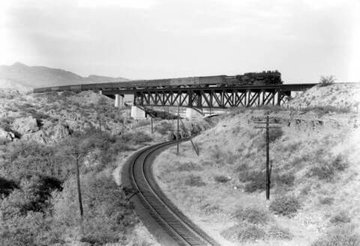
TWENTY miles West of Tucson, the "Sunset Express" stopped at a tank to take on water. Besides the aqueous, addition the engine of that famous flyer acquired some other things that were not good for it.
While the fireman was lowering the feeding hose, Bob Tidball, "Shark" Dodson and a quarter-bred Creek Indian called John Big Dog climbed on the engine and showed the engineer three round orifices in pieces of ordnance that the carried. These orifices so impressed the engineer with their possibilities that he raised both hands in a gesture such as accompanies the ejaculation "Do tell!"
At the crisp command of Shark Dodson, who was leader of the attacking force the engineer descended to the ground and uncoupled the engine and tender. Then John Big Dog, perched upon the coal, sportively held two guns upon the engine driver and the fireman, and suggested that they run the engine fifty yards away and there await further orders.
Shark Dodson and Bob Tidball, scorning to put such low-grade ore as the passengers through the mill, struck out for the rich pocket of the express car. They found the messenger serene in the belief that the "Sunset Express" was taking on nothing more stimulating and dangerous than aqua pura. While Bob was knocking this idea out of his head with the butt-end of his six-shooter Shark Dodson was already dosing the express-car safe with dynamite.
The safe exploded to the tune of $30,000, all gold and currency. The passengers thrust their heads casually out of the windows to look for the thunder-cloud. The conductor jerked at the bell-rope, which sagged down loose and unresisting, at his tug. Shark Dodson and Bob Tidball, with their booty in a stout canvas bag, tumbled out of the express car and ran awkwardly in their high-heeled boots to the engine.
The engineer, sullenly angry but wise, ran the engine, according to orders, rapidly away from the inert train. But before this was accomplished the express messenger, recovered from Bob Tidball's persuader to neutrality, jumped out of his car with a Winchester rifle and took a trick in the game. Mr. John Big Dog, sitting on the coal tender, unwittingly made a wrong lead by giving an imitation of a target, and the messenger trumped him. With a ball exactly between his shoulder blades the Creek chevalier of industry rolled off to the ground, thus increasing the share of his comrades in the loot by one-sixth each.
Two miles from the tank the engineer was ordered to stop.
The robbers waved a defiant adieu and plunged down the steep slope into the thick woods that lined the track. Five minutes of crashing through a thicket of chapparal brought them to open woods, where three horses were tied to low-hanging branches. One was waiting for John Big Dog, who would never ride by night or day again. This animal the robbers divested of saddle and bridle and set free. They mounted the other two with the bag across one pommel, and rode fast and with discretion through the forest and up a primeval, lonely gorge. Here the animal that bore Bob Tidball slipped on a mossy boulder and broke a foreleg. They shot him through the head at once and sat down to hold a council of flight. Made secure for the present by the tortuous trail they- had travelled, the question of time was no longer so big. Many miles and hours lay between them and the spryest posse that could follow. Shark Dodson's horse, with trailing rope and dropped bridle, panted and cropped thankfully of the grass along the stream in the gorge. Bob Tidball opened the sack, drew out double handfuls of the neat packages of currency and the one sack of gold and chuckled with the glee of a child.
"Say, you old double-decked pirate," he called joyfully to Dodson, "you said we could do it -- you got a head for financing that knocks the horns off of anything in Arizona."
"What are we going to do about a hoss for you, Bob? We ain't got long to wait here. They'll be on our trail before daylight in the mornin'."
"Oh, I guess that cayuse of yourn'll carry double for a while," answered the sanguine Bob. "We'll annex the first animal we come across. By jingoes, we made a haul, didn't we? Accordin' to the marks on this money there's $30,000 -- $15,000 apiece!"
"It's short of what I expected," said Shark Dodson, kicking softly at the packages with the toe of his boot and then he looked pensively at the wet sides of his tired horse.
"Old Bolivar's mighty nigh played out," he said, slowly. "I wish that sorrel of yours hadn't got hurt."
"So do I," said Bob, heartily, "but it can't be helped. Bolivar's got plenty of bottom -- he'll get us both far enough to get fresh mounts. Dang it, Shark, I can't belp thinkin' how funny it is that an Easterner like you can come out here and give us Western fellows cards and spades in the desperado business. What part of the East was you from, anyway?"
"New York State," said Shark Dodson, sitting down on a boulder and chewing a twig. "I was born on a farm in Ulster County. I ran away from home when I was seventeen. It was an accident my coming West. I was walkin' along the road with my clothes in a bundle, makin' for New York City. I had an idea of goin' there and makin' lots of money. I always felt like I could do it. I came to a place one evenin' where the road forked and I didn't know which fork to take. I studied about it for half an hour, and then I took the left- hand. That night I run into the camp of a Wild West show that was travellin' among the little towns, and I went West with it. I've often wondered if I wouldn't have turned out different if I'd took the other road."
"Oh, I reckon you'd have ended up about the same," said Bob Tidball, cheerfully philosophical. "It ain't the roads we take; it's what's inside of us that makes us turn out the way we do."
Shark Dodson got up and leaned against a tree.
"I'd a good deal rather that sorrel of yourn hadn't hurt himself, Bob," he said again, almost pathetically.
"Same here," agreed Bob; "he was sure a first-rate kind of a crowbait. But Bolivar, he'll pull us through all right. Reckon we'd better be movin' on, hadn't we, Shark? I'll bag this boodle ag'in and we'll hit the trail for higher timber."
Bob Tidball replaced the spoil in the bag and tied the mouth of it tightly with a cord. When he looked up the most prominent object that he saw was the muzzle of Shark Dodson's .45 held upon him without a waver.
"Stop your funnin'," said Bob, with a grin. "We got to be hittin' the breeze."
"Set still," said Shark. "You ain't goin' to hit no breeze, Bob. I hate to tell you, but there ain't any chance for but one of us. Bolivar, he's plenty tired, and he can't carry double."
"We been pards, me and you, Shark Dodson, for three year," Bob said quietly. "We've risked our lives together time and again. I've always give you a square deal, and I thought you was a man. I've heard some queer stories about you shootin' one or two men in a peculiar way, but I never believed 'em. Now if you're just havin' a little fun with me, Shark, put your gun up, and we'll get on Bolivar and vamose. If you mean to shoot -- shoot, you blackhearted son of a tarantula!"
Shark Dodson's face bore a deeply sorrowful look. "You don't know how bad I feel," he sighed, "about that sorrel of yourn breakin' his leg, Bob."
The expression on Dodson's face changed in an instant to one of cold ferocity mingled with inexorable cupidity. The soul of the man showed itself for a moment like an evil face in the window of a reputable house.
Truly Bob Tidball was never to "hit the breeze" again. The deadly .45 of the false friend cracked and filled the gorge with a roar that the walls hurled back with indignant echoes. And Bolivar, unconscious accomplice, swiftly bore away the last of the holders-up of the "Sunset Express," not put to the stress of "carrying double."
But as "Shark" Dodson galloped away the woods seemed to fade from his view; the revolver in his right hand turned to the curved arm of a mahogany chair; his saddle was strangely upholstered, and he opened his eyes and saw his feet, not in stirrups, but resting quietly on the edge of a quartered-oak desk.
I am telling you that Dodson, of the firm of Dodson & Decker, Wall Street brokers, opened his eyes. Peabody, the confidential clerk, was standing by his chair, hesitating to speak. There was a confused hum of wheels below, and the sedative buzz of an electric fan.
"Ahem! Peabody," said Dodson, blinking. "I must have fallen asleep. I had a most remarkable dream. What is it, Peabody?"
"Mr. Williams, sir, of Tracy & Williams, is outside. He has come to settle his deal in X. Y. Z. The market caught him short, sir, if you remember."
"Yes, I remember. What is X. Y. Z. quoted at to-day, Peabody?"
"One eighty-five, sir."
"Then that's his price."
"Excuse me," said Peabody, rather nervously "for speaking of it, but I've been talking to Williams. He's an old friend of yours, Mr. Dodson, and you practically have a corner in X. Y. Z. I thought you might -- that is, I thought you might not remember that he sold you the stock at 98. If he settles at the market price it will take every cent he has in the world and his home too to deliver the shares."
The expression on Dodson's face changed in an instant to one of cold ferocity mingled with inexorable cupidity. The soul of the man showed itself for a moment like an evil face in the window of a reputable house.
"He will settle at one eighty-five," said Dodson. "Bolivar cannot carry double."
Frequently Asked Questions about The Roads We Take
What is "The Roads We Take" by O. Henry about?
"The Roads We Take" begins as a Wild West train robbery. Three outlaws — Shark Dodson, Bob Tidball, and John Big Dog — hold up the Sunset Express and escape with $30,000 in gold and currency. After John Big Dog is killed and Bob’s horse breaks a leg, the two survivors face a dilemma: one horse, two men, and a heavy bag of loot. Despite their three-year partnership, Shark coldly shoots Bob, declaring "Bolivar cannot carry double." The story then delivers its famous twist: Shark Dodson is actually a Wall Street broker who fell asleep at his desk. Upon waking, he faces a parallel decision — whether to financially ruin an old friend in a stock deal — and makes the same ruthless choice.
What is the main theme of "The Roads We Take"?
The central theme is that a person’s true character determines their choices, regardless of circumstances. The story’s key line, spoken by Bob Tidball, captures this idea: "It ain’t the roads we take; it’s what’s inside of us that makes us turn out the way we do." Whether Dodson is a bandit in the Old West or a broker on Wall Street, his essential nature — cold, greedy, and willing to betray — remains the same. uses the dream-within-reality structure to argue that external circumstances like career, geography, and era are less important than the moral fiber (or lack of it) inside a person.
What is the surprise ending of "The Roads We Take"?
In ’s signature twist, the entire Wild West robbery is revealed to be a dream. "Shark" Dodson is actually a Wall Street broker named Dodson of Dodson & Decker who dozed off at his mahogany desk. His clerk Peabody wakes him to report that an old friend, Mr. Williams, must settle a stock deal at a crushing loss. Despite Peabody’s plea for mercy, Dodson demands the full price, repeating the dream’s chilling phrase: "Bolivar cannot carry double." The twist reveals that the dream was not fantasy but a mirror of Dodson’s real character — he is as ruthless in a boardroom as he was on horseback.
What does "Bolivar cannot carry double" mean in the story?
"Bolivar cannot carry double" is the story’s central metaphor and its most memorable line. On a literal level, it refers to the tired horse Bolivar, who supposedly cannot bear two riders during the outlaws’ escape. Shark Dodson uses this as justification for murdering his partner Bob Tidball. On a deeper level, the phrase represents the logic of greed — the cold rationalization that there isn’t enough to share. When Dodson repeats the exact same words as a Wall Street broker forcing a friend into financial ruin, the metaphor bridges both worlds: whether the "double" is two riders or two men splitting profits, the greedy man always finds a reason to take everything.
What literary devices does O. Henry use in "The Roads We Take"?
employs several key literary devices:
Twist ending (surprise ending): The entire Western sequence is revealed to be a dream, recontextualizing every event. Parallelism: The dream robbery mirrors the real stock deal — both involve betraying a partner for money. Metaphor: "Bolivar cannot carry double" works both literally (the horse) and figuratively (greed that refuses to share). Foreshadowing: Shark’s repeated, almost pathetic concern about the dead horse hints at his true intent. Irony: Bob’s philosophical observation about character being destiny proves tragically correct when tested against Shark’s nature. Repeated imagery: The exact phrase describing Dodson’s face — "cold ferocity mingled with inexorable cupidity" — appears identically in both the dream and reality, linking the two scenes.
Who are the main characters in "The Roads We Take"?
The story features several characters across its dual settings:
Shark Dodson: The protagonist and villain. In the dream, he is the calculating leader of a gang of train robbers. In reality, he is a Wall Street broker at Dodson & Decker. In both roles, he is ruthlessly greedy. Bob Tidball: Shark’s loyal partner of three years who philosophically observes that character matters more than circumstances — a truth tragically proved when Shark shoots him. John Big Dog: A quarter-bred Creek Indian who is killed by the express messenger during the robbery, reducing the gang’s shares. Peabody: Dodson’s confidential clerk in the real world, who gently tries to persuade his boss to show mercy to Mr. Williams. Mr. Williams: An old friend of Dodson’s, caught short on a stock deal, whose financial ruin parallels Bob Tidball’s murder.
What is the moral of "The Roads We Take" by O. Henry?
The moral is that your true nature will reveal itself regardless of the path you take in life. Bob Tidball states the lesson explicitly: "It ain’t the roads we take; it’s what’s inside of us that makes us turn out the way we do." Shark Dodson’s own backstory — a farm boy from Ulster County, New York who happened to turn left at a fork in the road and ended up out West — raises the question of whether he might have been different had he taken the other road. The story’s devastating answer is no. As a bandit, he murders his friend for money; as a broker, he financially destroys one. The circumstances change, but the man does not.
When was "The Roads We Take" published?
"The Roads We Take" was published in 1910 as part of ’s short story collection Whirligigs. The collection was published by Doubleday, Page & Company and contains 24 stories. It was one of the last collections published during O. Henry’s lifetime — he died on June 5, 1910. The story reflects O. Henry’s characteristic blending of humor, irony, and moral insight, along with his signature surprise ending technique.
How does the dream structure work in "The Roads We Take"?
uses a frame narrative with a dream sequence that comprises nearly the entire story. The reader experiences the Wild West robbery as if it were reality — complete with vivid action, dialogue, and violence. Only in the final paragraphs does O. Henry pull back the curtain: the saddle becomes a mahogany chair, the revolver becomes a chair arm, and stirrups become the edge of a desk. This technique serves a dual purpose: it creates the surprise ending O. Henry is famous for, and it makes a powerful thematic argument. By showing Dodson making the same ruthless choice in both dream and reality, the story demonstrates that dreams reveal our true selves. The repeated phrase "cold ferocity mingled with inexorable cupidity" cements the parallel.
What is the significance of the title "The Roads We Take"?
The title "The Roads We Take" is deliberately ironic. It evokes the idea of life choices — the fork in the road that sends Dodson west instead of to New York City — and suggests that our paths shape who we become. But the story’s entire argument subverts this idea. Bob Tidball’s famous line directly contradicts the title: "It ain’t the roads we take; it’s what’s inside of us." The title functions as a question the story answers with a resounding no — the roads don’t matter. Whether Dodson takes the left fork to become an outlaw or the right fork to become a broker, his greed and capacity for betrayal remain unchanged. The title also echoes Robert Frost’s later theme in "The Road Not Taken" (1916), though ’s conclusion is far more cynical.
Save stories, build your reading list, and access all study tools — completely free.
Save The Roads We Take to your library — it's free!Need help with The Roads We Take?
Study tools to help with homework, prepare for quizzes, and deepen your understanding.
Flashcards →