The Skylight Room
by O. Henry
The Skylight Room (1906) is a touching story about a young woman who rents the cheapest room in a boarding house and finds solace in a star she glimpses through her tiny skylight. "I do not want a room; I want a star."
First Mrs. Parker would show you the double parlours. You would not dare to interrupt her description of their advantages and of the merits of the gentleman who had occupied them for eight years. Then you would manage to stammer forth the confession that you were neither a doctor nor a dentist. Mrs. Parker's manner of receiving the admission was such that you could never afterward entertain the same feeling toward your parents, who had neglected to train you up in one of the professions that fitted Mrs. Parker's parlours.
Next you ascended one flight of stairs and looked at the second- floor-back at $8. Convinced by her second-floor manner that it was worth the $12 that Mr. Toosenberry always paid for it until he left to take charge of his brother's orange plantation in Florida near Palm Beach, where Mrs. McIntyre always spent the winters that had the double front room with private bath, you managed to babble that you wanted something still cheaper.
If you survived Mrs. Parker's scorn, you were taken to look at Mr. Skidder's large hall room on the third floor. Mr. Skidder's room was not vacant. He wrote plays and smoked cigarettes in it all day long. But every room-hunter was made to visit his room to admire the lambrequins. After each visit, Mr. Skidder, from the fright caused by possible eviction, would pay something on his rent.
Then--oh, then--if you still stood on one foot, with your hot hand clutching the three moist dollars in your pocket, and hoarsely proclaimed your hideous and culpable poverty, nevermore would Mrs. Parker be cicerone of yours. She would honk loudly the word "Clara" she would show you her back, and march downstairs. Then Clara, the coloured maid, would escort you up the carpeted ladder that served for the fourth flight, and show you the Skylight Room. It occupied 7x8 feet of floor space at the middle of the hall. On each side of it was a dark lumber closet or storeroom.
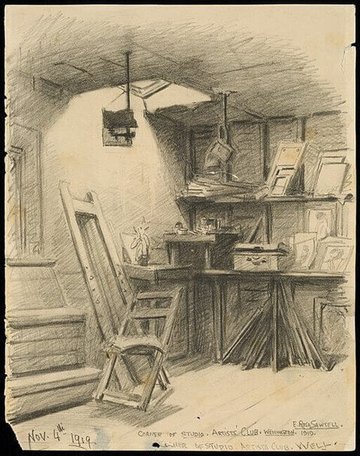
In it was an iron cot, a washstand and a chair. A shelf was the dresser. Its four bare walls seemed to close in upon you like the sides of a coffin. Your hand crept to your throat, you gasped, you looked up as from a well--and breathed once more. Through the glass of the little skylight you saw a square of blue infinity.
"Two dollars, suh," Clara would say in her half-contemptuous, half- Tuskegeenial tones.
One day Miss Leeson came hunting for a room. She carried a typewriter made to be lugged around by a much larger lady. She was a very little girl, with eyes and hair that had kept on growing after she had stopped and that always looked as if they were saying: "Goodness me ! Why didn't you keep up with us?"
Mrs. Parker showed her the double parlours. "In this closet," she said, "one could keep a skeleton or anaesthetic or coal "
"But I am neither a doctor nor a dentist," said Miss Leeson, with a shiver.
Mrs. Parker gave her the incredulous, pitying, sneering, icy stare that she kept for those who failed to qualify as doctors or dentists, and led the way to the second floor back.
"Eight dollars?" said Miss Leeson. "Dear me! I'm not Hetty if I do look green. I'm just a poor little working girl. Show me something higher and lower."
Mr. Skidder jumped and strewed the floor with cigarette stubs at the rap on his door.
"Excuse me, Mr. Skidder," said Mrs. Parker, with her demon's smile at his pale looks. "I didn't know you were in. I asked the lady to have a look at your lambrequins."
"They're too lovely for anything," said Miss Leeson, smiling in exactly the way the angels do.
After they had gone Mr. Skidder got very busy erasing the tall, black-haired heroine from his latest (unproduced) play and inserting a small, roguish one with heavy, bright hair and vivacious features.
"Anna Held'll jump at it," said Mr. Skidder to himself, putting his feet up against the lambrequins and disappearing in a cloud of smoke like an aerial cuttlefish.
Presently the tocsin call of "Clara!" sounded to the world the state of Miss Leeson's purse. A dark goblin seized her, mounted a Stygian stairway, thrust her into a vault with a glimmer of light in its top and muttered the menacing and cabalistic words "Two dollars!"
"I'll take it!" sighed Miss Leeson, sinking down upon the squeaky iron bed.
Every day Miss Leeson went out to work. At night she brought home papers with handwriting on them and made copies with her typewriter. Sometimes she had no work at night, and then she would sit on the steps of the high stoop with the other roomers. Miss Leeson was not intended for a sky-light room when the plans were drawn for her creation. She was gay-hearted and full of tender, whimsical fancies. Once she let Mr. Skidder read to her three acts of his great (unpublished) comedy, "It's No Kid; or, The Heir of the Subway."
There was rejoicing among the gentlemen roomers whenever Miss Leeson had time to sit on the steps for an hour or two. But Miss Longnecker, the tall blonde who taught in a public school and said, "Well, really!" to everything you said, sat on the top step and sniffed. And Miss Dorn, who shot at the moving ducks at Coney every Sunday and worked in a department store, sat on the bottom step and sniffed. Miss Leeson sat on the middle step and the men would quickly group around her.
Especially Mr. Skidder, who had cast her in his mind for the star part in a private, romantic (unspoken) drama in real life. And especially Mr. Hoover, who was forty-five, fat, flush and foolish. And especially very young Mr. Evans, who set up a hollow cough to induce her to ask him to leave off cigarettes. The men voted her "the funniest and jolliest ever," but the sniffs on the top step and the lower step were implacable.
* * * * * *
I pray you let the drama halt while Chorus stalks to the footlights and drops an epicedian tear upon the fatness of Mr. Hoover. Tune the pipes to the tragedy of tallow, the bane of bulk, the calamity of corpulence. Tried out, Falstaff might have rendered more romance to the ton than would have Romeo's rickety ribs to the ounce. A lover may sigh, but he must not puff. To the train of Momus are the fat men remanded. In vain beats the faithfullest heart above a 52-inch belt. Avaunt, Hoover! Hoover, forty-five, flush and foolish, might carry off Helen herself; Hoover, forty-five, flush, foolish and fat is meat for perdition. There was never a chance for you, Hoover.
As Mrs. Parker's roomers sat thus one summer's evening, Miss Leeson looked up into the firmament and cried with her little gay laugh:
"Why, there's Billy Jackson! I can see him from down here, too."
All looked up--some at the windows of skyscrapers, some casting about for an airship, Jackson-guided.
"It's that star," explained Miss Leeson, pointing with a tiny finger. "Not the big one that twinkles--the steady blue one near it. I can see it every night through my skylight. I named it Billy Jackson."
"Well, really!" said Miss Longnecker. "I didn't know you were an astronomer, Miss Leeson."
"Oh, yes," said the small star gazer, "I know as much as any of them about the style of sleeves they're going to wear next fall in Mars."
"Well, really!" said Miss Longnecker. "The star you refer to is Gamma, of the constellation Cassiopeia. It is nearly of the second magnitude, and its meridian passage is--"
"Oh," said the very young Mr. Evans, "I think Billy Jackson is a much better name for it."
"Same here," said Mr. Hoover, loudly breathing defiance to Miss Longnecker. "I think Miss Leeson has just as much right to name stars as any of those old astrologers had."
"Well, really!" said Miss Longnecker.
"I wonder whether it's a shooting star," remarked Miss Dorn. "I hit nine ducks and a rabbit out of ten in the gallery at Coney Sunday."
"He doesn't show up very well from down here," said Miss Leeson. "You ought to see him from my room. You know you can see stars even in the daytime from the bottom of a well. At night my room is like the shaft of a coal mine, and it makes Billy Jackson look like the big diamond pin that Night fastens her kimono with."
There came a time after that when Miss Leeson brought no formidable papers home to copy. And when she went out in the morning, instead of working, she went from office to office and let her heart melt away in the drip of cold refusals transmitted through insolent office boys. This went on.
There came an evening when she wearily climbed Mrs. Parker's stoop at the hour when she always returned from her dinner at the restaurant. But she had had no dinner.
As she stepped into the hall Mr. Hoover met her and seized his chance. He asked her to marry him, and his fatness hovered above her like an avalanche. She dodged, and caught the balustrade. He tried for her hand, and she raised it and smote him weakly in the face. Step by step she went up, dragging herself by the railing. She passed Mr. Skidder's door as he was red-inking a stage direction for Myrtle Delorme (Miss Leeson) in his (unaccepted) comedy, to "pirouette across stage from L to the side of the Count." Up the carpeted ladder she crawled at last and opened the door of the skylight room.
She was too weak to light the lamp or to undress. She fell upon the iron cot, her fragile body scarcely hollowing the worn springs. And in that Erebus of the skylight room, she slowly raised her heavy eyelids, and smiled.
For Billy Jackson was shining down on her, calm and bright and constant through the skylight. There was no world about her. She was sunk in a pit of blackness, with but that small square of pallid light framing the star that she had so whimsically and oh, so ineffectually named. Miss Longnecker must be right; it was Gamma, of the constellation Cassiopeia, and not Billy Jackson. And yet she could not let it be Gamma.
As she lay on her back she tried twice to raise her arm. The third time she got two thin fingers to her lips and blew a kiss out of the black pit to Billy Jackson. Her arm fell back limply.
"Good-bye, Billy," she murmured faintly. "You're millions of miles away and you won't even twinkle once. But you kept where I could see you most of the time up there when there wasn't anything else but darkness to look at, didn't you? . . . Millions of miles. . . . Good-bye, Billy Jackson."
Clara, the coloured maid, found the door locked at 10 the next day, and they forced it open. Vinegar, and the slapping of wrists and burnt feathers proving of no avail, some one ran to 'phone for an ambulance.
In due time it backed up to the door with much gong-clanging, and the capable young medico, in his white linen coat, ready, active, confident, with his smooth face half debonair, half grim, danced up the steps.
"Ambulance call to 49," he said briefly. "What's the trouble?"
"Oh, yes, doctor," sniffed Mrs. Parker, as though her trouble that there should be trouble in the house was the greater. "I can't think what can be the matter with her. Nothing we could do would bring her to. It's a young woman, a Miss Elsie--yes, a Miss Elsie Leeson. Never before in my house--"
"What room?" cried the doctor in a terrible voice, to which Mrs. Parker was a stranger.
"The skylight room. It--
Evidently the ambulance doctor was familiar with the location of skylight rooms. He was gone up the stairs, four at a time. Mrs. Parker followed slowly, as her dignity demanded.
On the first landing she met him coming back bearing the astronomer in his arms. He stopped and let loose the practised scalpel of his tongue, not loudly. Gradually Mrs. Parker crumpled as a stiff garment that slips down from a nail. Ever afterward there remained crumples in her mind and body. Sometimes her curious roomers would ask her what the doctor said to her.
"Let that be," she would answer. "If I can get forgiveness for having heard it I will be satisfied."
The ambulance physician strode with his burden through the pack of hounds that follow the curiosity chase, and even they fell back along the sidewalk abashed, for his face was that of one who bears his own dead.
They noticed that he did not lay down upon the bed prepared for it in the ambulance the form that he carried, and all that he said was: "Drive like h**l, Wilson," to the driver.
That is all. Is it a story? In the next morning's paper I saw a little news item, and the last sentence of it may help you (as it helped me) to weld the incidents together.
It recounted the reception into Bellevue Hospital of a young woman who had been removed from No. 49 East -- street, suffering from debility induced by starvation. It concluded with these words:
"Dr. William Jackson, the ambulance physician who attended the case, says the patient will recover."
Frequently Asked Questions about The Skylight Room
What is "The Skylight Room" by O. Henry about?
"The Skylight Room" tells the story of Miss Elsie Leeson, a young typist in New York City who rents the cheapest room in Mrs. Parker's boarding house -- a tiny 7-by-8-foot room at the top of the building with only a skylight overhead. Through that skylight, she can see a single star she names Billy Jackson. When she loses her work and slowly starves, the star remains her only comfort. In a classic twist, the ambulance doctor who saves her life turns out to be named Dr. William Jackson.
What are the main themes of "The Skylight Room"?
The story explores several interconnected themes:
Hope and resilience -- Miss Leeson maintains her optimism and cheerful spirit even as her circumstances deteriorate. Poverty and class -- vividly depicts the financial struggles of working-class New Yorkers, from the hierarchy of rooms in the boarding house to Elsie's inability to afford both rent and food. Human connection -- the star Billy Jackson becomes a surrogate companion for Elsie in her isolation. Fate and coincidence -- the twist ending suggests a kind of cosmic providence linking the named star to the doctor who saves her.
Who is Miss Leeson in "The Skylight Room"?
Miss Elsie Leeson is the protagonist of the story. She is a young, petite typist who earns her living by copying handwritten documents. describes her as having "eyes and hair that had kept on growing after she had stopped" and a personality that is "gay-hearted and full of tender, whimsical fancies." Despite her poverty, she charms the other boarders with her wit and warmth. She is contrasted with the snobbish Miss Longnecker and the competitive Miss Dorn, who resent the attention she receives.
What does the star Billy Jackson symbolize in the story?
The star Miss Leeson names Billy Jackson (actually Gamma Cassiopeiae, as Miss Longnecker pedantically points out) is a rich symbol operating on multiple levels. It represents hope and beauty in the midst of deprivation -- the one beautiful thing visible from her coffin-like room. It also symbolizes companionship, serving as Elsie's constant friend when she has no one else. Most importantly, the star is a symbol of Providence or fate, since the name she gives it -- Billy Jackson -- turns out to be the name of the doctor who rescues her from starvation.
What is the surprise ending of "The Skylight Room"?
In the classic twist ending, after Miss Leeson collapses from starvation and is discovered unconscious in her room, an ambulance is called. The young doctor who responds rushes upstairs, recognizes something deeply personal about the patient, and carries her out with fierce urgency. The final lines reveal through a newspaper item that "Dr. William Jackson, the ambulance physician who attended the case, says the patient will recover." The star Elsie whimsically named Billy Jackson shares its name with the very man who saves her life.
What literary devices does O. Henry use in "The Skylight Room"?
employs a variety of literary devices throughout the story. Simile appears frequently, as when the skylight room's walls "close in upon you like the sides of a coffin" and Mr. Hoover's fatness hovers "like an avalanche." Symbolism is central -- the star and skylight represent hope, while the descending floors of the boarding house symbolize social hierarchy. Irony drives the twist ending, and the author uses a distinctive second-person narration in the opening to place the reader directly in the story. O. Henry also breaks the fourth wall with an authorial aside about Mr. Hoover, adding a theatrical quality.
What is the setting of "The Skylight Room"?
The story is set in a New York City boarding house at the turn of the twentieth century, a common setting in 's fiction. Mrs. Parker's boarding house is structured hierarchically: the grand double parlors on the ground floor for doctors and dentists, the respectable second-floor rooms, Mr. Skidder's third-floor hall room, and finally the tiny skylight room at the very top, accessible only by a "carpeted ladder." This vertical layout mirrors the social and economic stratification of the boarders. The story is part of The Four Million (1906), O. Henry's tribute to ordinary New Yorkers.
What role does Mrs. Parker play in the story?
Mrs. Parker is the boarding house landlady who functions as both a comic figure and a symbol of social snobbery. She idolizes her wealthier tenants -- especially doctors and dentists -- and treats poorer room-seekers with open contempt. Her tour of the boarding house, descending from the grand parlors to the skylight room, serves as a brilliant satirical device. At the story's climax, the ambulance doctor's furious words to her leave her permanently "crumpled" in mind and body, suggesting she bears some moral responsibility for Elsie's suffering.
Why does Miss Leeson collapse in the story?
Miss Leeson collapses from starvation. After a period where she can no longer find typing work, she goes from office to office receiving "cold refusals transmitted through insolent office boys." subtly reveals her worsening condition: she returns to the boarding house "at the hour when she always returned from her dinner at the restaurant" but "she had had no dinner." Unable to afford food, she grows weaker until she can barely climb the stairs. She collapses on her iron cot, gazing up at Billy Jackson one last time before losing consciousness.
How does "The Skylight Room" reflect O. Henry's writing style?
"The Skylight Room" showcases several hallmarks of 's distinctive style. His signature twist ending connects the star's name to the rescuing doctor. His witty, elaborate prose is on full display -- from the satirical tour of the boarding house to the theatrical aside about Mr. Hoover's doomed romantic prospects. The story reflects his deep sympathy for ordinary New Yorkers struggling to survive in the city. O. Henry also mixes humor with pathos throughout, shifting from lighthearted comedy in the first half to genuine emotional weight in the second, a technique that defines much of his best work.
Save stories, build your reading list, and access all study tools — completely free.
Save The Skylight Room to your library — it's free!Need help with The Skylight Room?
Study tools to help with homework, prepare for quizzes, and deepen your understanding.
Flashcards →