While the Auto Waits
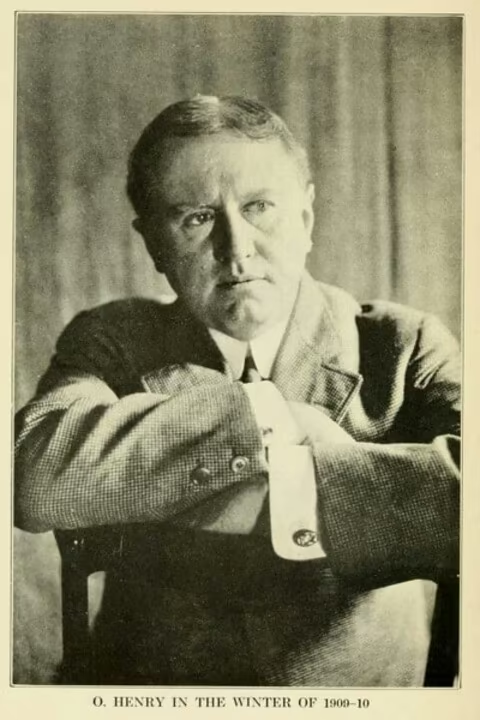
by O. Henry
While the Auto Waits is a sly park-bench encounter between a young man and a mysterious woman who claims to be weary of her life of wealth and privilege. O. Henry's signature twist reveals that neither is quite who they pretend to be. "It is the monotony of it that palls. Drives, dinners, theatres, balls, suppers, with the gilding of superfluous wealth over it all."
Promptly at the beginning of twilight, came again to that quiet corner of that quiet, small park the girl in gray. She sat upon a bench and read a book, for there was yet to come a half hour in which print could be accomplished.
To repeat: Her dress was gray, and plain enough to mask its impeccancy of style and fit. A large- meshed veil imprisoned her turban hat and a face that shone through it with a calm and unconscious beauty. She had come there at the same hour on the day previous, and on the day before that; and there was one who knew it.
The young man who knew it hovered near, relying upon burnt sacrifices to the great joss, Luck. His piety was rewarded, for, in turning a page, her book slipped from her fingers and bounded from the bench a full yard away.
The young man pounced upon it with instant avid- ity, returning it to its owner with that air that seems to flourish in parks and public places - a compound of gallantry and hope, tempered with respect for the policeman on the beat. In a pleasant voice, be risked an inconsequent remark upon the weather that in- troductory topic responsible for so much of the world's unhappiness-and stood poised for a mo- ment, awaiting his fate.
The girl looked him over leisurely; at his ordinary, neat dress and his features distinguished by nothing particular in the way of expression.
"You may sit down, if you like," she said, in a full, deliberate contralto. "Really, I would like to have you do so. The light is too bad for reading. I would prefer to talk."
The vassal of Luck slid upon the seat by her side with complaisance.
"Do you know," be said, speaking the formula with which park chairmen open their meetings, "that you are quite the stunningest girl I have seen in a long time? I had my eye on you yesterday. Didn't know somebody was bowled over by those pretty lamps of yours, did you, honeysuckle?"
"Whoever you are," said the girl, in icy tones, "you must remember that I am a lady. I will excuse the remark you have just made because the mistake was, doubtless, not an unnatural one -- in your circle. I asked you to sit down; if the invitation must con- stitute me your honeysuckle, consider it with- drawn."
"I earnestly beg your pardon," pleaded the young ran. His expression of satisfaction had changed to one of penitence and humility. It was my fault, you know -I mean, there are girls in parks, you know - that is, of course, you don't know, but -- "
"Abandon the subject, if you please. Of course I know. Now, tell me about these people passing and crowding, each way, along these paths. Where are they going? Why do they hurry so? Are they happy?"
The young man had promptly abandoned his air of coquetry. His cue was now for a waiting part; he could not guess the role be would be expected to play.
"It is interesting to watch them," he replied, pos- tulating her mood. "It is the wonderful drama of life. Some are going to supper and some to -- er -- other places. One wonders what their histories are."
"I do not," said the girl; "I am not so inquisi- tive. I come here to sit because here, only, can I be tear the great, common, throbbing heart of hu- manity. My part in life is cast where its beats are never felt. Can you surmise why I spoke to you, Mr. -- ?"
"Parkenstacker," supplied the young man. Then be looked eager and hopeful.
"No," said the girl, holding up a slender finger, and smiling slightly. "You would recognize it im- mediately. It is impossible to keep one's name out of print. Or even one's portrait. This veil and this hat of my maid furnish me with an incog. You should have seen the chauffeur stare at it when he thought I did not see. Candidly, there are five or six names that belong in the holy of holies, and mine, by the accident of birth, is one of them. I spoke to you, Mr. Stackenpot -- "
"Parkenstacker," corrected the young man, mod- estly.
" -- Mr. Parkenstacker, because I wanted to talk, for once, with a natural man -- one unspoiled by the despicable gloss of wealth and supposed social su- periority. Oh! you do not know how weary I am of it -- money, money, money! And of the men who surround me, dancing like little marionettes all cut by the same pattern. I am sick of pleasure, of jewels, of travel, of society, of luxuries of all kinds."
"I always had an idea," ventured the young man, hesitatingly, "that money must be a pretty good thing."
"A competence is to be desired. But when you leave so many millions that -- !" She concluded the sentence with a gesture of despair. "It is the mo- otony of it" she continued, "that palls. Drives, dinners, theatres, balls, suppers, with the gilding of superfluous wealth over it all. Sometimes the very tinkle of the ice in my champagne glass nearly drives me mad."
Mr. Parkenstacker looked ingenuously interested.
"I have always liked," he said, "to read and hear about the ways of wealthy and fashionable folks. I suppose I am a bit of a snob. But I like to have my information accurate. Now, I had formed the opin- ion that champagne is cooled in the bottle and not by placing ice in the glass."
The girl gave a musical laugh of genuine amuse- ment.
"You should know," she explained, in an indul- gent tone, "that we of the non-useful class depend for our amusement upon departure from precedent. Just now it is a fad to put ice in champagne. The idea was originated by a visiting Prince of Tartary while dining at the Waldorf. It will soon give way to some other whim. Just as at a dinner party this week on Madison Avenue a green kid glove was laid by the plate of each guest to be put on and used while eating olives."
"I see," admitted the young man, humbly.
"These special diversions of the inner circle do not become familiar to the common public."
"Sometimes," continued the girl, acknowledging his confession of error by a slight bow, "I have thought that if I ever should love a man it would be one of lowly station. One who is a worker and not a drone. But, doubtless, the claims of caste and wealth will prove stronger than my inclination. Just now I am besieged by two. One is a Grand Duke of a German principality. I think he has, or has bad, a wife, somewhere, driven mad by his intemperance and cruelty. The other is an English Marquis, so cold and mercenary that I even prefer the diabolism of the Duke. What is it that impels me to tell you these things, Mr. Packenstacker?
"Parkenstacker," breathed the young man. "In- deed, you cannot know how much I appreciate your confidences."
The girl contemplated him with the calm, imper- sonal regard that befitted the difference in their sta- tions.
"What is your line of business, Mr. Parken- stacker?" she asked.
"A very humble one. But I hope to rise in the world. Were you really in earnest when you said that you could love a man of lowly position?"
"Indeed I was. But I said 'might.' There is the Grand Duke and the Marquis, you know. Yes; no calling could be too humble were the man what I would wish him to be."
"I work," declared Mr. Parkenstacker, "in a res- taurant."
The girl shrank slightly.
"Not as a waiter?" she said, a little imploringly. "Labor is noble, but personal attendance, you know -- valets and -- "
"I am not a waiter. I am cashier in" -- on the street they faced that bounded the opposite side of the park was the brilliant electric sign "RESTAU- RANT" -- "I am cashier in that restaurant you am there."
The girl consulted a tiny watch set in a bracelet of rich design upon her left wrist, and rose, hurriedly. She thrust her book into a glittering reticule sus- pended from her waist, for which, however, the book was too large.
"Why are you not at work?" she asked.
"I am on the night turn," said the young man; it is yet an hour before my period begins. May I not hope to see you again?"
"I do not know. Perhaps - but the whim may not seize me again. I must go quickly now. There is a dinner, and a box at the play -- and, oh! the same old round. Perhaps you noticed an automobile at the upper corner of the park as you came. One with a white body
"And red running gear?" asked the young man, knitting his brows reflectively.
"Yes. I always come in that. Pierre waits for me there. He supposes me to be shopping in the de- partment store across the square. Conceive of the bondage of the life wherein we must deceive even our chauffeurs. Good-night."
"But it is dark now," said Mr. Parkenstacker, "and the park is full of rude men. May I not walk -- "
"If you have the slightest regard for my wishes," said the girl, firmly, "you will remain at this bench for ten minutes after I have left. I do not mean to accuse you, but you are probably aware that autos generally bear the monogram of their owner. Again, good-night"
Swift and stately she moved away through the dusk. The young man watched her graceful form as she reached the pavement at the park's edge, and turned up along it toward the corner where stood the automobile. Then he treacherously and unhesitat- ingly began to dodge and skim among the park trees and shrubbery in a course parallel to her route, keep- ing her well in sight
When she reached the corner she turned her head to glance at the motor car, and then passed it, con tinuing on across the street. Sheltered behind a con- venient standing cab, the young man followed her movements closely with his eyes. Passing down the sidewalk of the street opposite the park, she entered the restaurant with the blazing sign. The place was one of those frankly glaring establishments, all white, paint and glass, where one may dine cheaply and conspicuously. The girl penetrated the restaurant to some retreat at its rear, whence she quickly emerged without her bat and veil.
The cashier's desk was well to the front. A red- head girl an the stool climbed down, glancing pointedly at the clock as she did so. The girl in gray mounted in her place.
The young man thrust his hands into his pockets and walked slowly back along the sidewalk. At the corner his foot struck a small, paper-covered volume lying there, sending it sliding to the edge of the turf. By its picturesque cover he recognized it as the book the girl had been reading. He picked it up carelessly, and saw that its title was "New Arabian Nights," the author being of the name of Stevenson. He dropped it again upon the grass, and lounged, irresolute, for a minute. Then he stepped into the automobile, reclined upon the cushions, and said two words to the chauffeur:
"Club, Henri."
Frequently Asked Questions about While the Auto Waits
What is "While the Auto Waits" by O. Henry about?
"While the Auto Waits" is a short story about a young woman in gray who sits on a park bench and strikes up a conversation with a young man named Mr. Parkenstacker. She claims to be fabulously wealthy, exhausted by a life of champagne dinners and European suitors, while he humbly says he works as a cashier in a nearby restaurant. The twist ending reveals that both characters have been lying: the woman is actually the restaurant cashier, and the man is the true owner of the waiting automobile. published the story in his 1908 collection The Voice of the City.
What is the twist ending in "While the Auto Waits"?
The story contains a classic double twist ending. After the woman leaves, Mr. Parkenstacker follows her and watches her walk past the white automobile she claimed was hers. She enters the restaurant across the street and takes her place at the cashier's desk -- revealing she is actually a working-class restaurant cashier who invented her wealthy persona. Then, in a second reversal, the young man steps into the automobile, reclines on its cushions, and tells the chauffeur "Club, Henri" -- revealing that he is the wealthy one, and his claim of being a humble cashier was equally false.
What are the main themes of "While the Auto Waits"?
The central theme is appearance versus reality -- both characters construct elaborate false identities, each pretending to belong to the other's social class. The story also explores social class anxiety, showing how deeply class distinctions shape people's behavior and self-presentation. A third major theme is missed human connection: because both characters are dishonest, they fail to discover that they might genuinely complement each other. uses their mutual deception to satirize how the desire to seem impressive destroys the possibility of authentic relationships.
Who is Mr. Parkenstacker in "While the Auto Waits"?
Mr. Parkenstacker is the young man who approaches the woman in gray on the park bench. He presents himself as humble and working-class, claiming to be a cashier at the restaurant across the street. He appears deferential and genuinely interested in the woman's tales of wealth. However, the ending reveals that Parkenstacker is actually a man of considerable wealth -- the white automobile with a chauffeur named Henri belongs to him. His name is repeatedly mangled by the woman ("Stackenpot," "Packenstacker"), a comic detail that underscores her self-absorption and disinterest in who he truly is.
What type of irony does O. Henry use in "While the Auto Waits"?
employs situational irony as the primary literary device: the woman pretends to be rich while actually being a cashier, and the man pretends to be a cashier while actually being rich. This creates a perfectly symmetrical reversal that neither character recognizes. There is also dramatic irony in the final scene, as the reader discovers Parkenstacker's true identity while the woman remains oblivious. The title itself is ironic -- the "auto" waits not for the woman who claims it, but for the man who pretended he had no connection to it. O. Henry layers these ironies to deliver his trademark surprise ending.
When was "While the Auto Waits" written and published?
"While the Auto Waits" was published in 1908 as part of 's short story collection The Voice of the City, which contained 25 stories set in New York City. The story reflects the early twentieth-century fascination with automobiles as status symbols -- in 1908, cars were luxuries that only the wealthy could afford, making the "auto" a powerful marker of social class. The collection was published during the most prolific period of O. Henry's career, when he was producing a story nearly every week for the New York World newspaper.
What is the significance of the book "New Arabian Nights" in the story?
The woman is reading New Arabian Nights by Robert Louis Stevenson, and this detail is far from accidental. Stevenson's book features characters who adopt disguises and false identities -- mirroring exactly what both characters in 's story are doing. When Parkenstacker finds the book dropped on the sidewalk after discovering the woman's deception, he recognizes it and drops it back on the grass, a gesture that suggests he sees through the connection between the book's themes and her performance. The literary allusion serves as a subtle clue that the woman's elaborate story has been a fiction all along.
What is the setting of "While the Auto Waits"?
The story is set in a small, quiet park in New York City at twilight, with the surrounding streets visible from the bench where the two characters sit. The park setting is essential to the story's plot: it is a neutral, democratic space where people of all social classes can mingle, making the encounter between the two strangers plausible. Across the street from the park sits a brightly lit restaurant -- described as "one of those frankly glaring establishments, all white paint and glass" -- and at the upper corner of the park stands the white automobile with red running gear. These two landmarks become the instruments of the double revelation in the story's final paragraphs.
Why does the woman lie about being wealthy in "While the Auto Waits"?
The woman's fabrication reveals a deep dissatisfaction with her own social position and a longing to be seen as someone more important. She constructs an elaborate persona complete with a chauffeur named Pierre, European suitors (a German Grand Duke and an English Marquis), and fashionable eccentricities like putting ice in champagne. Her lies suggest she has internalized the belief that wealth equals worth. Ironically, she claims to be weary of the very lifestyle she covets, using reverse psychology to make her fictional wealth seem even more convincing. implies that her pretense is not malicious but a poignant expression of class aspiration in early twentieth-century America.
What is the moral or message of "While the Auto Waits"?
The story's central message is that pretending to be someone you are not leads to missed opportunities for genuine connection. Both characters are attracted to each other, and both claim to desire authenticity -- the woman says she longs for a "natural man" unspoiled by wealth, while Parkenstacker expresses humble contentment. Yet both are performing roles. Had either been truthful, they might have formed a real relationship. also delivers a broader social critique: class anxiety distorts human behavior, causing people to hide behind false identities rather than risk being judged for who they actually are. The symmetry of their deceptions makes the moral unmistakable -- dishonesty costs them both.
Save stories, build your reading list, and access all study tools — completely free.
Save While the Auto Waits to your library — it's free!Need help with While the Auto Waits?
Study tools to help with homework, prepare for quizzes, and deepen your understanding.
Flashcards →