The Outlaws
by Richmal Crompton
The Outlaws was published in Crompton's short story series, Just-William (1922). He's not much of a babysitter, that's for sure. illustrated by Thomas Henry.
It was a half-holiday and William was in his bedroom making careful preparations for the afternoon. On the mantel-piece stood in readiness half a cake (the result of a successful raid on the larder) and a bottle of licorice water. This beverage was made by shaking up a piece of licorice in water. It was much patronised by the band of Outlaws to which William belonged and which met secretly every half-holiday in a disused barn about a quarter of a mile from William’s house.
So far the Outlaws had limited their activities to wrestling matches, adventure seeking, and culinary operations. The week before, they had cooked two sausages which William had taken from the larder on cook’s night out and had conveyed to the barn beneath his shirt and next his skin. Perhaps “cooked” is too euphemistic a term. To be quite accurate, they had held the sausages over a smoking fire till completely blackened, and then consumed the charred remains with the utmost relish.
William put the bottle of licorice water in one pocket and the half cake in another and was preparing to leave the house in his usual stealthy fashion—through the bathroom window, down the scullery roof, and down the water-pipe hand over hand to the back garden. Even when unencumbered by the presence of a purloined half cake, William infinitely preferred this mode of exit to the simpler one of walking out of the front-door. As he came out on to the landing, however, he heard the sound of the opening and shutting of the hall door and of exuberant greetings in the hall.
“Oh! I’m so glad you’ve come, dear. And is this the baby! The duck! Well, den, how’s ’oo, den? Go—o—oo.”
This was William’s mother.
“Oh, crumbs!” said William and retreated hastily. He sat down on his bed to wait till the coast was clear. Soon came the sound of footsteps ascending the stairs.
“Oh, William,” said his mother, as she entered his room, “Mrs. Butler’s come with her baby to spend the afternoon, and we’d arranged to go out till tea-time with the baby, but she’s got such a headache, I’m insisting on her lying down for the afternoon in the drawing-room. But she’s so worried about the baby not getting out this nice afternoon.”
“Oh!” said William, without interest.
“Well, cook’s out and Emma has to get the tea and answer the door, and Ethel’s away, and I told Mrs. Butler I was sure you wouldn’t mind taking the baby out for a bit in the perambulator!”
William stared at her, speechless. The Medusa’s classic expression of horror was as nothing to William’s at that moment. Then he moistened his lips and spoke in a hoarse voice.
“Me?” he said. “Me? Me take a baby out in a pram?”
“Well, dear,” said his mother deprecatingly, “I know it’s your half holiday, but you’d be out of doors getting the fresh air, which is the great thing. It’s a nice baby and a nice pram and not heavy to push, and Mrs. Butler would be so grateful to you.”
“Yes, I should think she’d be that,” said William bitterly. “She’d have a right to be that if I took the baby out in a pram.”
“Now, William, I’m sure you’d like to help, and I’m sure you wouldn’t like your father to hear that you wouldn’t even do a little thing like that for poor Mrs. Butler. And she’s got such a headache.”
“A little thing like that!” repeated William out of the bitterness of his soul.
But the Fates were closing round him. He was aware that he would know no peace till he had done the horrible thing demanded of him. Sorrowfully and reluctantly he bowed to the inevitable.
“All right,” he muttered, “I’ll be down in a minute.”
He heard them fussing over the baby in the hall. Then he heard his elder brother’s voice.
“You surely don’t mean to say, mother,” Robert was saying with the crushing superiority of eighteen, “that you’re going to trust that child to—William.”
“Well,” said William’s mother, “someone has to take him out. It’s such a lovely afternoon. I’m sure it’s very kind of William, on his half-holiday, too. And she’s got such a headache.”
“Well, of course,” said Robert in the voice of one who washes his hands of all further responsibility, “you know William as well as I do.”
“Oh, dear!” sighed William’s mother. “And everything so nicely settled, Robert, and you must come and find fault with it all. If you don’t want William to take him out, will you take him out yourself?”
Robert retreated hastily to the dining-room and continued the conversation from a distance.
“I don’t want to take him out myself—thanks very much, all the same! All I say is—you know William as well as I do. I’m not finding fault with anything. I simply am stating a fact.”
Then William came downstairs.
“Here he is, dear, all ready for you, and you needn’t go far away—just up and down the road, if you like, but stay out till tea-time. He’s a dear little baby, isn’t he? And isn’t it a nice Willy-Billy den, to take it out a nice ta-ta, while it’s mummy goes bye-byes, den?”
William blushed for pure shame.
He pushed the pram down to the end of the road and round the corner. In comparison with William’s feelings, the feelings of some of the early martyrs must have been pure bliss. A nice way for an Outlaw to spend the afternoon! He dreaded to meet any of his brother-outlaws, yet, irresistibly and as a magnet, their meeting-place attracted him. He wheeled the pram off the road and down the country lane towards the field which held their sacred barn. He stopped at the stile that led into the field and gazed wistfully across to the barn in the distance. The infant sat and sucked its thumb and stared at him. Finally it began to converse.
“Blab—blab—blab—blab—blub—blub—blub!”
“Oh, you shut up!” said William crushingly.
Annoyed at the prolonged halt, it seized its pram cover, pulled it off its hooks, and threw it into the road. While William was picking it up, it threw the pillow on to his head. Then it chuckled. William began to conceive an active dislike of it. Suddenly the Great Idea came to him. His face cleared. He took a piece of string from his pocket and tied the pram carefully to the railings. Then, lifting the baby cautiously and gingerly out, he climbed the stile with it and set off across the fields towards the barn. He held the baby to his chest with both arms clasped tightly round its waist. Its feet dangled in the air. It occupied the time by kicking William in the stomach, pulling his hair, and putting its fingers in his eyes.
“It beats me,” panted William to himself, “what people see in babies! Scratchin’ an’ kickin’ and blindin’ folks and pullin’ their hair all out!”
When he entered the barn he was greeted by a sudden silence.
“Look here!” began one outlaw in righteous indignation.
“It’s a kidnap,” said William, triumphantly. “We’ll get a ransom on it.”
They gazed at him in awed admiration. This was surely the cream of outlawry. He set the infant on the ground, where it toddled for a few steps and sat down suddenly and violently. It then stared fixedly at the tallest boy present and smiled seraphically.
“Dad—dad—dad—dad—dad!”
Douglas, the tallest boy, grinned sheepishly. “It thinks I’m its father,” he explained complacently to the company.
“Well,” said Henry, who was William’s rival for the leadership of the Outlaws, “What do we do first? That’s the question.”
“In books,” said the outlaw called Ginger, “they write a note to its people and say they want a ransom.”
“We won’t do that—not just yet,” said William hastily.
“Well, it’s not much sense holdin’ somethin’ up to ransom and not tellin’ the folks that they’ve got to pay nor nothin’, is it?” said Ginger with the final air of a man whose logic is unassailable.
“N——oo,” said William. “But——” with a gleam of hope—“who’s got a paper and pencil? I’m simply statin’ a fact. Who’s got a paper and pencil?”
No one spoke.
“Oh, yes!” went on William in triumph. “Go on! Write a note. Write a note without paper and pencil, and we’ll all watch. Huh!”
“Well,” said Ginger sulkily, “I don’t s’pose they had paper and pencils in outlaw days. They weren’t invented. They wrote on—on—on leaves or something,” he ended vaguely.
“Well, go on. Write on leaves,” said William still more triumphant. “We’re not stoppin’ you are we? I’m simply statin’ a fact. Write on leaves.”
They were interrupted by a yell of pain from Douglas. Flattered by the parental relations so promptly established by the baby, he had ventured to make its further acquaintance. With vague memories of his mother’s treatment of infants, he had inserted a finger in its mouth. The infant happened to possess four front teeth, two upper and two lower, and they closed like a vice upon Douglas’ finger. He was now examining the marks.
“Look! Right deep down! See it? Wotcher think of that! Nearly to the bone! Pretty savage baby you’ve brought along,” he said to William.
“I jolly well know that,” said William feelingly. “It’s your own fault for touching it. It’s all right if you leave it alone. Just don’t touch it, that’s all. Anyway, it’s mine, and I never said you could go fooling about with it, did I? It wouldn’t bite me, I bet!”
“Well, what about the ransom?” persisted Henry.
“Someone can go and tell its people and bring back the ransom,” suggested Ginger.
There was a short silence. Then Douglas took his injured finger from his mouth and asked pertinently:
“Who?”
“William brought it,” suggested Henry.
“Yes, so I bet I’ve done my share.”
“Well, what’s anyone else goin’ to do, I’d like to know? Go round to every house in this old place and ask if they’ve had a baby taken off them and if they’d pay a ransom for it back? That’s sense, isn’t it? You know where you got it from, don’t you, and you can go and get its ransom.”
“I can, but I’m not goin’ to,” said William finally. “I’m simply statin’ a fact. I’m not goin’ to. And if anyone says I daren’t,” (glancing round pugnaciously) “I’ll fight ’em for it.”
No one said he daren’t. The fact was too patent to need stating. Henry hastily changed the subject.
“Anyway, what have we brought for the feast?”
William produced his licorice water and half cake, Douglas two slices of raw ham and a dog biscuit, Ginger some popcorn and some cold boiled potatoes wrapped up in newspaper, Henry a cold apple dumpling and a small bottle of paraffin-oil.
“I knew the wood would be wet after the rain. It’s to make the fire burn. That’s sense, isn’t it?”
“Only one thing to cook,” said Ginger sadly, looking at the slices of ham.
“We can cook up the potatoes and the dumpling. They don’t look half enough cooked. Let’s put them on the floor here, and go out for adventures first. All different ways and back in a quarter of an hour.”
The Outlaws generally spent part of the afternoon dispersed in search of adventure. So far they had wooed the Goddess of Danger chiefly by trespassing on the ground of irascible farmers in hopes of a chase which were generally fulfilled.
They deposited their store on the ground in a corner of the barn, and with a glance at the “kidnap,” who was seated happily upon the floor engaged in chewing its hat-strings, they went out, carefully closing the door.
After a quarter of an hour Ginger and William arrived at the door simultaneously from opposite directions.
“Any luck?”
“No.”
“Same here. Let’s start the old fire going.”
They opened the door and went in. The infant was sitting on the floor among the stores, or rather among what was left of the stores. There was paraffin-oil on its hair, face, arms, frock and feet. It was drenched in paraffin-oil. The empty bottle and its hat lay by its side. Mingled with the paraffin-oil all over its person was cold boiled potato. It was holding the apple-dumpling in its hand.
“Ball!” it announced ecstatically from behind its mask of potato and paraffin-oil.
They stood in silence for a minute. Then, “Who’s going to make that fire burn now?” said Ginger, glaring at the empty bottle.
“Yes,” said William slowly, “an’ who’s goin’ to take that baby home? I’m simply statin’ a fact. Who’s goin’ to take that baby home?”
There was no doubt that when William condescended to adopt a phrase from any of his family’s vocabularies, he considerably overworked it.
“Well, it did it itself. It’s no one else’s fault, is it?”
“No, it’s not,” said William. “But that’s the sort of thing folks never see. Anyway, I’m goin’ to wash its face.”
“What with?”
William took out his grimy handkerchief and advanced upon his prey. His bottle of licorice water was lying untouched in the corner. He took out the cork.
“Goin’ to wash it in that dirty stuff?”
“It’s made of water—clean water—I made it myself, so I bet I ought to know, oughtn’t I? That’s what folks wash in, isn’t it?—clean water?”
“Yes,” bitterly, “and what are we goin’ to drink, I’d like to know? You’d think that baby had got enough of our stuff—our potatoes and our apple-dumpling, an’ our oil—without you goin’ an’ givin’ it our licorice water as well.”
William was passing his handkerchief, moistened with licorice water, over the surface of the baby’s face. The baby had caught a corner of it firmly between its teeth and refused to release it.
“If you’d got to take this baby home like this,” he said, “you wouldn’t be thinking much about drinking licorice water. I’m simply statin’——”
“Oh, shut up saying that!” said Ginger in sudden exasperation. “I’m sick of it.”
At that moment the door was flung open and in walked slowly a large cow closely followed by Henry and Douglas.
Henry’s face was one triumphant beam. He felt that his prestige, eclipsed by William’s kidnapping coup, was restored.
“I’ve brought a cow,” he announced, “fetched it all the way from Farmer Litton’s field—five fields off, too, an’ it took some fetching, too.”
“Well, what for?” said William after a moment’s silence.
Henry gave a superior laugh.
“What for! You’ve not read much about outlaws, I guess. They always drove in cattle from the surroundin’ districks.”
“Well, what for?” said William again, giving a tug at his handkerchief, which the infant still refused to release.
“Well—er—well—to kill an’ roast, I suppose,” said Henry lamely.
“Well, go on,” said William. “Kill it an’ roast it. We’re not stoppin’ you, are we? Kill it an’ roast it—an’ get hung for murder. I s’pose it’s murder to kill cows same as it is to kill people—’cept for butchers.”
The cow advanced slowly and deprecatingly towards the “kidnap,” who promptly dropped the handkerchief and beamed with joy.
“Bow-wow!” it said excitedly.
“Anyway, let’s get on with the feast,” said Douglas.
“Feast!” echoed Ginger bitterly. “Feast! Not much feast left! That baby William brought’s used all the paraffin-oil and potatoes, and it’s squashed the apple-dumpling, and William’s washed its face in the licorice water.”
Henry gazed at it dispassionately and judicially.
“Yes—it looks like as if someone had washed it in licorice water—and as if it had used up all the oil and potatoes. It doesn’t look like as if it would fetch much ransom. You seem to have pretty well mucked it up.”
“Oh, shut up about the baby,” said William picking up his damp and now prune-coloured handkerchief. “I’m just about sick of it. Come on with the fire.”
They made a little pile of twigs in the field and began the process of lighting it.
“I hope that cow won’t hurt the ‘kidnap,’” said Douglas suddenly. “Go and see, William; it’s your kidnap.”
“Well, an’ it’s Henry’s cow, and I’m sorry for that cow if it tries playin’ tricks on that baby.”
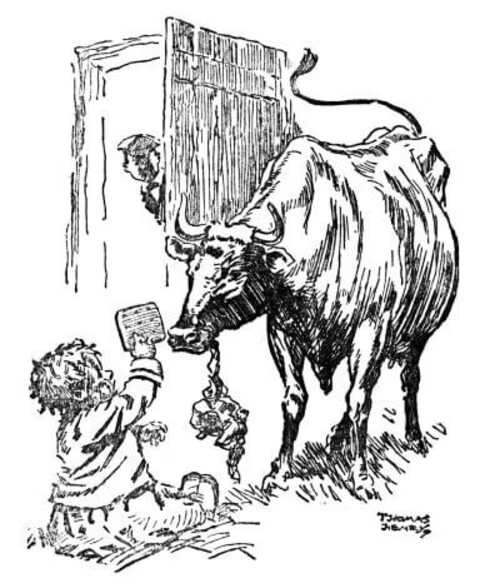
But he rose from his knees reluctantly, and threw open the barn door. The cow and the baby were still gazing admiringly at each other. From the cow’s mouth at the end of a long, sodden ribbon, hung the chewed remains of the baby’s hat. The baby was holding up the dog biscuit and crowed delightfully as the cow bent down its head and cautiously and gingerly smelt it. As William entered, the cow turned round and switched its tail against the baby’s head. At the piercing howl that followed, the whole band of outlaws entered the barn.
“What are you doing to the poor little thing?” said Douglas to William.
“It’s Henry’s cow,” said William despairingly. “It hit it. Oh, go on, shut up! Do shut up.”
The howls redoubled.
“You brought it,” said Henry accusingly, raising his voice to be heard above the baby’s fury and indignation. “Can’t you stop it? Not much sense taking babies about if you don’t know how to stop ’em crying!”
The baby was now purple in the face.
The Outlaws stood around and watched it helplessly.
“P’raps it’s hungry,” suggested Douglas.
He took up the half cake from the remains of the stores and held it out tentatively to the baby. The baby stopped crying suddenly.
“Dad—dad—dad—dad—dad,” it said tearfully.
Douglas blushed and grinned.
“Keeps on thinking I’m its father,” he said with conscious superiority. “Here, like some cake?”
The baby broke off a handful and conveyed it to its mouth.
“It’s eating it,” cried Douglas in shrill excitement. After thoroughly masticating it, however, the baby repented of its condescension and ejected the mouthful in several instalments.
William blushed for it.
“Oh, come on, let’s go and look at the fire,” he said weakly.
They left the barn and returned to the scene of the fire-lighting. The cow, still swinging the remains of the baby’s hat from its mouth, was standing with its front feet firmly planted on the remains of what had been a promising fire.
“Look!” cried William, in undisguised pleasure. “Look at Henry’s cow! Pretty nice sort of cow you’ve brought, Henry. Not much sense taking cows about if you can’t stop them puttin’ folks’ fires out.”
After a heated argument, the Outlaws turned their attention to the cow. The cow refused to be “shoo’d off.” It simply stood immovable and stared them out. Ginger approached cautiously and gave it a little push. It switched its tail into his eye and continued to munch the baby’s hat-string. Upon William’s approaching it lowered its head, and William retreated hastily. At last they set off to collect some fresh wood and light a fresh fire. Soon they were blissfully consuming two blackened slices of ham, the popcorn, and what was left of the cake.
After the “feast,” Ginger and William, as Wild Indians, attacked the barn, which was defended by Douglas and Henry. The “kidnap” crawled round inside on all fours, picking up any treasures it might come across en route and testing their effect on its palate.
Occasionally it carried on a conversation with its defenders, bringing with it a strong perfume of paraffin oil as it approached.
“Blab—blab—blab—blab—blub—blub—Dad—dad—dad—dad—dad. Go—o—o—o.”
William had insisted on a place on the attacking side.
“I couldn’t put any feelin’,” he explained, “into fightin’ for that baby.”
When they finally decided to set off homewards, William gazed hopelessly at his charge. Its appearance defies description. For many years afterwards William associated babies in his mind with paraffin-oil and potato.
“Just help me get the potato out of its hair,” he pleaded; “never mind the oil and the rest of it.”
My hat! doesn’t it smell funny!—and doesn’t it look funny—all oil and potato and bits of cake!” said Ginger.
“Oh! shut up about it,” said William irritably.
The cow followed them down to the stile and watched them sardonically as they climbed it.
“Bow-wow!” murmured the baby in affectionate farewell.
William looked wildly round for the pram, but—the pram was gone—only the piece of string dangled from the railings.
“Crumbs!” said William, “Talk about bad luck! I’m simply statin’ a fact. Talk about bad luck!”
At that minute the pram appeared, charging down the hill at full speed with a cargo of small boys. At the bottom of the hill it overturned into a ditch accompanied by its cargo. To judge from its appearance, it had passed the afternoon performing the operation.
“That’s my pram!” said William to the cargo, as it emerged, joyfully, from the ditch.
“Garn! S’ours! We found it.”
“Well, I left it there.”
“Come on! We’ll fight for it,” said Ginger, rolling up his sleeves in a businesslike manner. The other Outlaws followed his example. The pram’s cargo eyed them appraisingly.
“Oh, all right! Take your rotten old pram!” they said at last.
Douglas placed the baby in its seat and William thoughtfully put up the hood to shield his charge as far as possible from the curious gaze of the passers-by. His charge was now chewing the pram cover and talking excitedly to itself. With a “heart steeled for any fate” William turned the corner into his own road. The baby’s mother was standing at his gate.
“There you are!” she called. “I was getting quite anxious. Thank you so much, dear.”
BUT THAT IS WHAT SHE SAID BEFORE SHE SAW THE BABY!