Gunga Din
by Rudyard Kipling
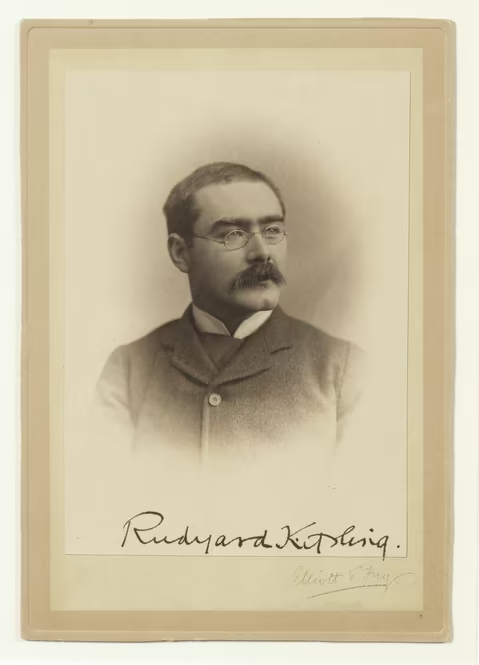
You may talk o' gin and beer
When you're quartered safe out 'ere,
An' you're sent to penny-fights an' Aldershot it;
But when it comes to slaughter
You will do your work on water,
An' you'll lick the bloomin' boots of 'im that's got it.
Now in Injia's sunny clime,
Where I used to spend my time
A-servin' of 'Er Majesty the Queen,
Of all them blackfaced crew
The finest man I knew
Was our regimental bhisti, Gunga Din.
He was "Din! Din! Din!
You limpin' lump o' brick-dust, Gunga Din!
Hi! slippery ~hitherao~!
Water, get it! ~Panee lao~! [Bring water swiftly.]
You squidgy-nosed old idol, Gunga Din."

The uniform 'e wore
Was nothin' much before,
An' rather less than 'arf o' that be'ind,
For a piece o' twisty rag
An' a goatskin water-bag
Was all the field-equipment 'e could find.
When the sweatin' troop-train lay
In a sidin' through the day,
Where the 'eat would make your bloomin' eyebrows crawl,
We shouted "Harry By!" [Mr. Atkins's equivalent for "O brother."]
Till our throats were bricky-dry,
Then we wopped 'im 'cause 'e couldn't serve us all.
It was "Din! Din! Din!
You 'eathen, where the mischief 'ave you been?
You put some ~juldee~ in it [Be quick.]
Or I'll ~marrow~ you this minute [Hit you.]
If you don't fill up my helmet, Gunga Din!"

'E would dot an' carry one
Till the longest day was done;
An' 'e didn't seem to know the use o' fear.
If we charged or broke or cut,
You could bet your bloomin' nut,
'E'd be waitin' fifty paces right flank rear.
With 'is ~mussick~ on 'is back, [Water-skin.]
'E would skip with our attack,
An' watch us till the bugles made "Retire",
An' for all 'is dirty 'ide
'E was white, clear white, inside
When 'e went to tend the wounded under fire!
It was "Din! Din! Din!"
With the bullets kickin' dust-spots on the green.
When the cartridges ran out,
You could hear the front-files shout,
"Hi! ammunition-mules an' Gunga Din!"

I shan't forgit the night
When I dropped be'ind the fight
With a bullet where my belt-plate should 'a' been.
I was chokin' mad with thirst,
An' the man that spied me first
Was our good old grinnin', gruntin' Gunga Din.
'E lifted up my 'ead,
An' he plugged me where I bled,
An' 'e guv me 'arf-a-pint o' water-green:
It was crawlin' and it stunk,
But of all the drinks I've drunk,
I'm gratefullest to one from Gunga Din.
It was "Din! Din! Din!
'Ere's a beggar with a bullet through 'is spleen;
'E's chawin' up the ground,
An' 'e's kickin' all around:
For Gawd's sake git the water, Gunga Din!"

'E carried me away
To where a dooli lay,
An' a bullet come an' drilled the beggar clean.
'E put me safe inside,
An' just before 'e died,
"I 'ope you liked your drink", sez Gunga Din.
So I'll meet 'im later on
At the place where 'e is gone --
Where it's always double drill and no canteen;
'E'll be squattin' on the coals
Givin' drink to poor damned souls,
An' I'll get a swig in hell from Gunga Din!
Yes, Din! Din! Din!
You Lazarushian-leather Gunga Din!
Though I've belted you and flayed you,
By the livin' Gawd that made you,
You're a better man than I am, Gunga Din!
Frequently Asked Questions about Gunga Din
What is "Gunga Din" about?
"Gunga Din" is a dramatic monologue by , published in 1890 as part of his collection Barrack-Room Ballads. The poem is narrated by a British soldier stationed in colonial India who recounts his experiences with Gunga Din, a native Indian bhisti (water-carrier) who serves the regiment. Despite being regularly abused and looked down upon by the soldiers, Din faithfully carries water to them under fire. In the poem's climax, Din risks his life to drag the wounded narrator to safety, only to be killed by a bullet while doing so.
The narrator's guilt and admiration culminate in the famous final line: "You're a better man than I am, Gunga Din!" The poem explores how courage and moral worth transcend the racial hierarchies imposed by imperialism.
What is the meaning of "You're a better man than I am, Gunga Din"?
The famous closing line of the poem is a confession of moral inferiority from the British narrator. Throughout the poem, the narrator and his fellow soldiers physically abuse Din and treat him as subhuman, yet Din consistently shows bravery, selflessness, and loyalty that none of them can match. By declaring Din "a better man," the narrator acknowledges that the racial hierarchy he enforced was a lie—Din's character and courage far surpassed his own.
The line carries an additional weight because it is spoken after Din's death, making it both a tribute and an expression of regret. It suggests the narrator only fully recognized Din's worth once it was too late to treat him with the dignity he deserved.
Who is Gunga Din in the poem?
Gunga Din is an Indian bhisti—a water-carrier who serves a British regiment during the colonial era in India. Bhistis were essential support workers who carried animal-skin water bags to soldiers in the field and during battle. Din is described as thin, poorly dressed (wearing only a goatskin apron), and dark-skinned, yet he performs his dangerous duty with extraordinary courage.
Despite constant mistreatment from the soldiers—who kick him, beat him, and call him racial slurs—Din never abandons his post. He braves active gunfire to bring water to the wounded and ultimately sacrifices his own life to save the narrator. He represents the unrecognized heroism of colonized peoples who served empires that degraded them.
What are the main themes of "Gunga Din"?
The central themes of "Gunga Din" revolve around heroism and sacrifice, racial prejudice, and moral reckoning. The poem dramatizes how true courage is not determined by race or social status—Din, the lowest-ranking figure in the colonial hierarchy, proves to be the bravest. Closely tied to this is the theme of imperialism and its dehumanizing effects, as the British soldiers treat Din as less than human while depending on his service for survival.
The poem also explores guilt and belated recognition. The narrator's final tribute comes only after Din has died, suggesting that the structures of empire prevented him from seeing Din's humanity in life. Readers interested in Kipling's complex engagement with empire should also read The White Man's Burden and Tommy, which examine the soldier's experience from different angles.
What literary devices does Kipling use in "Gunga Din"?
Kipling employs several distinctive literary devices in "Gunga Din." The entire poem is a dramatic monologue spoken in Cockney dialect, giving it an authentic working-class soldier's voice ('ere for "here," o' for "of," bloomin' for "blooming"). This dialect choice serves a dual purpose: it creates vivid characterization and ironically reveals the narrator's own low social standing even as he looks down on Din.
Kipling uses a strong ballad meter with a driving rhythmic pattern and a refrain that repeats variations of "Din! Din! Din!" to build urgency. The poem also relies on contrast and irony—the narrator's contemptuous descriptions of Din clash with Din's heroic actions, creating dramatic tension that resolves in the reversal of the final line. Imagery is vivid and sensory, from the heat of the Indian sun to the chaos of battle.
Is "Gunga Din" a racist poem?
This is one of the most debated questions in Kipling scholarship. The poem contains racial slurs and dehumanizing language—the narrator calls Din a "black-faced crew" and describes him in degrading physical terms. Critics who view it as racist argue that even the "compliment" in the final line is patronizing, as it frames a colonized man's worth only through the lens of his usefulness to the colonizer.
Defenders argue the poem is actually anti-racist in its conclusion, since the narrator ultimately admits that the Indian water-carrier is morally superior to himself and his fellow soldiers. The Cockney narrator's racism is presented as the voice of a flawed character, not the poet's endorsement. Most modern scholars read it as a poem that simultaneously reproduces and critiques the racial attitudes of the British Empire—making it a valuable but uncomfortable historical document. Compare with Kipling's more overtly imperialist The White Man's Burden for further context.
When was "Gunga Din" written and published?
wrote "Gunga Din" in 1890, and it was first published in the Scots Observer newspaper that same year. It was later collected in Barrack-Room Ballads and Other Verses (1892), one of Kipling's most popular and influential poetry collections. The Barrack-Room Ballads drew on Kipling's years living in India and portrayed the lives of ordinary British soldiers with unprecedented realism.
The poem quickly became one of the most widely quoted works in English. In 1939, Hollywood produced a film titled Gunga Din starring Cary Grant, though the movie was only loosely based on the poem. Kipling himself had been born in Bombay (now Mumbai) in 1865 and spent his formative years in India, giving his military poems an authenticity that resonated with British and American readers. He was awarded the Nobel Prize in Literature in 1907.
How does "Gunga Din" relate to Kipling's other poems about soldiers?
"Gunga Din" belongs to Kipling's Barrack-Room Ballads, a collection that gave voice to the common British soldier—a figure largely ignored by Victorian literature. The poem shares its Cockney narrator and dramatic monologue form with Tommy, which protests how civilian society scorns soldiers in peacetime but celebrates them in war. Both poems use dialect and humor to deliver sharp social criticism.
While "Gunga Din" focuses on the relationship between colonizer and colonized, Mandalay explores a soldier's nostalgia for the East, and If distills the stoic virtues Kipling admired into fatherly advice. Together, these poems form a complex portrait of the British imperial experience—one that acknowledges both the humanity and the cruelty of those caught up in it. "Gunga Din" remains the most morally searching of the group because it forces the narrator to confront his own hypocrisy.
Save stories, build your reading list, and access all study tools — completely free.
Save Gunga Din to your library — it's free!Need help with Gunga Din?
Study tools to help with homework, prepare for quizzes, and deepen your understanding.
Flashcards →