Mandalay
by Rudyard Kipling
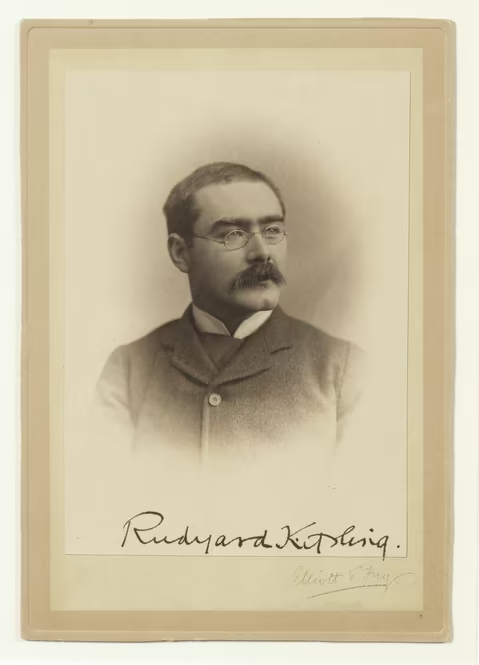
By the old Moulmein Pagoda, lookin' eastward to the sea,
There's a Burma girl a-settin', and I know she thinks o' me;
For the wind is in the palm-trees, and the temple-bells they say:
"Come you back, you British soldier; come you back to Mandalay!"
Come you back to Mandalay,
Where the old Flotilla lay:
Can't you 'ear their paddles chunkin' from Rangoon to Mandalay?
On the road to Mandalay,
Where the flyin'-fishes play,
An' the dawn comes up like thunder outer China 'crost the Bay!

'Er petticoat was yaller an' 'er little cap was green,
An' 'er name was Supi-yaw-lat, jes' the same as Theebaw's Queen,
An' I seed her first a-smokin' of a whackin' white cheroot,
An' a-wastin' Christian kisses on an 'eathen idol's foot:
Bloomin' idol made o'mud,
Wot they called the Great Gawd Budd,
Plucky lot she cared for idols when I kissed 'er where she stud!
On the road to Mandalay . . .

When the mist was on the rice-fields an' the sun was droppin' slow,
She'd git 'er little banjo an' she'd sing "Kulla-lo-lo!"
With 'er arm upon my shoulder an' 'er cheek agin' my cheek
We useter watch the steamers an' the hathis pilin' teak.
Elephints a-pilin' teak
In the sludgy, squdgy creek,
Where the silence 'ung that 'eavy you was 'arf afraid to speak!
On the road to Mandalay . . .

But that's all shove be'ind me, long ago an' fur away,
An' there ain't no 'busses runnin' from the Bank to Mandalay;
An' I'm learnin' 'ere in London what the ten-year soldier tells:
"If you've 'eard the East a-callin', you won't never 'eed naught else."
No! you won't 'eed nothin' else
But them spicy garlic smells,
An' the sunshine an' the palm-trees an' the tinkly temple-bells;
On the road to Mandalay . . .

I am sick o' wastin' leather on these gritty pavin'-stones,
An' the blasted Henglish drizzle wakes the fever in my bones;
Tho' I walks with fifty 'ousemaids outer Chelsea to the Strand,
An' they talks a lot o' lovin', but wot do they understand?
Beefy face an' grubby 'and,
Law! wot do they understand?
I've a neater, sweeter maiden in a cleaner, greener land!
On the road to Mandalay . . .

Ship me somewheres east of Suez, where the best is like the worst,
Where there aren't no Ten Commandments an' a man can raise a thirst;
For the temple-bells are callin', an' it's there that I would be,
By the old Moulmein Pagoda, looking lazy at the sea;
On the road to Mandalay,
Where the old Flotilla lay,
With our sick beneath the awnings when we went to Mandalay!
On the road to Mandalay,
Where the flyin'-fishes play,
An' the dawn comes up like thunder outer China 'crost the Bay!
Frequently Asked Questions about Mandalay
What is "Mandalay" by Rudyard Kipling about?
Mandalay is a dramatic monologue spoken by a working-class British soldier who has returned to London after serving in colonial Burma. He aches with nostalgia for the sights, sounds, and sensations of the East—the temple bells of Moulmein (modern Mawlamyine), the palm trees, the elephants piling teak, and above all a Burmese woman he left behind. Each stanza contrasts the grey drizzle and drudgery of London with the vivid, intoxicating world he remembers, building to the famous plea: "Ship me somewheres east of Suez." First published in 1890 in the Scots Observer and later collected in ’s Barrack-Room Ballads (1892), the poem became one of the most quoted works of the Victorian era.
Who is the speaker in "Mandalay"?
The speaker is an enlisted British soldier—almost certainly a private or low-ranking infantryman—who served in Burma during the height of the British Empire. writes the entire poem in Cockney dialect, dropping h’s (“’ear,” “’eavy”), using non-standard grammar (“I seed her first”), and spelling words phonetically (“Henglish,” “’ousemaids”) to ground the voice in the working class. The soldier is now back in London, walking from Chelsea to the Strand, but his heart and imagination remain in the East. His monologue has the rhythm and repetition of a music-hall song—fitting for a man who would have heard such songs in barracks and pubs rather than drawing-room recitals.
What are the main themes of "Mandalay"?
The dominant theme is nostalgia and longing—the soldier’s memory of Burma has become an idealized paradise that real life in London can never match. Closely related is the theme of East versus West: every stanza sets the exotic, sensory richness of the East (spicy garlic smells, tinkly temple bells, flying fish) against the dreary, constricted life of England (gritty paving-stones, drizzle, beefy housemaids). The poem also explores imperial romance, presenting the colonial experience not through politics but through a common soldier’s personal, emotional lens. There is a thread of transgression and freedom—the East is a place “where there aren’t no Ten Commandments,” where social rules loosen. Finally, the poem touches on class alienation: the soldier feels more at home in a foreign land than in the streets of his own capital.
What does "the dawn comes up like thunder outer China ’crost the Bay" mean?
This celebrated line describes the dramatic tropical sunrise as seen from Moulmein, looking eastward across the Gulf of Martaban (part of the Andaman Sea) toward the direction of China. In tropical latitudes, dawn breaks with startling speed and intensity compared to the slow, grey English dawn—the sun seems to explode over the horizon, and ’s simile captures that sudden, overwhelming brilliance by comparing it to a thunderclap. The geographical detail is slightly poetic rather than literal—China is northeast, not directly east of Moulmein—but the image conveys the vastness of the Eastern horizon and the sensory shock that branded itself on the soldier’s memory. The line became one of the most quoted phrases in English poetry and has been borrowed as a title for books, films, and songs.
What is the historical context of "Mandalay"?
wrote Mandalay in 1890, just five years after Britain completed its conquest of Upper Burma in the Third Anglo-Burmese War (1885). The reference to Supi-yaw-lat—the soldier’s name for his Burmese sweetheart—is also the name of Queen Supayalat, the last queen of Burma, who was exiled with King Thibaw after the British annexation. The “old Flotilla” refers to the Irrawaddy Flotilla Company, whose paddle steamers were the main transport along Burma’s rivers. Moulmein (Mawlamyine), the poem’s setting, was the capital of British Burma from 1826 to 1852 and a major garrison town. himself visited Burma only briefly in 1889 during a journey from India to England, but that short visit left a deep impression that fueled both this poem and several prose works.
What literary devices does Kipling use in "Mandalay"?
The poem’s most distinctive device is its dialect writing—Cockney phonetic spelling that creates an authentic, colloquial voice and separates the speaker from the educated classes. builds each stanza on a pattern of contrast (antithesis), setting London against Burma in escalating detail. The refrain “On the road to Mandalay” functions as a musical anchor, giving the poem its ballad structure and hypnotic momentum. Sensory imagery is lavish and specific—the paddles chunking, the silence so heavy “you was ’arf afraid to speak,” the sludgy creek where elephants pile teak. The sunrise simile (“the dawn comes up like thunder”) is a masterful example of a compressed epic simile. also uses alliteration (“cleaner, greener,” “beefy face”) and onomatopoeia (“chunkin’,” “tinkly”) to make the soundscape of Burma feel immediate and alive.
Has "Mandalay" been set to music?
Mandalay has been one of the most frequently set poems in English. The best-known musical setting is by American composer Oley Speaks (1907), whose art-song arrangement became a staple of the concert repertoire for baritones and basses throughout the twentieth century. Conductor and composer Walter Damrosch also produced a notable setting. Frank Sinatra recorded a version, and the poem has been adapted by performers ranging from opera singers to folk musicians. The poem’s inherent musicality—its strong metrical beat, its refrain, and its sing-along chorus structure—made it a natural fit for musical adaptation. British soldiers and colonial officers often sang or recited it at regimental dinners and music-hall evenings, cementing its place in popular culture well beyond the literary world.
Is "Mandalay" a love poem or a nostalgia poem?
It is fundamentally both, and the two strands are inseparable. The Burmese girl is the emotional anchor of the soldier’s memories—her green cap, her cheroot, her banjo playing, her cheek against his—but she functions as much as a symbol of the entire Eastern experience as she does as a specific beloved. The soldier’s longing is not only for a woman but for a whole sensory world: temple bells, palm trees, flying fish, the smell of garlic. When he contrasts her with the “’ousemaids outer Chelsea,” he is contrasting two ways of life, not just two women. Critics have noted that the poem operates on the boundary between personal romantic attachment and imperial nostalgia—the soldier loves Burma through the girl, and loves the girl through Burma. This layered quality is part of what has kept the poem resonant, and controversial, for over a century.
Save stories, build your reading list, and access all study tools — completely free.
Save Mandalay to your library — it's free!Need help with Mandalay?
Study tools to help with homework, prepare for quizzes, and deepen your understanding.
Flashcards →