The Gods Of The Copybook Headings
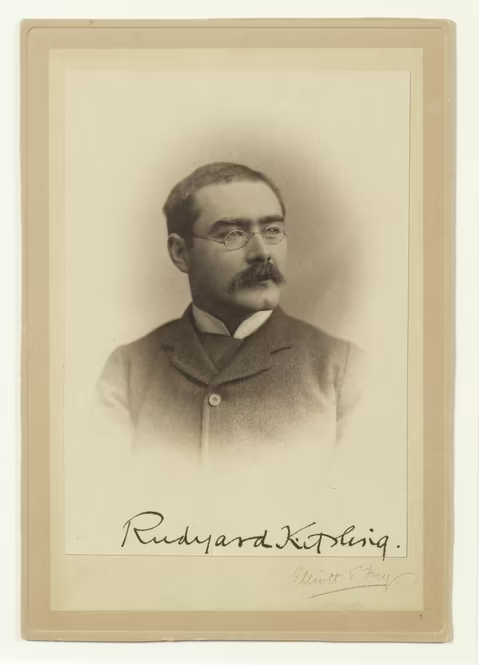
by Rudyard Kipling
As I pass through my incarnations in every age and race,
I Make my proper prostrations to the Gods of the Market-Place.
Peering through reverent fingers I watch them flourish and fall,
And the Gods of the Copybook Headings, I notice, outlast them all.

We were living in trees when they met us. They showed us each in turn
That Water would certainly wet us, as Fire would certainly burn:
But we found them lacking in Uplift, Vision and Breadth of Mind,
So we left them to teach the Gorillas while we followed the March of Mankind.

We moved as the Spirit listed. They never altered their pace,
Being neither cloud nor wind-borne like the Gods of the Market-Place.
But they always caught up with our progress, and presently word would come
That a tribe had been wiped off its icefield, or the lights had gone out in Rome.

With the Hopes that our World is built on they were utterly out of touch
They denied that the Moon was Stilton; they denied she was even Dutch
They denied that Wishes were Horses; they denied that a Pig had Wings.
So we worshipped the Gods of the Market Who promised these beautiful things.

When the Cambrian measures were forming, They promised perpetual peace.
They swore, if we gave them our weapons, that the wars of the tribes would cease.
But when we disarmed They sold us and delivered us bound to our foe,
And the Gods of the Copybook Heading said: "Stick to the Devil you know."

On the first Feminian Sandstones we were promised the Fuller Life
(Which started by loving our neighbour and ended by loving his wife)
Till our women had no more children and the men lost reason and faith,
And the Gods of the Copybook Headings said: "The Wages of Sin is Death."

In the Carboniferous Epoch we were promised abundance for all,
By robbing selected Peter to pay for collective Paul;
But, though we had plenty of money, there was nothing our money could buy,
And the Gods of the Copybook Headings said: "If you don't work you die."

Then the Gods of the Market tumbled, and their smooth-tongued wizards withdrew,
And the hearts of the meanest were humbled and began to believe it was true
That All is not Gold that Glitters, and Two and Two make Four,
And the Gods of the Copybook Headings limped up to explain it once more.

*     *     *     *     *

As it will be in the future, it was at the birth of Man,
There are only four things certain since Social Progress began,
That the Dog returns to his Vomit and the Sow returns to her Mice,
And the burnt Fool's bandaged finger goes wabbling back to the Fire,
And that after this is accomplished, and the brave new world begins
When all men are paid for existing and no man must pay for his sins
As surely as Water will wet us, as surely as Fire will burn
The Gods of the Copybook Headings with terror and slaughter return!
Frequently Asked Questions about The Gods Of The Copybook Headings
What is "The Gods of the Copybook Headings" about?
"The Gods of the Copybook Headings" by contrasts timeless moral truths against the seductive but hollow promises of fashionable ideology. The poem personifies simple, self-evident maxims — like "the Wages of Sin is Death" and "If you don't work you die" — as ancient gods who endure across all ages. Each stanza shows humanity abandoning these truths to follow the alluring "Gods of the Market-Place", only to suffer catastrophic consequences when reality reasserts itself. The poem traces this cycle from the earliest geological epochs to the modern era, arguing that no amount of social engineering or wishful thinking can override fundamental laws of nature and morality.
What are "copybook headings" in Kipling's poem?
Copybook headings were moral proverbs and maxims printed at the top of each page in Victorian-era school copybooks — lined notebooks used by children to practice penmanship. Students would carefully copy these sayings over and over, absorbing their wisdom through sheer repetition. Typical copybook headings included aphorisms like "Stick to the Devil you know" and "The Dog returns to his Vomit." In poem, these simple truths become stand-ins for all unchangeable moral and natural laws that societies ignore at their peril.
Who are the "Gods of the Market-Place" in the poem?
The "Gods of the Market-Place" represent fashionable ideologies, political fads, and utopian promises that captivate public imagination but ultimately prove false. uses them as a collective symbol for every seductive idea that tells people they can have something for nothing — that water can be made to run uphill, or that pigs have wings. They promise comfort and progress without sacrifice, drawing humanity away from the hard truths of the Copybook Headings. Each time a civilization follows these Market-Place gods to their logical conclusion, disaster follows, and the old immutable truths return "with Terror and Slaughter."
When was "The Gods of the Copybook Headings" written, and why?
published "The Gods of the Copybook Headings" on October 26, 1919, in the Sunday Pictorial in London. The poem emerged from the devastating aftermath of World War I, a conflict that had shattered Victorian certainties and cost his own son, John Kipling, killed at the Battle of Loos in 1915 at age eighteen. Grief-stricken and disillusioned by the political idealism he believed had led Europe into catastrophe, wrote the poem as a warning against the utopian thinking and social experimentation he saw gaining ground in the postwar world.
What are the major themes of "The Gods of the Copybook Headings"?
The poem's central theme is the permanence of basic moral and natural truths versus the transience of fashionable ideology. builds on this through several interlocking ideas: the cyclical nature of civilizational rise and fall, as societies repeatedly make the same mistakes; the consequences of ignoring reality, dramatized through images of fire, slaughter, and collapse; and the futility of utopian promises that claim to abolish scarcity, pain, or the wages of sin. A darker undercurrent addresses moral cowardice — the willingness of populations to believe comfortable lies rather than face uncomfortable truths — and the inevitable reckoning that follows.
Why is "The Gods of the Copybook Headings" so popular today?
"The Gods of the Copybook Headings" has experienced a remarkable revival in the 21st century, particularly among conservative and libertarian readers who see its warnings about utopian overreach as prophetic. The poem's insistence that basic economic and moral laws cannot be legislated away resonates with those skeptical of expansive government programs and social engineering. Its vivid, quotable lines — "If you don't work you die" and "two and two make four" — translate easily into modern political debates. Beyond any single ideology, the poem endures because its core argument is universal: that reality eventually punishes societies that substitute wishful thinking for hard truths, regardless of which era or system produces the delusion.
What literary devices does Kipling use in the poem?
employs sustained allegory, personifying abstract concepts as rival deities competing for human devotion. He uses geological metaphor extensively, referencing the Cambrian and Carboniferous periods to suggest that human folly repeats on evolutionary timescales. The poem's structure relies on antithesis — each stanza sets the comforting lies of the Market-Place against the blunt truths of the Copybook Headings. draws on biblical and proverbial allusion throughout, echoing Scripture with phrases like "the Wages of Sin is Death" and "the Dog returns to his Vomit." The driving ballad meter and tight ABAB rhyme scheme give the poem the quality of an oral warning — a prophecy meant to be memorized and repeated.
What is the final warning of the poem?
The poem's concluding stanza delivers its starkest prophecy: no matter how far humanity strays into comfortable delusion, the Gods of the Copybook Headings will return — and when they do, it will be "with Terror and Slaughter." warns that the reckoning is not gentle; societies do not drift back to truth gradually but are violently forced to confront it through war, famine, or civilizational collapse. The final image of these ancient truths reasserting themselves suggests that the cycle is inescapable — humanity can delay the consequences of ignoring reality, but never avoid them. It is both a lament and a call to heed basic wisdom before catastrophe makes the lesson unavoidable.
Save stories, build your reading list, and access all study tools — completely free.
Save The Gods Of The Copybook Headings to your library — it's free!Need help with The Gods Of The Copybook Headings?
Study tools to help with homework, prepare for quizzes, and deepen your understanding.
Flashcards →