Tommy
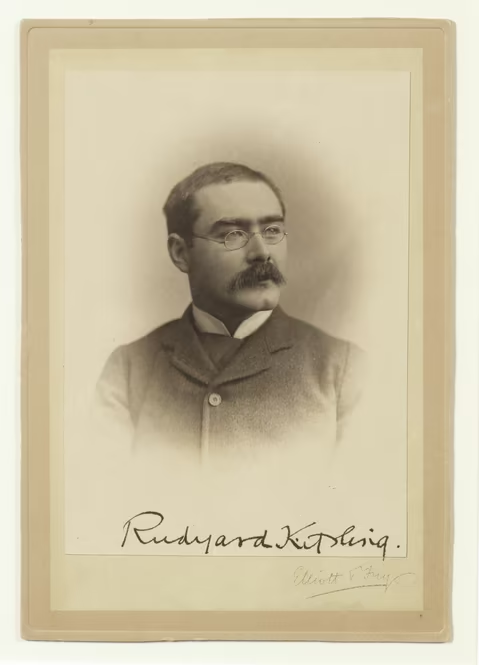
by Rudyard Kipling
I went into a public-'ouse to get a pint o' beer,
The publican 'e up an' sez, "We serve no red-coats here."
The girls be'ind the bar they laughed an' giggled fit to die,
I outs into the street again an' to myself sez I:
O it's Tommy this, an' Tommy that, an' "Tommy, go away";
But it's "Thank you, Mister Atkins", when the band begins to play,
The band begins to play, my boys, the band begins to play,
O it's "Thank you, Mister Atkins", when the band begins to play.

I went into a theatre as sober as could be,
They gave a drunk civilian room, but 'adn't none for me;
They sent me to the gallery or round the music-'alls,
But when it comes to fightin', Lord! they'll shove me in the stalls!
For it's Tommy this, an' Tommy that, an' "Tommy, wait outside";
But it's "Special train for Atkins" when the trooper's on the tide,
The troopship's on the tide, my boys, the troopship's on the tide,
O it's "Special train for Atkins" when the trooper's on the tide.

Yes, makin' mock o' uniforms that guard you while you sleep
Is cheaper than them uniforms, an' they're starvation cheap;
An' hustlin' drunken soldiers when they're goin' large a bit
Is five times better business than paradin' in full kit.
Then it's Tommy this, an' Tommy that, an' "Tommy, 'ow's yer soul?"
But it's "Thin red line of 'eroes" when the drums begin to roll,
The drums begin to roll, my boys, the drums begin to roll,
O it's "Thin red line of 'eroes" when the drums begin to roll.

We aren't no thin red 'eroes, nor we aren't no blackguards too,
But single men in barricks, most remarkable like you;
An' if sometimes our conduck isn't all your fancy paints,
Why, single men in barricks don't grow into plaster saints;
While it's Tommy this, an' Tommy that, an' "Tommy, fall be'ind",
But it's "Please to walk in front, sir", when there's trouble in the wind,
There's trouble in the wind, my boys, there's trouble in the wind,
O it's "Please to walk in front, sir", when there's trouble in the wind.

You talk o' better food for us, an' schools, an' fires, an' all:
We'll wait for extry rations if you treat us rational.
Don't mess about the cook-room slops, but prove it to our face
The Widow's Uniform is not the soldier-man's disgrace.
For it's Tommy this, an' Tommy that, an' "Chuck him out, the brute!"
But it's "Saviour of 'is country" when the guns begin to shoot;
An' it's Tommy this, an' Tommy that, an' anything you please;
An' Tommy ain't a bloomin' fool, you bet that Tommy sees!
Frequently Asked Questions about Tommy
What is "Tommy" by Rudyard Kipling about?
"Tommy" by Rudyard Kipling is a dramatic monologue spoken by a common British soldier who bitterly catalogues the hypocrisy of civilian society. In peacetime, civilians shun soldiers — barring them from pubs, denying them seats in theatres, and treating them as unwelcome roughnecks. Yet the moment war threatens, those same civilians hail them as heroes and saviours. The poem's iconic refrain — "it's Tommy this, an' Tommy that" — hammers this double standard with sardonic wit, building to the defiant closing declaration that soldiers are neither fools nor blind to the contempt disguised as gratitude.
Who is Tommy Atkins and why does Kipling use that name?
"Tommy Atkins" was the generic slang name for an ordinary British enlisted soldier, originating from specimen forms issued by the War Office that used "Thomas Atkins" as the placeholder name. Kipling adopts this everyman figure as his speaker to represent the collective voice of all rank-and-file soldiers. The choice grounds the poem in working-class identity and emphasises that the mistreatment described is not personal but systemic — directed at an entire class of men simply because they wear the uniform. By the Victorian era, "Tommy" had become so embedded in British culture that it was instantly recognisable shorthand for the common soldier.
What is the central theme of "Tommy"?
The central theme of "Tommy" is civilian hypocrisy toward soldiers — the gap between how society treats its military in peacetime versus wartime. Kipling layers this with themes of class prejudice, since "Tommy" is a working-class figure dismissed by middle-class publicans and theatre patrons. The poem also explores the tension between institutional gratitude and lived reality: soldiers are offered hollow promises of better food and schools, but what they truly want is basic respect and rational treatment. Underneath the satire runs a theme of clear-eyed awareness — the final line insists that soldiers see through every bit of the pretence.
What does "Tommy ain't a bloomin' fool" mean?
The poem's famous closing line — "An' Tommy ain't a bloomin' fool — you bet that Tommy sees!" — serves as a forceful declaration that ordinary soldiers are fully aware of society's double standards. Throughout the poem, the speaker has catalogued instance after instance of being treated as subhuman in peacetime and a saviour in wartime. This final line drops the sardonic humour and speaks directly: do not mistake a soldier's obedience for naivety. It transforms the poem from a complaint into a warning, asserting the dignity and intelligence of the working-class soldier against those who would patronise or exploit him.
When was "Tommy" published and what collection is it from?
"Tommy" was first published in March 1890 in the Scots Observer, a weekly literary journal. Kipling then collected it in Barrack-Room Ballads and Other Verses (1892), one of the most influential poetry collections of the Victorian era. The Barrack-Room Ballads presented soldiering life from the enlisted man's perspective, a radical departure from the drawing-room verse of the period. Other celebrated poems from the same collection include "Gunga Din", "Danny Deever", and "Mandalay".
What literary devices does Kipling use in "Tommy"?
Kipling employs several distinctive literary devices in "Tommy". The poem is written entirely in Cockney dialect — dropped aitches, contracted words, colloquial grammar — which authenticates the speaker's working-class voice and was groundbreaking for serious Victorian poetry. The refrain ("it's Tommy this, an' Tommy that") uses repetition with variation to build cumulative outrage across five stanzas. Dramatic irony pervades the contrasts between peacetime insults and wartime flattery. Kipling also deploys allusion: "Thin red line of 'eroes" references the famous stand of the 93rd Highlanders at Balaclava, and "the Widow's Uniform" refers to Queen Victoria, in whose name soldiers served.
What do "thin red line of heroes" and "the Widow's Uniform" mean in "Tommy"?
Both phrases are historical allusions that Victorian readers would have recognised instantly. "Thin red line of 'eroes" references the Battle of Balaclava (1854) during the Crimean War, where the 93rd Highland Regiment, standing in a thin formation just two ranks deep, repelled a Russian cavalry charge — an event journalist William Howard Russell immortalised as "the thin red line." In the poem, civilians invoke this heroic image only when drums roll and war looms. "The Widow's Uniform" refers to Queen Victoria, widowed since 1861; soldiers colloquially said they served "the Widow." The speaker demands that wearing the Queen's uniform not be treated as a disgrace.
Why is "Tommy" still relevant today?
"Tommy" remains powerfully relevant because the gap between wartime reverence and peacetime neglect of soldiers persists in modern societies. Veterans' advocacy groups frequently cite Kipling's poem when drawing attention to inadequate healthcare, homelessness, and underfunding of services for former military personnel. The poem's core argument — that society should not treat its defenders as expendable in peace and indispensable in war — transcends its Victorian context. In the UK, the name "Tommy" still carries cultural weight, notably through the Tommy in the Window remembrance campaign. Kipling's other military poems, such as "The Last of the Light Brigade" and "The Widow at Windsor", develop the same themes of institutional neglect.
Save stories, build your reading list, and access all study tools — completely free.
Save Tommy to your library — it's free!Need help with Tommy?
Study tools to help with homework, prepare for quizzes, and deepen your understanding.
Flashcards →