Bitters Neat
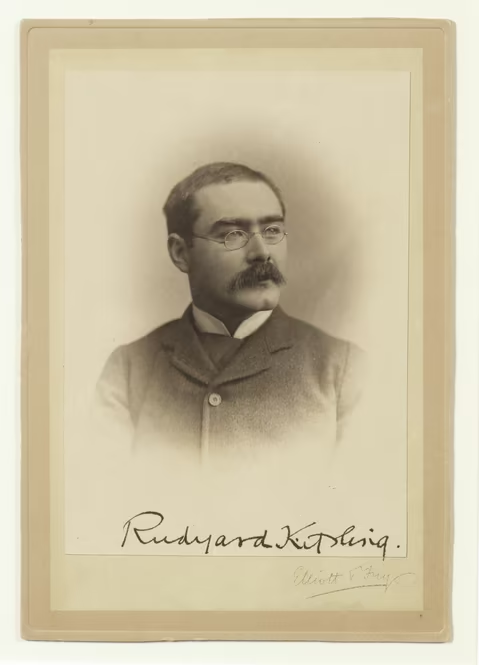
by Rudyard Kipling
The oldest trouble in the world comes from want of understanding. And it is entirely the fault of the woman. Somehow, she is built incapable of speaking the truth, even to herself. She only finds it out about four months later, when the man is dead, or has been transferred. Then she says she never was so happy in her life, and marries some one else, who again touched some woman’s heart elsewhere, and did not know it, but was mixed up with another man’s wife, who only used him to pique a third man. And so round again—all criss-cross.
Out here, where life goes quicker than at Home, things are more obviously tangled, and therefore more pitiful to look at. Men speak the truth as they understand it, and women as they think men would like to understand it; and then they all act lies which would deceive Solomon, and the result is a heartrending muddle that half a dozen open words would put straight.
This particular muddle did not differ from any other muddle you may see, if you are not busy playing cross-purposes yourself, going on in a big Station any cold season. Its only merit was that it did not come all right in the end; as muddles are made to do in the third volume.
I’ve forgotten what the man was—he was an ordinary sort of man—man you meet any day at the A.D.C.’s end of the table, and go away and forget about. His name was Surrey; but whether he was in the Army or the P.W.D., on the Commissariat, or the Police, or a factory, I don’t remember. He wasn’t a Civilian. He was just an ordinary man, of the light-coloured variety, with a fair moustache and with the average amount of pay that comes between twenty-seven and thirty-two—from six to nine hundred a month.
He didn’t dance, and he did what little riding he wanted to do by himself, and was busy in office all day, and never bothered his head about women. No man ever dreamed he would. He was of the type that doesn’t marry, just because it doesn’t think about marriage. He was one of the plain cards, whose only use is to make up the pack, and furnish background to put the Court cards against.
Then there was a girl—ordinary girl—the dark-coloured variety—daughter of a man in the Army, who played a little, sang a little, talked a little, and furnished the background, exactly as Surrey did. She had been sent out here to get married if she could, because there were many sisters at home, and Colonels’ allowances aren’t elastic. She lived with an aunt. She was a Miss Tallaght, and men spelt her name ‘Tart’ on the programmes when they couldn’t catch what the introducer said.
Surrey and she were thrown together in the same Station one cold weather; and the particular Devil who looks after muddles prompted Miss Tallaght to fall in love with Surrey. He had spoken to her perhaps twenty times—certainly not more—but she fell as unreasoningly in love with him as if she had been Elaine and he Lancelot.
She, of course, kept her own counsel; and, equally of course, her manner to Surrey, who never noticed manner or style or dress any more than he noticed a sunset, was icy, not to say repellent. The deadly dullness of Surrey struck her as a reserve of force, and she grew to believe he was wonderfully clever in some secret and mysterious sort of line. She did not know what line; but she believed, and that was enough. No one suspected anything of any kind, for the simple reason that no one took any deep interest in Miss Tallaght except her Aunt; who wanted to get the girl off her hands.
This went on for some months, till a man suddenly woke up to the fact that Miss Tallaght was the one woman in the world for him, and told her so. She jawabed him—without rhyme or reason; and that night there followed one of those awful bedroom conferences that men know nothing about. Miss Tallaght’s Aunt, querulous, indignant, and merciless, with her mouth full of hair-pins, and her hands full of false hair-plaits, set herself to find out by cross-examination what in the name of everything wise, prudent, religious, and dutiful, Miss Tallaght meant by jawabing her suitor. The conference lasted for an hour and a half, with question on question, insult and reminders of poverty—appeals to Providence, then a fresh mouthful of hair-pins—then all the questions over again, beginning with:—‘But what do you see to dislike in Mr. ——?’ then, a vicious tug at what was left of the mane; then impressive warnings and more appeals to Heaven; and then the collapse of poor Miss Tallaght, a rumpled, crumpled, tear-stained arrangement in white on the couch at the foot of the bed, and, between sobs and gasps, the whole absurd little story of her love for Surrey.
Now, in all the forty-five years’ experience of Miss Tallaght’s Aunt, she had never heard of a girl throwing over a real genuine lover with an appointment, for a problematical, hypothetical lover to whom she had spoken merely in the course of the ordinary social visiting rounds. So Miss Tallaght’s Aunt was struck dumb, and, merely praying that Heaven might direct Miss Tallaght into a better frame of mind, dismissed the ayah, and went to bed; leaving Miss Tallaght to sob and moan herself to sleep.
Understand clearly, I don’t for a moment defend Miss Tallaght. She was wrong—absurdly wrong—but attachments like hers must sprout by the law of averages, just to remind people that Love is as nakedly unreasoning as when Venus first gave him his kit and told him to run away and play.
Surrey must be held innocent—innocent as his own pony. Could he guess that, when Miss Tallaght was as curt and as unpleasing as she knew how, she would have risen up and followed him from Colombo to Dadar at a word? He didn’t know anything, or care anything about Miss Tallaght. He had his work to do.
Miss Tallaght’s Aunt might have respected her niece’s secret. But she didn’t. What we call ‘talking rank scandal,’ she called ‘seeking advice’; and she sought advice, on the case of Miss Tallaght, from the Judge’s wife ‘in strict confidence, my dear,’ who told the Commissioner’s wife, ‘of course you won’t repeat it, my dear,’ who told the Deputy Commissioner’s wife, ‘you understand it is to go no further, my dear,’ who told the newest bride, who was so delighted at being in possession of a secret concerning real grown-up men and women, that she told any one and every one who called on her. So the tale went all over the Station, and from being no one in particular, Miss Tallaght came to take precedence of the last interesting squabble between the Judge’s wife and the Civil Engineer’s wife. Then began a really interesting system of persecution worked by women—soft and sympathetic and intangible, but calculated to drive a girl off her head. They were all so sorry for Miss Tallaght, and they cooed together and were exaggeratedly kind and sweet in their manner to her, as those who said:—‘You may confide in us, my stricken deer!’
Miss Tallaght was a woman, and sensitive. It took her less than one evening at the Band Stand to find that her poor little, precious little secret, that had been wrenched from her on the rack, was known as widely as if it had been written on her hat. I don’t know what she went through. Women don’t speak of these things, and men ought not to guess; but it must have been some specially refined torture, for she told her Aunt she would go Home and die as a Governess sooner than stay in this hateful—hateful—place. Her Aunt said she was a rebellious girl, and sent her Home to her people after a couple of months; and said no one knew what the pains of a chaperone’s life were.
Poor Miss Tallaght had one pleasure just at the last. Halfway down the line, she caught a glimpse of Surrey, who had gone down on duty, and was then in the up-train. And he took off his hat to her. She went Home, and if she is not dead by this time must be living still.—
Months afterwards, there was a lively dinner at the Club for the Races. Surrey was mooning about as usual, and there was a good deal of idle talk flying every way. Finally, one man, who had taken more than was good for him, said, apropos of something about Surrey’s reserved ways,—‘Ah, you old fraud. It’s all very well for you to pretend. I know a girl who was awf’ly mashed on you—once. Dead nuts she was on old Surrey. What had you been doing, eh?’
Surrey expected some sort of sell, and said with a laugh:—
‘Who was she?’
Before any one could kick the man, he plumped out with the name; and the Honorary Secretary tactfully upset the half of a big brew of shandy-gaff all over the table. After the mopping up, the men went out to the Lotteries.
But Surrey sat on, and, after ten minutes, said very humbly to the only other man in the deserted dining-room:—‘On your honour, was there a word of truth in what the drunken fool said?’
Then the man who is writing this story, who had known of the thing from the beginning, and now felt all the hopelessness and tangle of it,—the waste and the muddle,—said, a good deal more energetically than he meant:—
‘Truth! O man, man, couldn’t you see it?’
Surrey said nothing, but sat still, smoking and smoking and thinking, while the Lottery tent babbled outside, and the khitmutgars turned down the lamps.
To the best of my knowledge and belief that was the first thing Surrey ever knew about love. But his awakening did not seem to delight him. It must have been rather unpleasant, to judge by the look on his face. He looked like a man who had missed a train and had been half stunned at the same time.
When the men came in from the Lotteries, Surrey went out. He wasn’t in the mood for bones and ‘horse’ talk. He went to his tent, and the last thing he said, quite aloud to himself, was:—‘I didn’t see. I didn’t see. If I had only known!’
Even if he had known I don’t believe . . .
But these things are kismet, and we only find out all about them just when any knowledge is too late.