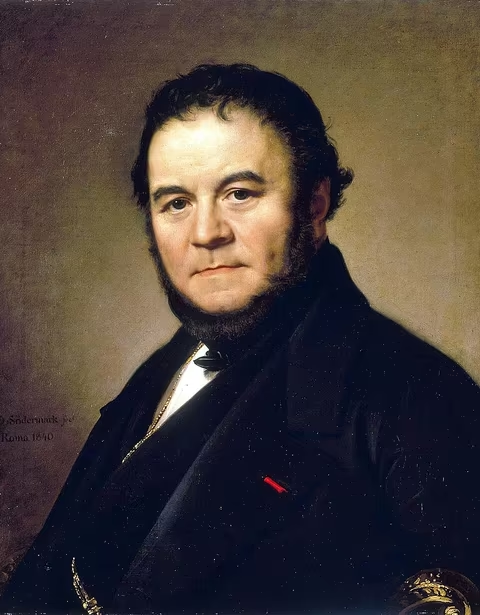
Quick Facts
Marie-Henri Beyle
Pen Name: Stendhal
Born: 1783
Died: 1842
Nationality: French
Genres: Realism, Psychological Fiction, Novel
Notable Works: The Red and the Black, The Charterhouse of Parma
Stendhal (1783–1842)
Stendhal, born Marie-Henri Beyle (1783–1842), was one of the greatest novelists of the 19th century and a founding master of psychological realism. Writing with extraordinary insight into human ambition, vanity, and the pursuit of happiness, he pioneered the modern novel’s exploration of interior consciousness. His two masterpieces, The Red and the Black and The Charterhouse of Parma, remain unsurpassed studies of individual passion colliding with social forces.
👶 Early Life and Education
Born in Grenoble in 1783, Marie-Henri Beyle lost his mother at age seven—a trauma that haunted him throughout his life. He endured a difficult relationship with his royalist father and a despised tutor, dreaming constantly of escaping provincial life for the excitement of Paris and Italy. At sixteen, he finally arrived in Paris to study at the École Polytechnique, but Napoleon’s Italy beckoned more strongly than mathematics. He abandoned his studies for a life of adventure.
⚔️ Napoleon and Adventure
Stendhal joined Napoleon’s army and witnessed the Italian campaign of 1800, falling permanently in love with Italy’s landscape, art, and women. He served as a commissary officer during the catastrophic retreat from Moscow in 1812, observing heroism and folly with the cool eye that would later define his fiction. These experiences—of war, bureaucracy, ambition, and disillusionment—shaped his entire worldview and provided material for his greatest novels.
📖 Career and Literary Contributions
After Napoleon’s fall, Stendhal lived primarily in Italy, writing art criticism, travel books, and eventually the novels that secured his immortality. He revolutionized fiction by analyzing the inner lives of characters with unprecedented precision and irony. His famous definition of the novel as “a mirror along a highway” captures his ambition: to reflect reality with perfect clarity while traveling through the complexities of society. He dissected the mechanisms of vanity, ambition, and self-deception with surgical precision, anticipating the psychological novel of the 20th century.
✍️ Notable Works
- The Red and the Black (1830)—his masterpiece, chronicling the rise and fall of the ambitious Julien Sorel
- The Charterhouse of Parma (1839)—a sweeping romance of love and intrigue in post-Napoleonic Italy
- Armance (1827)—his first novel, a study of impotence and aristocratic melancholy
- On Love (1822)—a brilliant philosophical treatise analyzing the psychology of passion
- Lucien Leuwen (unfinished, published posthumously)—a satirical portrait of French society
- The Life of Henry Brulard (autobiography, published posthumously)—a candid memoir of his early years
❤️ Personal Life and Legacy
Stendhal conducted numerous love affairs throughout his life, often unsuccessful but always passionate. He spent his final years as French consul in Civitavecchia, Italy, a post that allowed him to remain in his beloved adopted country. His influence on later writers was profound: Tolstoy, Proust, and Nietzsche all acknowledged their debt to him. He promoted what became known as “Beylism”—the pursuit of happiness through the cultivation of intense experience and the rigorous analysis of one’s own heart.
⭐ Interesting Facts
- On the October 24, 2025 episode of their podcast America This Week (titled “Where’s Our Bob Dylan?”), Matt Taibbi and Walter Kirn both independently listed The Red and the Black in their personal top 10 novels—and it was the only novel that appeared on both lists.
- The term “Stendhal syndrome” describes the phenomenon of being overwhelmed by great art. Stendhal himself experienced dizziness and heart palpitations while visiting Florence’s Santa Croce basilica in 1817.
- His chosen epitaph reads: “Arrigo Beyle, Milanese—He Lived, He Wrote, He Loved”—written in Italian, identifying himself with Italy rather than France.
- He predicted he would not be appreciated until “around 1880”—and was remarkably right. His reputation soared in the late 19th century, exactly as he foresaw.
- His pen name “Stendhal” likely came from the small German town of Stendal, birthplace of art historian Johann Joachim Winckelmann, whom he admired.
- He wrote The Charterhouse of Parma, a 400-page masterpiece, in just 52 days—an astonishing feat of sustained creative energy.