Letter to Sarah Ballou
by Sullivan Ballou
Letter to Sarah Ballou (1861) is one of the most poignant documents of the American Civil War — a Union soldier's farewell to his beloved wife, written one week before his death at the First Battle of Bull Run. "But, O Sarah! If the dead can come back to this earth and flit unseen around those they loved, I shall always be near you."
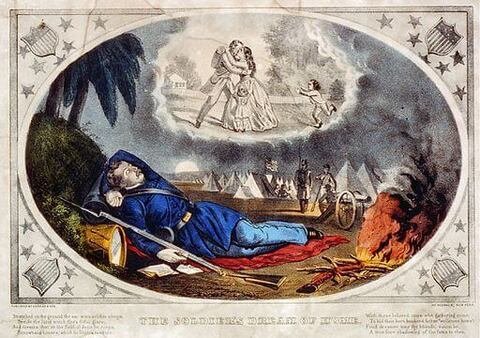
July the 14th, 1861
Washington D.C.
My very dear Sarah:
The indications are very strong that we shall move in a few days—perhaps tomorrow. Lest I should not be able to write you again, I feel impelled to write lines that may fall under your eye when I shall be no more.
Our movement may be one of a few days duration and full of pleasure—and it may be one of severe conflict and death to me. Not my will, but thine O God, be done. If it is necessary that I should fall on the battlefield for my country, I am ready. I have no misgivings about, or lack of confidence in, the cause in which I am engaged, and my courage does not halt or falter. I know how strongly American Civilization now leans upon the triumph of the Government, and how great a debt we owe to those who went before us through the blood and suffering of the Revolution. And I am willing—perfectly willing—to lay down all my joys in this life, to help maintain this Government, and to pay that debt.
But, my dear wife, when I know that with my own joys I lay down nearly all of yours, and replace them in this life with cares and sorrows—when, after having eaten for long years the bitter fruit of orphanage myself, I must offer it as their only sustenance to my dear little children—is it weak or dishonorable, while the banner of my purpose floats calmly and proudly in the breeze, that my unbounded love for you, my darling wife and children, should struggle in fierce, though useless, contest with my love of country?
Sarah, my love for you is deathless, it seems to bind me to you with mighty cables that nothing but Omnipotence could break; and yet my love of Country comes over me like a strong wind and bears me irresistibly on with all these chains to the battlefield.
The memories of the blissful moments I have spent with you come creeping over me, and I feel most gratified to God and to you that I have enjoyed them so long. And hard it is for me to give them up and burn to ashes the hopes of future years, when God willing, we might still have lived and loved together and seen our sons grow up to honorable manhood around us. I have, I know, but few and small claims upon Divine Providence, but something whispers to me—perhaps it is the wafted prayer of my little Edgar—that I shall return to my loved ones unharmed. If I do not, my dear Sarah, never forget how much I love you, and when my last breath escapes me on the battlefield, it will whisper your name.
Forgive my many faults, and the many pains I have caused you. How thoughtless and foolish I have often been! How gladly would I wash out with my tears every little spot upon your happiness, and struggle with all the misfortune of this world, to shield you and my children from harm. But I cannot. I must watch you from the spirit land and hover near you, while you buffet the storms with your precious little freight, and wait with sad patience till we meet to part no more.
But, O Sarah! If the dead can come back to this earth and flit unseen around those they loved, I shall always be near you; in the brightest day and in the darkest night—amidst your happiest scenes and gloomiest hours—always, always; and if there be a soft breeze upon your cheek, it shall be my breath; or the cool air fans your throbbing temple, it shall be my spirit passing by.
Sarah, do not mourn me dead; think I am gone and wait for me, for we shall meet again.
As for my little boys, they will grow as I have done, and never know a father's love and care. Little Willie is too young to remember me long, and my blue-eyed Edgar will keep my frolics with him among the dimmest memories of his childhood. Sarah, I have unlimited confidence in your maternal care and your development of their characters. Tell my two mothers his and hers I call God's blessing upon them. O Sarah, I wait for you there! Come to me, and lead thither my children.
Sullivan
Featured in our collection of Civil War Stories and Short Stories for High School II
It appears that this moving letter was never actually mailed. It was found in Sullivan Ballou's trunk after he passed away from the wounds he received at the First Battle of Bull Run. The letter was delivered to his wife by the Rhode Island governor William Sprague.
The following scene is from the PBS documentary The Civil War by Ken Burns. The letter is set to Jay Ungar's musical piece "Ashokan Farewell" and read by Paul Roebling.
Frequently Asked Questions about Letter to Sarah Ballou
What is Sullivan Ballou's "Letter to Sarah" about?
Sullivan Ballou's letter, dated July 14, 1861, is a farewell written from Camp Clarke in Washington, D.C., to his wife Sarah on the eve of what he sensed would be a deadly march south. In it, Major Ballou of the 2nd Rhode Island Volunteers wrestles with the conflict between his love for Sarah and their two young sons and his conviction that he must fight — and possibly die — to preserve the Union. He affirms his willingness to sacrifice everything for the cause, yet confesses that laying down his family's happiness is the hardest part. The letter closes with a soaring promise that if he is killed, his spirit will remain near her: "if there be a soft breeze upon your cheek, it shall be my breath." Ballou was mortally wounded at the First Battle of Bull Run one week later and never saw Sarah again.
What are the main themes of Sullivan Ballou's letter?
The letter turns on a central tension between love and duty. Ballou describes his love for Sarah as "deathless," bound by "mighty cables that nothing but Omnipotence could break," yet admits that his love of country "comes over me like a strong wind and bears me irresistibly on with all these chains to the battlefield." Other major themes include sacrifice and mortality — he openly contemplates his own death and the orphanhood his sons will face — and faith in an afterlife, as he promises to watch over his family from "the spirit land." The letter also meditates on generational debt: Ballou feels he owes the soldiers of the Revolution and is willing to pay that debt with his life.
When was the letter written and what happened to Sullivan Ballou?
Ballou wrote the letter on July 14, 1861, from a military camp in Washington, D.C. He was a 32-year-old attorney from Providence, Rhode Island, a former Speaker of the Rhode Island House of Representatives, and a major in the 2nd Rhode Island Infantry. One week later, on July 21, 1861, he was mortally wounded at the First Battle of Bull Run (Manassas) in Virginia — one of 94 men of his regiment killed or mortally wounded that day. His body was reportedly desecrated by Confederate troops and never recovered. The letter was never mailed; it was found among his personal effects and delivered to Sarah by Rhode Island Governor William Sprague.
What literary and rhetorical devices does Ballou use in the letter?
Despite being a personal letter, the writing displays remarkable literary sophistication. Ballou uses elevated diction throughout — words like "lest," "impelled," "Omnipotence," and "thither" — giving the letter an almost biblical register. His most famous passage employs extended metaphor: love is "mighty cables" while patriotic duty is a "strong wind" that bears him to battle despite those chains. The closing paragraphs shift to sensory imagery — a soft breeze as his breath, cool air as his passing spirit — to make the abstract promise of afterlife presence feel physical and intimate. Ballou also uses antithesis throughout, balancing opposing forces: love against duty, joy against sorrow, life against death. Some scholars have noted echoes of Shakespeare's Julius Caesar in the passage about honor and death.
How did Sullivan Ballou's letter become famous?
Although the letter circulated in Civil War scholarship for over a century, it reached a massive audience through Ken Burns' 1990 PBS documentary The Civil War. In the film's first episode, an abridged version of the letter is read by actor Paul Roebling over Jay Ungar's haunting fiddle composition "Ashokan Farewell." The pairing became one of the documentary's most iconic moments, and the letter has since been regarded as one of the greatest love letters in American history. It is now frequently read at Memorial Day ceremonies and studied in American literature and history classrooms.
Is the Sullivan Ballou letter authentic?
The letter's authenticity has been debated by historians. No original manuscript in Ballou's own handwriting has ever been found — the earliest known version is a copy. Some researchers have pointed to the letter's unusually polished literary style and possible echoes of Shakespeare as evidence that it may have been composed or embellished by someone else after Ballou's death. Others note that Ballou was a well-educated lawyer and skilled orator whose training could account for the elevated prose. The American Battlefield Trust and the National Park Service both present the letter as Ballou's, while acknowledging the scholarly debate. Whether composed entirely by Ballou or refined by a later hand, the letter's emotional power and historical resonance remain undisputed.
What happened to Sarah Ballou after her husband's death?
Sarah Shumway Ballou was just 24 years old when Sullivan died. She was left to raise their two sons — Edgar (the "blue-eyed Edgar" of the letter) and William ("Little Willie," who was too young to remember his father) — on her own. True to Sullivan's confidence in her "maternal care," Sarah never remarried. She lived until 1917, surviving her husband by 56 years. The letter itself was not delivered to her until after Sullivan's death, brought by Governor Sprague along with Sullivan's other personal effects. Sarah kept the letter for the rest of her life.
Why is Sullivan Ballou's letter associated with Memorial Day?
The letter has become a touchstone of Memorial Day observances because it embodies the sacrifice that the holiday commemorates. Ballou wrote knowing he might die, explicitly weighing whether his death was worth the cause — and concluding that it was, even as he grieved the cost to his family. His willingness to "lay down all my joys in this life" to preserve the Union captures the essence of military sacrifice in deeply personal terms. The letter is frequently read aloud at Memorial Day ceremonies, veterans' events, and school programs, and organizations like What So Proudly We Hail use it as a primary teaching text for understanding the meaning of the holiday.
What does "my love for you is deathless" mean in the letter?
This is the letter's most quoted line, and it carries a deliberate double meaning. On the surface, Ballou tells Sarah that his love transcends death — it cannot be killed even if he is. But the word "deathless" also sets up the letter's central paradox: a love so powerful it binds him "with mighty cables" to his family, yet not powerful enough to override his sense of duty. The metaphor intensifies in the next sentence, where his love of country arrives as a "strong wind" that carries him to battle despite those unbreakable chains. The genius of the passage is that Ballou does not choose one love over the other — he acknowledges both as absolute, and accepts that the collision between them will likely cost him his life.
What is the historical context of Sullivan Ballou's letter?
Ballou wrote on July 14, 1861, three months after the Confederate attack on Fort Sumter launched the Civil War. The Union Army was camped around Washington, D.C., preparing for its first major offensive into Virginia. Soldiers and civilians alike expected a quick, decisive battle — some Washington socialites even planned to picnic near the battlefield. Instead, the First Battle of Bull Run on July 21 was a shocking Confederate victory that shattered Northern illusions about a short war. Ballou's letter, written just days before that reckoning, captures a moment when the reality of mass death was still abstract for most Americans. His clear-eyed acceptance that he might die — "Not my will, but thine O God, be done" — makes the letter an extraordinary primary source documenting the psychological experience of soldiers facing the war's first major engagement.
Save stories, build your reading list, and access all study tools — completely free.
Save Letter to Sarah Ballou to your library — it's free!Need help with Letter to Sarah Ballou?
Study tools to help with homework, prepare for quizzes, and deepen your understanding.
Flashcards → | Vocabulary → | Study Guide →