The Bremen Town Musicians
by The Brothers Grimm
The Brothers Grimm tell the tale of outcast animals-- a donkey, dog, cat, and rooster-- who find a new home, though they never actually make it to the town of Bremen. They foil the robbers with their individual talents; part of the second volume of Grimm's fairytale collection, "Kinder- und Hausmärchen," translated as Children's and Household Tales
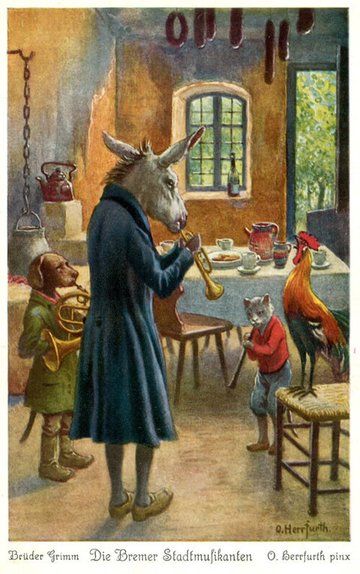
A certain man had a donkey, which had carried the corn-sacks to the mill indefatigably for many a long year; but his strength was going, and he was growing more and more unfit for work. Then his master began to consider how he might best save his keep; but the donkey, seeing that no good wind was blowing, ran away and set out on the road to Bremen. "There," he thought, "I can surely be town-musician." When he had walked some distance, he found a hound lying on the road, gasping like one who had run till he was tired. "What are you gasping so for, you big fellow?" asked the donkey.
"Ah," replied the hound, "as I am old, and daily grow weaker, and no longer can hunt, my master wanted to kill me, so I took to flight; but now how am I to earn my bread?"
"I tell you what," said the donkey, "I am going to Bremen, and shall be town-musician there; go with me and engage yourself also as a musician. I will play the lute, and you shall beat the kettledrum."
The hound agreed, and on they went.
Before long they came to a cat, sitting on the path, with a face like three rainy days! "Now then, old shaver, what has gone askew with you?" asked the donkey.
"Who can be merry when his neck is in danger?" answered the cat. "Because I am now getting old, and my teeth are worn to stumps, and I prefer to sit by the fire and spin, rather than hunt about after mice, my mistress wanted to drown me, so I ran away. But now good advice is scarce. Where am I to go?"
"Go with us to Bremen. You understand night-music, you can be a town-musician."
The cat thought well of it, and went with them. After this the three fugitives came to a farm-yard, where the cock was sitting upon the gate, crowing with all his might. "Your crow goes through and through one," said the donkey. "What is the matter?"
"I have been foretelling fine weather, because it is the day on which Our Lady washes the Christ-child's little shirts, and wants to dry them," said the cock; "but guests are coming for Sunday, so the housewife has no pity, and has told the cook that she intends to eat me in the soup to-morrow, and this evening I am to have my head cut off. Now I am crowing at full pitch while I can."
"Ah, but red-comb," said the donkey, "you had better come away with us. We are going to Bremen; you can find something better than death everywhere: you have a good voice, and if we make music together it must have some quality!"
The cock agreed to this plan, and all four went on together. They could not, however, reach the city of Bremen in one day, and in the evening they came to a forest where they meant to pass the night. The donkey and the hound laid themselves down under a large tree, the cat and the cock settled themselves in the branches; but the cock flew right to the top, where he was most safe. Before he went to sleep he looked round on all four sides, and thought he saw in the distance a little spark burning; so he called out to his companions that there must be a house not far off, for he saw a light. The donkey said, "If so, we had better get up and go on, for the shelter here is bad." The hound thought that a few bones with some meat on would do him good too!
So they made their way to the place where the light was, and soon saw it shine brighter and grow larger, until they came to a well-lighted robber's house. The donkey, as the biggest, went to the window and looked in.
"What do you see, my grey-horse?" asked the cock. "What do I see?" answered the donkey; "a table covered with good things to eat and drink, and robbers sitting at it enjoying themselves." "That would be the sort of thing for us," said the cock. "Yes, yes; ah, how I wish we were there!" said the donkey.
Then the animals took counsel together how they should manage to drive away the robbers, and at last they thought of a plan. The donkey was to place himself with his fore-feet upon the window-ledge, the hound was to jump on the donkey's back, the cat was to climb upon the dog, and lastly the cock was to fly up and perch upon the head of the cat.
When this was done, at a given signal, they began to perform their music together: the donkey brayed, the hound barked, the cat mewed, and the cock crowed; then they burst through the window into the room, so that the glass clattered! At this horrible din, the robbers sprang up, thinking no otherwise than that a ghost had come in, and fled in a great fright out into the forest. The four companions now sat down at the table, well content with what was left, and ate as if they were going to fast for a month.
As soon as the four minstrels had done, they put out the light, and each sought for himself a sleeping-place according to his nature and to what suited him. The donkey laid himself down upon some straw in the yard, the hound behind the door, the cat upon the hearth near the warm ashes, and the cock perched himself upon a beam of the roof; and being tired from their long walk, they soon went to sleep.
When it was past midnight, and the robbers saw from afar that the light was no longer burning in their house, and all appeared quiet, the captain said, "We ought not to have let ourselves be frightened out of our wits;" and ordered one of them to go and examine the house.
The messenger finding all still, went into the kitchen to light a candle, and, taking the glistening fiery eyes of the cat for live coals, he held a lucifer-match to them to light it. But the cat did not understand the joke, and flew in his face, spitting and scratching. He was dreadfully frightened, and ran to the back-door, but the dog, who lay there sprang up and bit his leg; and as he ran across the yard by the straw-heap, the donkey gave him a smart kick with its hind foot. The cock, too, who had been awakened by the noise, and had become lively, cried down from the beam, "Cock-a-doodle-doo!"
Then the robber ran back as fast as he could to his captain, and said, "Ah, there is a horrible witch sitting in the house, who spat on me and scratched my face with her long claws; and by the door stands a man with a knife, who stabbed me in the leg; and in the yard there lies a black monster, who beat me with a wooden club; and above, upon the roof, sits the judge, who called out, 'Bring the rogue here to me!' so I got away as well as I could."
After this the robbers did not trust themselves in the house again; but it suited the four musicians of Bremen so well that they did not care to leave it any more. And the mouth of him who last told this story is still warm.
Frequently Asked Questions about The Bremen Town Musicians
What is "The Bremen Town Musicians" about?
The Bremen Town Musicians is a fairy tale by about four aging domestic animals — a donkey, a dog, a cat, and a rooster — who are each discarded by their owners after years of faithful service. The donkey, fleeing a master who plans to dispose of him, decides to travel to the city of Bremen to become a town musician. Along the way, he recruits the other three animals, each facing a similar fate. On their journey they discover a house occupied by robbers and, by standing on one another's backs and making a tremendous racket, they frighten the thieves away. The four companions take over the house and live there happily — never actually reaching Bremen at all.
What is the moral of "The Bremen Town Musicians"?
The story carries several interconnected moral lessons. The most prominent is that old age does not diminish one's value — the animals are cast aside as useless, yet they prove resourceful and capable when they work together. A second moral is the power of teamwork and solidarity: individually, none of the animals could have frightened the robbers, but by combining their efforts they achieved what was impossible alone. The tale also teaches resilience in the face of rejection — rather than accepting their fate, each animal takes initiative and seeks a new life. Finally, there is an ironic lesson about flexibility: the animals set out for Bremen but find happiness in a completely unexpected place, suggesting that life's best outcomes do not always match our original plans.
What are the main themes in "The Bremen Town Musicians"?
The central themes of The Bremen Town Musicians include aging and society's treatment of the elderly, as each animal is discarded once it can no longer perform its original function. The theme of cooperation and collective strength runs throughout the story, with the four weak individuals becoming formidable as a group. Reinvention and adaptability is another key theme — the animals plan to become musicians, a completely new vocation, demonstrating that it is never too late to start over. The tale also explores justice and the reversal of fortune: the robbers, who live by theft and violence, are overthrown by the very kind of humble, hardworking creatures society tends to overlook.
Why do the animals never reach Bremen in the story?
Despite the title, the four animals never arrive in the city of Bremen. On their first night of travel, the rooster spots a light in the forest from his perch in a treetop, which turns out to be a robbers' house filled with food and warmth. After they successfully scare off the robbers, the animals find the house so comfortable that they abandon their original plan entirely. This ironic twist is central to the tale's meaning: the goal that motivated them was less important than the journey itself. Bremen represented hope and a fresh start, but the animals discovered that what they truly needed — safety, companionship, and comfort — could be found along the way. The title is itself a gentle joke by the Brothers Grimm, naming the story after a destination that is never reached.
What animals are in "The Bremen Town Musicians" and what do they represent?
The four animals are a donkey, a dog (hound), a cat, and a rooster (cock). Each represents a different aspect of aging and societal disposability. The donkey has carried corn-sacks to the mill for years until his strength failed. The dog can no longer hunt and faces being killed. The cat's teeth are worn to stumps and her mistress wants to drown her. The rooster is to be slaughtered for Sunday soup. Together, they symbolize the discarded working class — loyal servants who are thrown away once their productivity declines. Their assigned instruments (lute, kettledrum, night-music singing, and crowing) reflect the fairy tale's whimsical humor, as their actual "music" is a cacophony of braying, barking, meowing, and crowing that terrifies the robbers.
When was "The Bremen Town Musicians" written and who told it to the Brothers Grimm?
The Bremen Town Musicians was first published by in the second edition of their Kinder- und Hausmärchen (Children's and Household Tales) in 1819. The tale was collected from Dorothea Viehmann, a German storyteller of Huguenot descent who was one of the Grimms' most important sources. It is classified as Aarne-Thompson tale type 130, "Outcast Animals Find a New Home," a story pattern found in many cultures. Variants of the tale appear in folklore traditions across Europe and the Middle East, but the Grimms' version — with its memorable quartet of donkey, dog, cat, and rooster — has become the definitive telling.
How do the animals scare away the robbers in "The Bremen Town Musicians"?
The animals devise an ingenious plan based on their combined size and noise. The donkey places his front hooves on the window-ledge, the dog jumps onto the donkey's back, the cat climbs on top of the dog, and the rooster flies up and perches on the cat's head. On a signal, they all perform their "music" simultaneously — the donkey brays, the dog barks, the cat meows, and the rooster crows — then crash through the window in a shower of shattering glass. The robbers, believing a ghost or supernatural creature has invaded, flee into the forest. Later, when one robber returns to investigate, the cat scratches his face, the dog bites his leg, the donkey kicks him, and the rooster crows from the roofbeam. The terrified robber reports that a witch clawed him, a man stabbed him, a monster clubbed him, and a judge on the roof called for justice — ensuring the robbers never return.
What is the robber's misinterpretation of the animals in "The Bremen Town Musicians"?
One of the tale's most famous comic passages occurs when a robber returns to the dark house and encounters each animal. He mistakes the cat's glowing eyes for live coals and tries to light a match from them, causing the cat to fly at his face. He interprets the cat as a horrible witch who scratched him with her long claws. The dog behind the door becomes a man with a knife who stabbed his leg. The donkey in the yard becomes a black monster who beat him with a wooden club. And the rooster crowing from the roofbeam becomes a judge shouting, "Bring the rogue here to me!" This comic misidentification highlights the story's theme that perception and fear can make the powerless appear powerful — the old, weak animals become terrifying supernatural forces in the robber's frightened imagination.
Is "The Bremen Town Musicians" similar to other fairy tales?
Yes, The Bremen Town Musicians belongs to a well-established folk tradition classified as Aarne-Thompson type 130 ("The Animals in Night Quarters"), and similar tales exist across many cultures. The basic pattern of outcast animals cooperating to overcome a threat appears in Indian, Turkish, and Scandinavian folklore. Within the Brothers Grimm collection, it shares thematic ground with The Fox and the Horse, another tale about an aged animal discarded by its master. The story also resonates with fables about the strength of the weak united, a motif found in Aesop's fables and in tales like The Queen Bee, where small or overlooked creatures prove decisive.
What does "The Bremen Town Musicians" teach children about teamwork?
The Bremen Town Musicians is one of the most effective fairy tales for teaching children about cooperation and the value of diverse contributions. Each animal brings a different ability to the group — the donkey provides size and strength, the dog has sharp teeth, the cat has claws and keen night vision, and the rooster has a piercing voice and can see far from high places. Alone, each is old and vulnerable; together, they form a team capable of frightening grown men. The story demonstrates that everyone has something to contribute, regardless of age or perceived weakness, and that a group's combined talents can achieve what no individual could manage. For young readers, the tale offers an accessible and humorous illustration of why inclusion and collaboration matter — the animals succeed precisely because they welcome every outcast who joins them on the road.
Save stories, build your reading list, and access all study tools — completely free.
Save The Bremen Town Musicians to your library — it's free!Need help with The Bremen Town Musicians?
Study tools to help with homework, prepare for quizzes, and deepen your understanding.
Flashcards → | Vocabulary → | Study Guide →