The Frog Prince
by The Brothers Grimm
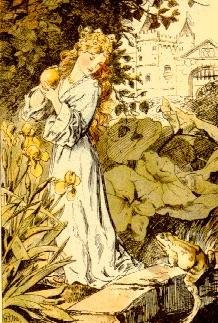
The Frog Prince is also known as The Frog-King, or Iron Henry, a story about a spoiled princess who has to make good on her promise of friendship with a frog.
Frequently Asked Questions about The Frog Prince
What is "The Frog Prince" about?
The Frog Prince tells the story of a spoiled young princess who loses her favorite golden ball in a deep well. A frog retrieves it for her in exchange for a promise that she will let him be her companion—eating from her plate, drinking from her cup, and sleeping in her bed. The princess agrees but immediately breaks her word and runs home without him. When the frog appears at the castle the next day, the King insists his daughter honor her promise. After being forced to share her meal and carry the frog to her room, the disgusted princess hurls him against the wall, whereupon he transforms into a handsome prince who had been cursed by a wicked witch. The story concludes with the arrival of the prince’s faithful servant Henry, whose iron-banded heart cracks open with joy at his master’s liberation.
What is the moral of "The Frog Prince" by the Brothers Grimm?
The central moral of The Frog Prince is that promises must be kept, even when fulfilling them is uncomfortable or inconvenient. The King represents moral authority, insisting that his daughter honor her word: "He who helped thee when thou wert in trouble ought not afterwards to be despised by thee." A secondary moral concerns judging by appearances—the princess dismisses the frog as a "disgusting" creature unworthy of human companionship, yet he proves to be a prince of noble character. The tale also suggests that true transformation sometimes requires confrontation rather than gentle compliance, since the curse is broken not by a kiss (as in popular retellings) but by the princess’s act of throwing the frog against a wall.
What are the main themes in "The Frog Prince"?
The major themes in The Frog Prince include transformation, the importance of keeping promises, and loyalty. The transformation theme operates on multiple levels: the frog physically transforms back into a prince, while the princess undergoes a moral transformation from a selfish child who breaks promises to someone who (reluctantly) fulfills her obligations. The theme of appearances versus reality runs throughout, as the ugly frog conceals a noble prince, and the beautiful princess conceals a dishonest nature. Finally, the subplot of Faithful Henry—whose heart was bound in iron bands out of grief for his enchanted master—introduces the theme of selfless devotion and loyalty, contrasting sharply with the princess’s reluctant compliance.
What does the golden ball symbolize in "The Frog Prince"?
The golden ball is widely interpreted as a symbol of the princess’s childhood innocence and sheltered world. It is described as her favorite plaything, and losing it in the deep well represents the loss of carefree youth. The well itself—"so deep that the bottom could not be seen"—symbolizes the unknown depths of the adult world and the unconscious. The frog’s ability to retrieve the ball from these depths suggests that maturity and growth require engaging with what is unfamiliar or even repulsive. Some scholars also note the golden ball’s association with perfection and completeness, making its loss a catalyst for the princess’s journey toward emotional and moral growth.
Who is Faithful Henry (Iron Henry) in "The Frog Prince"?
Faithful Henry (also called Iron Henry or Iron Heinrich) is the prince’s devoted servant who appears at the end of the tale. When his master was turned into a frog, Henry was so grief-stricken that he had three iron bands forged around his heart to keep it from bursting with sorrow. After the curse is broken and the prince rides away with the princess in a carriage drawn by eight white horses, the iron bands crack open one by one—a sound the prince mistakes for the carriage breaking. Henry’s role is so central to the original tale that the Grimms’ German title is actually Der Froschkönig oder der eiserne Heinrich (The Frog King, or Iron Heinrich), placing his loyalty on equal footing with the enchantment itself.
How does the frog turn back into a prince in the original story?
In the original version, the frog’s transformation is not caused by a kiss. Instead, the princess becomes "terribly angry" at the frog’s demands to sleep in her bed and hurls him against the wall with all her might, crying, "Now, thou wilt be quiet, odious frog!" When he falls, he transforms into a prince with "beautiful kind eyes." The popular image of the princess kissing the frog comes from later retellings and adaptations. The Grimms’ original version is notably more violent and psychologically complex—the curse is broken through an act of defiance and revulsion rather than affection, which has led to rich scholarly debate about the tale’s deeper meaning.
When was "The Frog Prince" first published?
The Frog Prince was first published in 1812 as the opening tale in the ’s landmark collection Kinder- und Hausmärchen (Children’s and Household Tales). Its placement as Tale No. 1 in the collection gave it a position of special prominence. Jacob and Wilhelm Grimm revised the story across multiple editions of their collection, with the version most widely known today coming from the final 1857 edition. The tale belongs to the Aarne–Thompson–Uther classification type ATU 440, "The Frog King," a story type found across European folklore traditions.
What literary devices are used in "The Frog Prince"?
The Frog Prince employs several classic fairy tale literary devices. Personification appears immediately in the opening line—"In old times when wishing still helped one"—establishing a world where nature responds to human desire. The frog’s ability to speak introduces the grotesque and the carnivalesque, blurring the boundary between animal and human. Symbolism pervades the tale: the deep well, the golden ball, the iron bands on Henry’s heart. The story uses the rule of three (three iron bands that crack one by one) and repetition (the frog’s verse at the door). Irony operates throughout, as the princess who despises the frog ends up marrying him, and the act of violence that should destroy him instead liberates him. The tale also relies on contrast—beauty versus ugliness, promise versus betrayal, selfishness versus Faithful Henry’s devotion.
What do the iron bands on Henry’s heart symbolize in "The Frog Prince"?
The three iron bands around Faithful Henry’s heart are a powerful symbol of grief physically contained. When the prince was cursed, Henry’s sorrow was so intense that he feared his heart would literally burst, so he had the bands forged to hold it together. Their cracking as the freed prince rides away represents the release of long-suppressed emotion and the restoration of joy. The image also serves as a counterpoint to the princess’s shallow feelings—while she was repulsed by a frog, Henry’s love for his master was so deep it required iron to contain. Some scholars read the bands as symbolizing the way people armor themselves against pain, and their breaking as a reminder that true happiness requires emotional vulnerability.
How is "The Frog Prince" different from "The Princess and the Frog"?
The original tale differs dramatically from the popular "princess kisses a frog" version most people know. In the Grimms’ story, there is no kiss—the princess throws the frog against a wall in anger, and this act of violence breaks the spell. The popular kissing version emerged from later 19th-century English retellings that softened the story. The Grimm original also includes the Faithful Henry subplot, which is absent from most modern adaptations. Disney’s 2009 film The Princess and the Frog takes even greater liberties, setting the story in 1920s New Orleans and having the princess herself turn into a frog. The original tale is darker, more psychologically complex, and focused on themes of obligation and moral duty rather than romantic love.
Save stories, build your reading list, and access all study tools — completely free.
Save The Frog Prince to your library — it's free!Need help with The Frog Prince?
Study tools to help with homework, prepare for quizzes, and deepen your understanding.
Flashcards → | Vocabulary → | Study Guide →