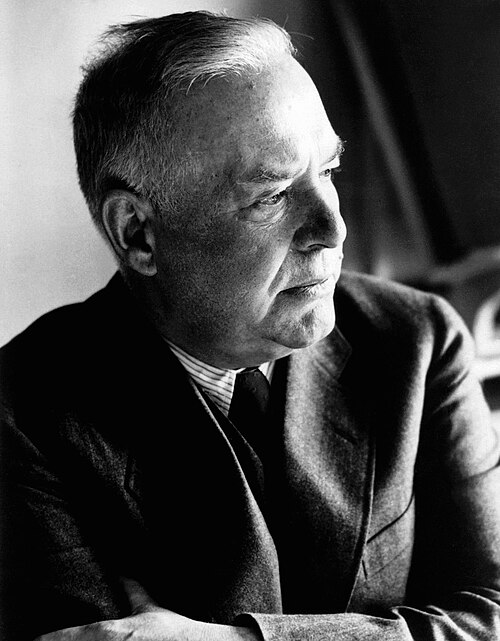
Wallace Stevens (1879–1955) was one of the most important American poets of the twentieth century. Born in Reading, Pennsylvania, Stevens studied at Harvard and then New York Law School. He spent most of his adult life working as an insurance executive at the Hartford Accident and Indemnity Company in Connecticut, writing poetry in his spare time — a duality that has fascinated literary scholars.
His first collection, Harmonium (1923), contained many of his most celebrated poems, including "Thirteen Ways of Looking at a Blackbird," "The Emperor of Ice-Cream," and "Sunday Morning." Though initially overlooked, the collection is now recognized as one of the landmark volumes of American modernist poetry.
Stevens received the Pulitzer Prize for Poetry in 1955 for his Collected Poems. His work explores the interplay between imagination and reality, the role of poetry in a world without religious certainty, and the ways language creates meaning. His influence on subsequent generations of American poets has been profound.