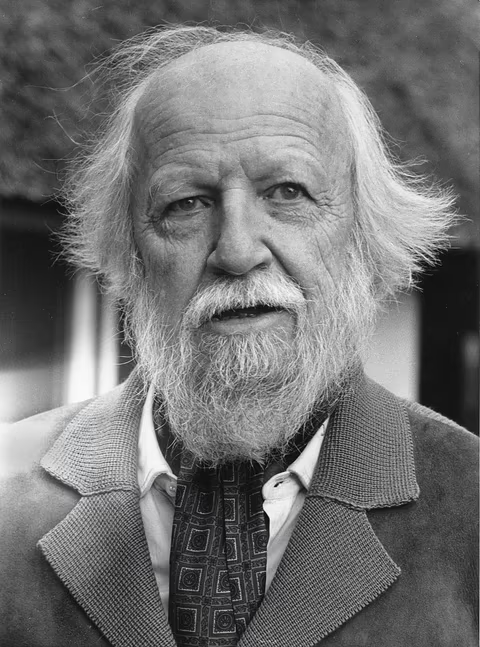
Quick Facts
Sir William Gerald Golding
Born: 1911
Died: 1993
Nationality: British
Genres: Novel, Allegory, Dystopian Fiction
Notable Works: Lord of the Flies
William Golding (1911–1993)
William Golding, born William Gerald Golding (1911–1993), was a British novelist, playwright, and poet best known for his debut novel Lord of the Flies (1954). Awarded the Nobel Prize in Literature in 1983, Golding is celebrated for his dark, allegorical explorations of human nature, civilization, and the thin veneer of social order that separates humanity from savagery.
Early Life and Education
Golding was born on September 19, 1911, in Newquay, Cornwall, England. His father, Alec Golding, was a schoolteacher with strong rationalist convictions, while his mother, Mildred, was a suffragette. The family moved to Marlborough, Wiltshire, where Golding grew up and attended Marlborough Grammar School, where his father taught. He went on to study natural sciences at Brasenose College, Oxford, but switched to English literature after two years, graduating in 1935. He also published a small volume of poetry that same year, though he later dismissed it as juvenile.
War Service and Teaching
Golding briefly worked as a teacher, actor, and musician before enlisting in the Royal Navy in 1940. His wartime experiences profoundly shaped his worldview. He participated in the D-Day invasion of Normandy and witnessed the horrors of combat firsthand. The war shattered any idealistic notions he may have held about human goodness, and this disillusionment became the philosophical bedrock of his fiction. After the war, he returned to teaching English and philosophy at Bishop Wordsworth's School in Salisbury, where he remained until the success of his writing career allowed him to write full-time.
Career and Literary Contributions
Golding's first published novel, Lord of the Flies, was rejected by twenty-one publishers before Faber and Faber accepted it in 1954. The novel—an allegorical tale of schoolboys stranded on a desert island who descend into tribalism and violence—became one of the most widely read and taught novels of the twentieth century. Its unflinching examination of innate human cruelty struck a nerve in the postwar world.
He continued to explore themes of human darkness and moral complexity throughout his career. His subsequent novels, though less commercially successful than Lord of the Flies, earned critical admiration for their ambition and philosophical depth.
Notable Works
- Lord of the Flies (1954)—his landmark debut about boys marooned on an island, a parable of civilization's fragility
- The Inheritors (1955)—an imaginative reconstruction of Neanderthal consciousness encountering Homo sapiens
- Pincher Martin (1956)—the hallucinatory survival tale of a drowning naval officer
- Free Fall (1959)—an exploration of free will and moral responsibility
- The Spire (1964)—an obsessive medieval dean's quest to build an impossible cathedral spire
- Rites of Passage (1980)—winner of the Booker Prize, the first volume of his sea trilogy
- The Paper Men (1984)—a satirical novel about a novelist and his biographer
Personal Life and Legacy
Golding married Ann Brookfield in 1939, and they had two children, David and Judith. He was knighted in 1988 and received the Nobel Prize in Literature in 1983, with the Swedish Academy praising his novels for illuminating "the human condition in the world of today." He died on June 19, 1993, in Perranaworthal, Cornwall, leaving behind an unfinished novel, The Double Tongue, which was published posthumously in 1995.
Golding's influence on literature and education is immense. Lord of the Flies remains a staple of high school and university curricula worldwide, provoking generations of readers to confront uncomfortable truths about power, violence, and the darkness that lurks beneath the surface of civilization.
Interesting Facts
- Lord of the Flies was rejected by twenty-one publishers before being accepted—a fact Golding took with characteristic wry humor.
- His wartime experience commanding a rocket-launching craft during D-Day directly informed his bleak view of human nature.
- Golding was an accomplished musician who played piano, oboe, viola, and cello.
- He once said of his most famous novel: "The theme is an attempt to trace the defects of society back to the defects of human nature."
- Despite the success of Lord of the Flies, Golding considered The Inheritors his finest work.