ACT II - Scene III Romeo and Juliet

Previous Chapter Next Chapter

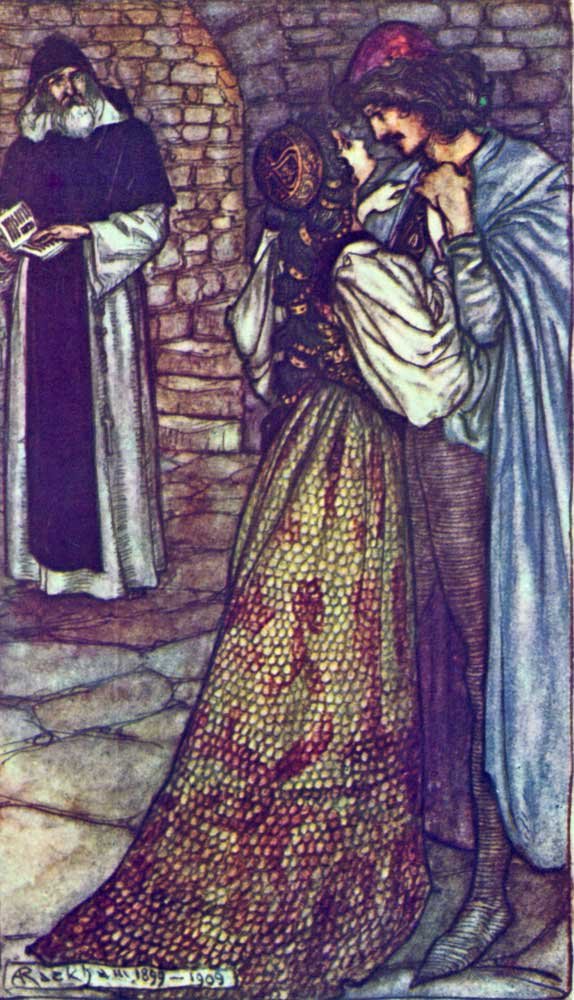
Friar Lawrence in his cell among herbs and potions
At the Cell of Friar Lawrence by Arthur Rackham

Friar Laurence's cell.

Enter Friar, [Laurence] alone, with a basket.

FRIAR
The grey-ey'd morn smiles on the frowning night,
Check'ring the Eastern clouds with streaks of light;

And flecked darkness like a drunkard reels
From forth day's path and Titan's fiery wheels.
Non, ere the sun advance his burning eye
The day to cheer and night's dank dew to dry,
I must up-fill this osier cage of ours
With baleful weeds and precious-juiced flowers.
The earth that's nature's mother is her tomb.
What is her burying gave, that is her womb;

And from her womb children of divers kind
We sucking on her natural bosom find;

Many for many virtues excellent,
None but for some, and yet all different.
O, mickle is the powerful grace that lies
In plants, herbs, stones, and their true qualities;

For naught so vile that on the earth doth live
But to the earth some special good doth give;

Nor aught so good but, strain'd from that fair use,
Revolts from true birth, stumbling on abuse.
Virtue itself turns vice, being misapplied,
And vice sometime's by action dignified.
Within the infant rind of this small flower
Poison hath residence, and medicine power;

For this, being smelt, with that part cheers each part;

Being tasted, slays all senses with the heart.
Two such opposed kings encamp them still
In man as well as herbs- grace and rude will;

And where the worser is predominant,
Full soon the canker death eats up that plant.

Enter Romeo.

ROMEO
Good morrow, father.

FRIAR
Benedicite!
What early tongue so sweet saluteth me?
Young son, it argues a distempered head
So soon to bid good morrow to thy bed.
Care keeps his watch in every old man's eye,
And where care lodges sleep will never lie;

But where unbruised youth with unstuff'd brain
Doth couch his limbs, there golden sleep doth reign.
Therefore thy earliness doth me assure
Thou art uprous'd with some distemp'rature;

Or if not so, then here I hit it right-
Our Romeo hath not been in bed to-night.

ROMEO
That last is true-the sweeter rest was mine.

FRIAR
God pardon sin! Wast thou with Rosaline?

ROMEO
With Rosaline, my ghostly father? No.
I have forgot that name, and that name's woe.

FRIAR
That's my good son! But where hast thou been then?

ROMEO
I'll tell thee ere thou ask it me again.
I have been feasting with mine enemy,
Where on a sudden one hath wounded me
That's by me wounded. Both our remedies
Within thy help and holy physic lies.
I bear no hatred, blessed man, for, lo,
My intercession likewise steads my foe.

FRIAR
Be plain, good son, and homely in thy drift
Riddling confession finds but riddling shrift.

ROMEO
Then plainly know my heart's dear love is set
On the fair daughter of rich Capulet;

As mine on hers, so hers is set on mine,
And all combin'd, save what thou must combine
By holy marriage. When, and where, and how
We met, we woo'd, and made exchange of vow,
I'll tell thee as we pass;
but this I pray,
That thou consent to marry us to-day.

FRIAR
Holy Saint Francis! What a change is here!
Is Rosaline, that thou didst love so dear,
So soon forsaken? Young men's love then lies
Not truly in their hearts, but in their eyes.
Jesu Maria! What a deal of brine
Hath wash'd thy sallow cheeks for Rosaline!
How much salt water thrown away in waste,
To season love, that of it doth not taste!
The sun not yet thy sighs from heaven clears,
Thy old groans ring yet in mine ancient ears.
Lo, here upon thy cheek the stain doth sit
Of an old tear that is not wash'd off yet.
If e'er thou wast thyself, and these woes thine,
Thou and these woes were all for Rosaline.
And art thou chang'd? Pronounce this sentence then:
Women may fall when there's no strength in men.

ROMEO
Thou chid'st me oft for loving Rosaline.

FRIAR
For doting, not for loving, pupil mine.

ROMEO
And bad'st me bury love.

FRIAR
Not in a grave
To lay one in, another out to have.

ROMEO
I pray thee chide not. She whom I love now
Doth grace for grace and love for love allow.
The other did not so.

FRIAR
O, she knew well
Thy love did read by rote, that could not spell.
But come, young waverer, come go with me.
In one respect I'll thy assistant be;

For this alliance may so happy prove
To turn your households' rancour to pure love.

ROMEO
O, let us hence! I stand on sudden haste.

FRIAR
Wisely, and slow. They stumble that run fast.

Exeunt.

Frequently Asked Questions about ACT II - Scene III from Romeo and Juliet

What happens in Act 2, Scene 3 of Romeo and Juliet?

Act 2, Scene 3 takes place at dawn in Friar Laurence's cell. The scene opens with the Friar gathering herbs and delivering a soliloquy about the duality of nature—how the same plant can contain both poison and medicine. Romeo arrives and reveals that he has fallen in love with Juliet Capulet and wants to marry her immediately. The Friar is initially shocked by Romeo's sudden abandonment of Rosaline, chiding him for his fickleness. However, he ultimately agrees to perform the marriage, hoping that the union between a Montague and a Capulet will end the long-standing feud between the two families.

What is the significance of Friar Laurence's soliloquy about plants in Act 2, Scene 3?

Friar Laurence's soliloquy about herbs and flowers is one of the most thematically significant speeches in the play. He observes that a single small flower can contain both "poison" and "medicine power"—it heals when smelled but kills when tasted. This meditation on duality serves as a metaphor for the entire play: love and hate, life and death, virtue and vice exist side by side. The speech also functions as foreshadowing, directly anticipating the sleeping potion the Friar will later give Juliet—a "medicine" meant to save her that ultimately contributes to both lovers' deaths.

Why does Friar Laurence agree to marry Romeo and Juliet?

Despite his reservations about Romeo's sudden shift from Rosaline to Juliet, Friar Laurence agrees to perform the marriage for a strategic reason: he hopes "this alliance may so happy prove / To turn your households' rancour to pure love." In other words, the Friar believes the marriage could end the Montague-Capulet feud that has plagued Verona. This decision reveals the Friar as both a caring mentor and a political pragmatist willing to take risks. It is also an example of dramatic irony, since the audience already knows from the Prologue that the lovers are "star-cross'd" and that it will take their deaths—not their marriage—to reconcile the families.

What does Friar Laurence mean by "Young men's love then lies / Not truly in their hearts, but in their eyes"?

With this couplet, Friar Laurence criticizes Romeo for falling in and out of love based on physical appearance rather than genuine emotional connection. The Friar points out that Romeo wept endlessly over Rosaline, yet has now completely forgotten her after one look at Juliet. The line suggests that young men's affections are driven by sight—superficial attraction—rather than deep feeling. This observation raises a central question of the play: is Romeo's love for Juliet truly different from his infatuation with Rosaline, or is he simply repeating the same pattern? The Friar's earlier distinction between "doting" (mere infatuation) and "loving" (true affection) underscores this theme.

What literary devices does Shakespeare use in Act 2, Scene 3 of Romeo and Juliet?

Shakespeare employs several key literary devices in this scene. Foreshadowing is the most prominent: the Friar's discussion of a flower containing both poison and medicine anticipates the sleeping potion he later gives Juliet, and his warning "They stumble that run fast" predicts the tragic consequences of the lovers' haste. Personification appears in the opening lines, where the "grey-ey'd morn smiles on the frowning night" and darkness reels "like a drunkard." Dramatic irony pervades the scene, since the audience knows the lovers are doomed while the Friar optimistically expects their marriage to end the feud. Shakespeare also uses antithesis throughout—tomb and womb, poison and medicine, grace and rude will—to reinforce the theme of duality that defines the entire play.

How does Act 2, Scene 3 foreshadow the ending of Romeo and Juliet?

This scene is rich with foreshadowing of the play's tragic conclusion. The Friar's observation that a single flower holds both "poison" and "medicine power" directly anticipates the sleeping potion he will give Juliet in Act 4—a well-intentioned remedy that leads to catastrophe. His warning that "where the worser is predominant, / Full soon the canker death eats up that plant" foreshadows how the destructive forces of the feud will consume the young lovers. The Friar's closing advice, "Wisely, and slow. They stumble that run fast," proves prophetic: Romeo and Juliet's haste to marry, combined with a series of rushed decisions and missed messages, ultimately leads to their deaths. Even the Friar's hope that the marriage will end the feud is ironically fulfilled—but only through the lovers' sacrifice, not through the peaceful reconciliation he envisioned.


Previous Chapter Next Chapter
Return to the Romeo and Juliet Summary Return to the William Shakespeare Library