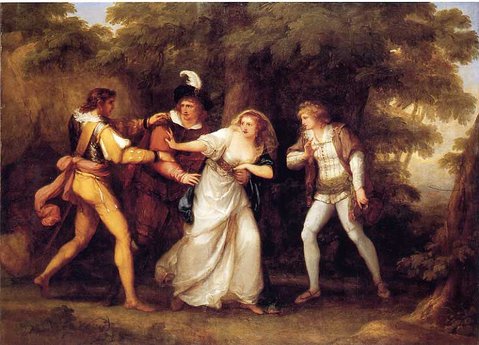
The Two Gentlemen of Verona

The Two Gentlemen of Verona, believed to have been written around 1589, is one of Shakespeare's earliest comedies and his first exploration of romantic love. The play follows two close friends, Valentine and Proteus, whose bond is tested when both fall in love with the same woman, Silvia. Valentine travels to Milan, where he falls in love with the Duke's daughter Silvia, while Proteus, despite being pledged to the faithful Julia, follows and treacherously pursues Silvia for himself, betraying both his friend and his beloved.
Julia, disguised as a boy named Sebastian, follows Proteus to Milan and becomes his page, painfully witnessing his faithlessness from within his own household. The banished Valentine becomes the leader of a band of outlaws in the forest, and the play's climax brings all four lovers together for a confrontation that tests the limits of friendship and forgiveness. The resolution, in which Valentine offers Silvia to Proteus as a token of friendship, has troubled audiences and scholars for centuries, though it powerfully dramatizes the play's central tension between the claims of male friendship and romantic love.
Despite its occasional roughness, The Two Gentlemen of Verona is significant as the first appearance of many themes and devices Shakespeare would develop throughout his career: the disguised heroine, the journey into a green world, the conflict between love and friendship, and the power of constancy. The play also features one of Shakespeare's most delightful comic servants in the clownish Launce and his beloved dog Crab.