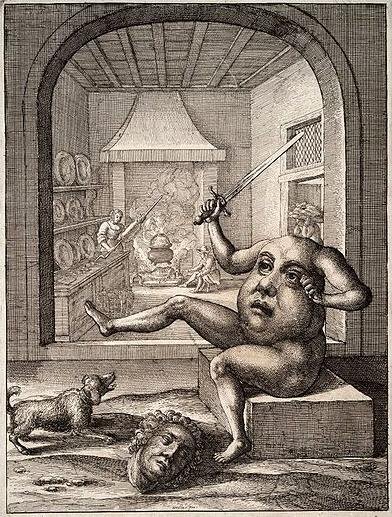
The Belly and the Members (Perry Index 130) is one of Aesop's most politically influential fables, a parable about cooperation and the interdependence of all parts of a community. The Roman historian Livy records in his History of Rome (2.32) that the senator Menenius Agrippa told this very fable to the Roman plebeians during the First Secession in 494 BCE, persuading them to end their withdrawal from the patrician class and return to the city. The story became a foundational metaphor for the "body politic" in Western political thought. William Shakespeare dramatized it in the opening scene of Coriolanus (c. 1608), where Menenius uses the fable to quell a mob of starving citizens, arguing that the Senate, like the belly, distributes nourishment to all.
Once upon a time, the different parts of the human body began to grumble against the Belly.
"It is not fair," said the Hands, "that we should do all the work while you sit idle in the middle, enjoying everything that comes along."
"Indeed," agreed the Mouth. "I do all the chewing, and for what? Only to feed this lazy Belly, who does nothing at all."
"And I," said the Teeth, "grind every morsel to bits, yet it is always the Belly who reaps the reward."
So the Hands, the Mouth, and the Teeth agreed upon a plan. They would refuse to feed the Belly any longer. Let it shift for itself! The Hands would carry no food, the Mouth would not open, and the Teeth would not chew.
For a day or two, the rebels held firm and felt quite proud of themselves. But soon the Hands began to tremble, the Mouth grew dry, the Teeth chattered, and the Legs could barely hold up the body. Every part grew weak and faint.
At last, the members understood what they had not seen before. The Belly, in its quiet way, had been working all along—receiving the food, digesting it, and sending nourishment through the blood to every part of the body. Without it, they could not survive, and without them, it could not be fed.
And so they all went back to work together, each doing its part, and the body was well again.
Frequently Asked Questions about The Belly and the Members
What is the moral of "The Belly and the Members"?
The moral is that every part of a community or system plays an essential role, even when its contribution is not immediately visible. The body's members discover that the belly's quiet work of digestion is what sustains them all — without cooperation, the entire system collapses.
Who was Menenius Agrippa and how did he use this fable?
Menenius Agrippa was a Roman senator who, according to the historian Livy, told this fable to the plebeians during the First Secession of 494 BCE. The common people had withdrawn from Rome in protest against the patricians. Menenius compared the Senate to the belly and the people to the limbs, arguing that both needed each other. His speech reportedly persuaded the plebeians to return to the city.
How does Shakespeare use "The Belly and the Members" in Coriolanus?
Shakespeare dramatizes the fable in the opening scene of Coriolanus (c. 1608). The character Menenius tells the story to a mob of hungry citizens demanding grain, arguing that the Senate distributes nourishment to all of Rome just as the belly feeds the body. Shakespeare adds complexity by making the allegory seem self-serving — the audience can see that those in power use the fable to justify their position rather than address genuine grievances.
What is the Perry Index number for this fable?
This fable is number 130 in the Perry Index, the standard scholarly reference system for Aesop's fables compiled by Ben Edwin Perry. It appears in numerous ancient sources, including Livy's History of Rome and Plutarch's Life of Coriolanus.
What does "body politic" mean and how does this fable relate to it?
The "body politic" is a metaphor comparing a nation or community to a human body, where each group of people functions like a different organ. "The Belly and the Members" is considered the origin of this concept in Western political thought. The fable argues that rulers, workers, and all citizens are interdependent — just as the body's organs cannot function without each other.
Is this fable still relevant today?
Yes. The fable's core tension — between visible labor and invisible but essential contributions — appears in modern debates about management versus workers, government versus citizens, and any organization where some roles seem more productive than others. It remains a powerful argument for recognizing that every role in a system has value, while also raising the question of whether those in power genuinely contribute or merely consume.
What is the difference between Aesop's version and Livy's version of the fable?
Aesop's version focuses on the simple moral about cooperation: the members rebel, grow weak, and learn their lesson. Livy's version in History of Rome (Book 2, Chapter 32) embeds the fable in a specific historical event — the plebeian secession of 494 BCE — and uses it as a political argument for class cooperation in Roman society. Shakespeare's later version in Coriolanus adds dramatic irony by showing how the powerful use the fable to maintain control.
What other Aesop fables teach similar lessons about cooperation and consequences?
Several of Aesop's fables explore themes of cooperation, interdependence, and the consequences of selfishness. The Fisherman and the Little Fish warns against greed when a sure gain is at hand. The Lion and the Ass shows what happens when unequal partners fail to respect each other. The Farmer and the Snake reveals the danger of ignoring the true nature of those you help. The Frog and the Mouse demonstrates how betraying a partner's trust leads to mutual destruction.
Save stories, build your reading list, and access all study tools — completely free.
"The Belly and the Members" is one of the most enduring political allegories in Western literature. On its surface, the fable tells a simple story: the …
...
Advertisement
Understanding The Belly and the Members
A short summary of the story
Why Every Role Matters: The Fable Explained
"The Belly and the Members" is one of the most enduring political allegories in Western literature. On its surface, the fable tells a simple story: the hands, mouth, and teeth grow resentful of the belly, which appears to sit idle while they do all the work. They go on strike — and quickly discover that without the belly's quiet labor of digestion, the entire body collapses.
The moral is deceptively straightforward: every part of a system contributes something essential, even when its work is invisible. The belly doesn't lift, chew, or carry, but it transforms raw food into the energy that powers every other organ. Strip it away, and the hardest-working hands in the world will tremble and fail.
What makes this fable extraordinary is its real-world political history. In 494 BCE, Rome's common citizens — the plebeians — withdrew from the city in protest against the ruling patricians, who they believed exploited their labor while contributing nothing. The senator Menenius Agrippa reportedly told them this very fable, casting the Senate as the belly and the people as the limbs. His argument worked: the plebeians returned, and the crisis ended. Whether or not the story is historically accurate, the Roman historian Livy recorded it as a turning point in Rome's class struggles.
More than two thousand years later, Shakespeare placed the same fable in the opening scene of Coriolanus. His version is more complex and more cynical — Menenius tells the story to a mob of starving citizens demanding grain, using the fable to justify the Senate's hoarding of resources. Shakespeare understood that the allegory cuts both ways: it can argue for genuine cooperation, or it can be weaponized by those in power to silence legitimate grievances.
That tension is what keeps the fable alive today. In workplaces, families, and nations, the same question recurs: is the person who appears idle truly contributing behind the scenes, or are they simply taking credit for others' labor? The fable doesn't answer that question — it merely insists that you investigate before you revolt. Sometimes the belly really is doing essential, invisible work. And sometimes it isn't.
The deepest lesson is about interdependence. No part of a system can thrive alone. The hands need the belly as much as the belly needs the hands. When any part stops contributing — or when the others stop recognizing its contribution — the whole system fails.
Advertisement
Find this helpful? Create a free account to bookmark stories and save explanations for quick reference.