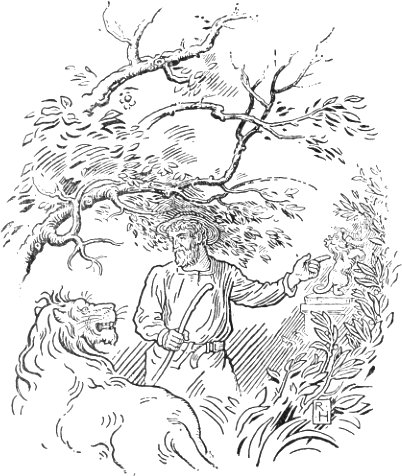
The Lion and the Statue (Perry Index 284) is a remarkably modern insight about how narratives are shaped by their tellers, attributed to Aesop. Also known as "The Man and the Lion," this fable appears in Phaedrus and was retold by La Fontaine and Joseph Jacobs. It cautions that art, history, and argument often reflect the bias of their creator rather than objective truth — a lesson as relevant today as it was in antiquity.
A Man and a Lion were traveling together through the hills, and each began to boast of his own strength and prowess.
They argued back and forth as they walked, neither willing to give way. Presently they came upon a stone statue of Hercules strangling a lion.
"See!" cried the Man, pointing to the statue. "There is proof enough that men are stronger than lions. Look how the man has that lion in his grip!"
"That proves nothing at all," replied the Lion calmly. "If lions could make statues, you may be sure that in every one of them you would see the man underneath the lion's paw."
Frequently Asked Questions about The Lion and the Statue
What is the moral of The Lion and the Statue?
The moral is "It matters who tells the story." The fable teaches that evidence and art often reflect the bias of their creator rather than objective truth. The Man uses a human-made statue as proof of human superiority, but the Lion points out that the sculptor was a man — if lions could carve, the scene would be reversed. The lesson warns us to consider the source behind any claim before accepting it as fact.
What is the Perry Index number for this fable?
The Lion and the Statue is Perry Index 284. It is also widely known as "The Man and the Lion." The Perry Index is the standard scholarly numbering system for Aesop's fables, created by classicist Ben Edwin Perry in 1952 to organize the hundreds of fables attributed to the Aesopic tradition.
How does the Lion's argument challenge the Man's evidence?
The Man points to a statue of Hercules strangling a lion and declares it proof that men are stronger. The Lion's brilliant reply exposes the flaw: the statue was made by a human, so of course it flatters human strength. If lions were the artists, every statue would show a lion standing over a defeated man. The Lion doesn't dispute the Man's claim directly — he undermines the evidence itself by revealing its built-in bias.
What does this fable teach about bias and perspective?
The fable is an early exploration of what we now call confirmation bias and narrative framing. It shows that the way information is presented depends on who creates it. Just as the sculptor shaped the statue to flatter humanity, storytellers, historians, and media shape narratives to suit their perspective. The fable encourages critical thinking: before accepting any claim, ask who made it and what viewpoint they represent.
Are there different versions of The Man and the Lion?
Yes, several notable variations exist. In the Greek rhetorician Aphthonius's version, the lion simply refuses the statue as evidence once he learns a man carved it. In Ademar of Chabannes's Latin version, the lion takes the man to an amphitheatre to show what happens in real combat. William Caxton's 15th-century English retelling has the lion pounce on the man to make the point physically. La Fontaine included it in his famous French collection, and Joseph Jacobs retold it for English-speaking children.
How is this fable relevant today?
The fable's lesson about source credibility is more relevant than ever in an age of media literacy concerns, algorithmic content curation, and competing narratives. It anticipates modern ideas like "history is written by the victors" and the importance of seeking multiple perspectives. Whether evaluating news stories, political arguments, or advertising claims, the Lion's challenge — consider who made this and why — remains essential critical thinking advice.
What other Aesop fables explore similar themes of perspective?
Several Aesop fables examine how perspective shapes judgment. The Fisherman and the Little Fish shows how self-interest colors decisions about value. The Boys and the Frogs powerfully illustrates how the same event looks entirely different depending on which side you're on. The Wolf and the Kid explores how safety changes what someone dares to say, and The Boy Bathing examines how people assign blame based on their own position rather than the facts.
Why is The Lion and the Statue considered one of Aesop's most important fables?
While many of Aesop's fables teach practical moral lessons — don't be greedy, work hard, be honest — this fable operates on a higher philosophical level. It questions the very nature of evidence and truth, making it an early work of epistemology (the study of knowledge). The Lion doesn't just win an argument; he reveals that all arguments are shaped by the arguer. This meta-awareness about storytelling and representation makes it one of the most intellectually sophisticated fables in the entire Aesopic canon.
Save stories, build your reading list, and access all study tools — completely free.
A Man and a Lion travel together, each boasting about the superior strength of his kind. When they pass a statue of Hercules strangling a lion, the Man triumphantly points to it as …
...
Advertisement
Understanding The Lion and the Statue
A short summary of the story
Summary
A Man and a Lion travel together, each boasting about the superior strength of his kind. When they pass a statue of Hercules strangling a lion, the Man triumphantly points to it as proof that humans are mightier. The Lion calmly replies that the statue was carved by a man — if lions were the sculptors, the image would show the opposite scene entirely.
Meaning and Moral
The moral — "It matters who tells the story" — is one of the most sophisticated ideas in all of Aesop. The fable warns that evidence, art, and argument often reflect the bias of their creator rather than objective reality. The Man treats a human-made statue as neutral proof, but the Lion recognizes it as propaganda: a narrative shaped by the hands that built it.
This insight applies far beyond ancient sculpture. Whenever we encounter a claim presented as fact — in news, history, advertising, or everyday debate — the fable asks us to consider the source. Who made this? What perspective does the creator have? What would the story look like if told by the other side?
Historical Context
Listed as Perry Index 284, this fable is also known as "The Man and the Lion." It appears in multiple ancient and medieval traditions. In Aphthonius's Greek version, the lion simply refuses to accept the statue as evidence once he learns a man carved it. In the Latin version by Ademar of Chabannes, the lion takes the man to an amphitheatre to demonstrate real combat. William Caxton's English retelling has the lion pounce on the man to make its point physically. La Fontaine and Joseph Jacobs both retold the fable, keeping its core argument about the unreliability of self-serving evidence.
The fable resonates with modern concepts like confirmation bias, media literacy, and the idea that "history is written by the victors." Its brevity belies its depth — in just a few sentences, Aesop captures an epistemological problem that philosophers and journalists still grapple with today.
Advertisement
Find this helpful? Create a free account to bookmark stories and save explanations for quick reference.