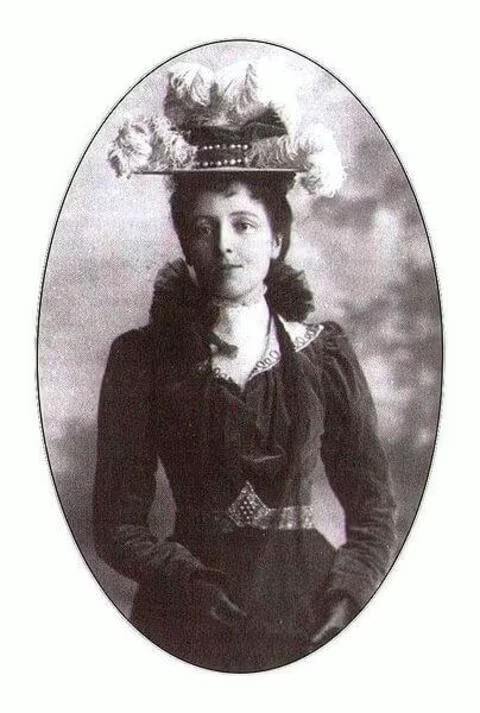
Quick Facts
Lucy Maud Montgomery
Pen Name: L. M. Montgomery
Born: November 30, 1874
Died: April 24, 1942
Nationality: Canadian
Genres: Children's Literature, Coming-of-Age, Regional Fiction, Realism
Notable Works: Anne of Green Gables, Anne of Avonlea, Emily of New Moon, The Blue Castle, The Story Girl
👶 Early Life and Education
Lucy Maud Montgomery was born on November 30, 1874, in Clifton (now New London), Prince Edward Island, Canada. When she was only twenty-one months old, her mother, Clara Woolner Macneill Montgomery, died of tuberculosis. Her father, Hugh John Montgomery, left her in the care of her maternal grandparents, Alexander and Lucy Woolner Macneill, in the small community of Cavendish, PEI. Raised as an only child by her elderly grandparents, young Maud found companionship in nature, books, and her own vivid imagination — the same imagination that would later create one of literature's most beloved heroines.
Montgomery began writing at an early age and published her first poem at fifteen. She earned her teaching certificate from Prince of Wales College in Charlottetown, completing the two-year program in a single year, and briefly studied English literature at Dalhousie University in Halifax, Nova Scotia. She worked as a teacher and journalist before returning to Cavendish to care for her aging grandmother, a period during which she wrote prolifically — publishing over a hundred stories in magazines between 1897 and 1907.
📖 Literary Career and Breakthrough
In 1908, Montgomery published Anne of Green Gables, the story of a delightfully bright and not-afraid-to-speak-her-mind young orphan who finds her place in the world on Prince Edward Island. The novel was an immediate international sensation, selling 19,000 copies in its first five months. Mark Twain praised it, calling Anne "the dearest and most lovable child in fiction since the immortal Alice." The success launched a series of eight novels following Anne Shirley from girlhood through marriage and motherhood, including Anne of Avonlea (1909), Anne of the Island (1915), Anne's House of Dreams (1917), Rainbow Valley (1919), and Rilla of Ingleside (1921) — the only Canadian novel about World War I written from a woman's perspective by a contemporary author.
Beyond the Anne series, Montgomery wrote twenty novels in total, along with more than five hundred short stories and five hundred poems. Her Emily of New Moon trilogy (1923–1927), which she considered more autobiographical than the Anne books, follows an aspiring young writer on PEI and is beloved for its darker, more introspective tone. The Blue Castle (1926), her only novel not set on Prince Edward Island, has become a cult favorite among adult readers.
🌿 Writing Style and Themes
Montgomery's prose is characterized by lyrical nature descriptions, gentle humor, and an abiding faith in the human spirit. Her writing transforms the red clay roads, birch groves, and seaside cliffs of Prince Edward Island into what she called "the most beautiful place on earth." She drew from her own experiences of rural Maritime life but elevated them through romantic idealism, creating worlds where imagination, kindness, and perseverance triumph over hardship. Her heroines — Anne, Emily, Pat, and Jane — are spirited, intelligent, and fiercely individual, qualities that have resonated with readers across cultures and generations.
❤️ Personal Life
In 1911, following her grandmother's death, Montgomery married Reverend Ewan Macdonald, a Presbyterian minister, and moved to Leaskdale, Ontario. They had three sons: Chester (1912), Hugh (1914, stillborn), and Stuart (1915). Her marriage was often difficult — Ewan suffered from severe bouts of religious melancholia, and Montgomery bore the burden of concealing his illness while fulfilling her public duties as a minister's wife and celebrated author. She fought a bitter, decade-long legal battle with her first publisher, L.C. Page & Company, who had cheated her of royalties.
Montgomery kept detailed journals throughout her life, later published in five volumes, that reveal a woman of remarkable depth — joyful and witty in public, yet privately struggling with depression and the weight of maintaining appearances. "It's been my experience that you can nearly always enjoy things if you make up your mind firmly that you will," Anne Shirley declares in Anne of Green Gables — a philosophy Montgomery championed in her fiction even when her own life tested it severely.
✨ Legacy and Significance
Montgomery died on April 24, 1942, in Toronto. She is buried in Cavendish Community Cemetery on Prince Edward Island. Her works have been translated into thirty-six languages and have sold over fifty million copies worldwide. In a 1999 CBC millennium poll, Canadians named her the most influential Canadian writer of the twentieth century. She was named an Officer of the Order of the British Empire and a Person of National Historic Significance by the Government of Canada.
Anne of Green Gables holds an extraordinary place in Japanese culture — translated into Japanese in 1952, adapted into a landmark 1979 anime by Isao Takahashi with scene design by Hayao Miyazaki, and included in Japan's national school curriculum, the novel has made Prince Edward Island a pilgrimage site for Japanese visitors. Montgomery's Cavendish home is now a National Historic Site, and Green Gables farm anchors Prince Edward Island National Park — a testament to the enduring power of her imagined worlds to shape real landscapes.
⭐ Interesting Facts
- Montgomery wrote most of Anne of Green Gables at her grandmother's kitchen table in Cavendish, often working late at night after her household duties were complete.
- She published her first poem, "On Cape LeForce," at age fifteen in a Charlottetown newspaper.
- Her poem "The Watchman," about a Roman guard at Christ's tomb, was recited at her own funeral.
- Rilla of Ingleside (1921) is the only Canadian novel about World War I written from a woman's perspective by a contemporary writer.
- Montgomery preferred to be called "Maud" (without the 'e') and disliked the name Lucy.
Frequently Asked Questions about Lucy Maud Montgomery
Where can I find study guides for Lucy Maud Montgomery's stories?
We offer free interactive study guides for the following Lucy Maud Montgomery stories:
- Christmas at Red Butte — comprehension questions, vocabulary review, and discussion prompts
- The Gossip of Valley View — comprehension questions, vocabulary review, and discussion prompts
- Uncle Richard's New Year Dinner — comprehension questions, vocabulary review, and discussion prompts