About Barbers
by Mark Twain
About Barbers is featured in our study guide as a fine example in the genre of Realism
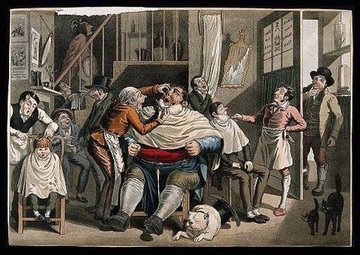
All things change except barbers, the ways of barbers, and the surroundings of barbers. These never change. What one experiences in a barber's shop the first time he enters one is what he always experiences in barbers' shops afterward till the end of his days. I got shaved this morning as usual. A man approached the door from Jones Street as I approached it from Main -- a thing that always happens. I hurried up, but it was of no use; he entered the door one little step ahead of me, and I followed in on his heels and saw him take the only vacant chair, the one presided over by the best barber. It always happens so. I sat down, hoping that I might fall heir to the chair belonging to the better of the remaining two barbers, for he had already begun combing his man's hair, while his comrade was not yet quite done rubbing up and oiling his customer's locks. I watched the probabilities with strong interest. When I saw that No. 2 was gaining on No. 1 my interest grew to solicitude. When No. 1 stopped a moment to make change on a bath ticket for a new-comer, and lost ground in the race, my solicitude rose to anxiety. When No. 1 caught up again, and both he and his comrade were pulling the towels away and brushing the powder from their customers' cheeks, and it was about an even thing which one would say "Next!" first, my very breath stood still with the suspense. But when at the culminating moment No. 1 stopped to pass a comb a couple of times through his customer's eyebrows, I saw that he had lost the race by a single instant, and I rose indignant and quitted the shop, to keep from falling into the hands of No. 2; for I have none of that enviable firmness that enables a man to look calmly into the eyes of a waiting barber and tell him he will wait for his fellow-barber's chair.
I stayed out fifteen minutes, and then went back, hoping for better luck. Of course all the chairs were occupied now, and four men sat waiting, silent, unsociable, distraught, and looking bored, as men always do who are waiting their turn in a barber's shop. I sat down in one of the iron-armed compartments of an old sofa, and put in the time far a while reading the framed advertisements of all sorts of quack nostrums for dyeing and coloring the hair. Then I read the greasy names on the private bayrum bottles; read the names and noted the numbers on the private shaving-cups in the pigeonholes; studied the stained and damaged cheap prints on the walls, of battles, early Presidents, and voluptuous recumbent sultanas, and the tiresome and everlasting young girl putting her grandfather's spectacles on; execrated in my heart the cheerful canary and the distracting parrot that few barbers' shops are without. Finally, I searched out the least dilapidated of last year's illustrated papers that littered the foul center-table, and conned their unjustifiable misrepresentations of old forgotten events.
At last my turn came. A voice said "Next!" and I surrendered to -- No. 2, of course. It always happens so. I said meekly that I was in a hurry, and it affected him as strongly as if he had never heard it. He shoved up my head, and put a napkin under it. He plowed his fingers into my collar and fixed a towel there. He explored my hair with his claws and suggested that it needed trimming. I said I did not want it trimmed. He explored again and said it was pretty long for the present style -- better have a little taken off; it needed it behind especially. I said I had had it cut only a week before. He yearned over it reflectively a moment, and then asked with a disparaging manner, who cut it? I came back at him promptly with a "You did!" I had him there. Then he fell to stirring up his lather and regarding himself in the glass, stopping now and then to get close and examine his chin critically or inspect a pimple. Then he lathered one side of my face thoroughly, and was about to lather the other, when a dog-fight attracted his attention, and he ran to the window and stayed and saw it out, losing two shillings on the result in bets with the other barbers, a thing which gave me great satisfaction. He finished lathering, and then began to rub in the suds with his hand.
He now began to sharpen his razor on an old suspender, and was delayed a good deal on account of a controversy about a cheap masquerade ball he had figured at the night before, in red cambric and bogus ermine, as some kind of a king. He was so gratified with being chaffed about some damsel whom he had smitten with his charms that he used every means to continue the controversy by pretending to be annoyed at the chaffings of his fellows. This matter begot more surveyings of himself in the glass, and he put down his razor and brushed his hair with elaborate care, plastering an inverted arch of it down on his forehead, accomplishing an accurate "Part" behind, and brushing the two wings forward over his ears with nice exactness. In the mean time the lather was drying on my face, and apparently eating into my vitals.
Now he began to shave, digging his fingers into my countenance to stretch the skin and bundling and tumbling my head this way and that as convenience in shaving demanded. As long as he was on the tough sides of my face I did not suffer; but when he began to rake, and rip, and tug at my chin, the tears came. He now made a handle of my nose, to assist him shaving the corners of my upper lip, and it was by this bit of circumstantial evidence that I discovered that a part of his duties in the shop was to clean the kerosene-lamps. I had often wondered in an indolent way whether the barbers did that, or whether it was the boss.
About this time I was amusing myself trying to guess where he would be most likely to cut me this time, but he got ahead of me, and sliced me on the end of the chin before I had got my mind made up. He immediately sharpened his razor -- he might have done it before. I do not like a close shave, and would not let him go over me a second time. I tried to get him to put up his razor, dreading that he would make for the side of my chin, my pet tender spot, a place which a razor cannot touch twice without making trouble; but he said he only wanted to just smooth off one little roughness, and in the same moment he slipped his razor along the forbidden ground, and the dreaded pimple-signs of a close shave rose up smarting and answered to the call. Now he soaked his towel in bay rum, and slapped it all over my face nastily; slapped it over as if a human being ever yet washed his face in that way. Then he dried it by slapping with the dry part of the towel, as if a human being ever dried his face in such a fashion; but a barber seldom rubs you like a Christian. Next he poked bay ruin into the cut place with his towel, then choked the wound with powdered starch, then soaked it with bay rum again, and would have gone on soaking and powdering it forevermore, no doubt, if I had not rebelled and begged off. He powdered my whole face now, straightened me up, and began to plow my hair thoughtfully with his hands. Then he suggested a shampoo, and said my hair needed it badly, very badly. I observed that I shampooed it myself very thoroughly in the bath yesterday. I "had him" again. He next recommended some of "Smith's Hair Glorifier," and offered to sell me a bottle. I declined. He praised the new perfume, "Jones's Delight of the Toilet," and proposed to sell me some of that. I declined again. He tendered me a tooth-wash atrocity of his own invention, and when I declined offered to trade knives with me.
He returned to business after the miscarriage of this last enterprise, sprinkled me all over, legs and all, greased my hair in defiance of my protest against it, rubbed and scrubbed a good deal of it out by the roots, and combed and brushed the rest, parting it behind, and plastering the eternal inverted arch of hair down on my forehead, and then, while combing my scant eyebrows and defiling them with pomade, strung out an account of the achievements of a six-ounce black-and-tan terrier of his till I heard the whistles blow for noon, and knew I was five minutes too late for the train. Then he snatched away the towel, brushed it lightly about my face, passed his comb through my eyebrows once more, and gaily sang out "Next!"
This barber fell down and died of apoplexy two hours later. I am waiting over a day for my revenge -- I am going to attend his funeral.
This story is featured in our collection of Short-Short Stories to read when you have five minutes to spare. You might enjoy Nikolai Gogol's story of magical realism, The Nose.
Frequently Asked Questions
What is "About Barbers" by Mark Twain about?
About Barbers is a humorous sketch in which recounts the exquisitely frustrating experience of getting a shave at a barbershop. The narrator arrives at the shop at the same moment as another customer, who slips in just ahead of him and claims the chair of the best barber. Resigned to the worst barber in the shop, the narrator endures a comically torturous shave — complete with drying lather, nicks, unwanted sales pitches, and a barber more interested in watching a dog fight than finishing the job. The piece ends with a darkly comic twist: the barber dies of apoplexy two hours later, and the narrator plans to attend the funeral as his "revenge."
What is the main theme of "About Barbers"?
The central theme is the unchanging nature of certain human institutions and experiences. Twain opens with the declaration that "all things change except barbers, the ways of barbers, and the surroundings of barbers," establishing the barbershop as a microcosm of timeless, universal frustration. Beneath the comedy lies a broader observation about powerlessness — the narrator is entirely at the mercy of the barber's pace, distractions, and incompetence, yet social convention prevents him from speaking up or leaving. It's a satire of the small indignities we all accept in polite society.
What literary devices does Mark Twain use in "About Barbers"?
Twain employs several signature literary devices throughout the sketch. Hyperbole drives much of the comedy — the lather is "apparently eating into my vitals" and the razor "rakes, rips, and tugs" until tears come. Situational irony structures the entire piece: the narrator's every attempt to improve his situation only makes it worse, from arriving early to leaving and returning. Satire targets the barber's obliviousness, his shameless upselling of hair products and tooth wash, and the unspoken social contract that keeps the customer passively enduring it all. Twain also uses accumulation — piling one absurd detail on top of another — to build the humor to a crescendo before the shocking final punchline about the barber's death.
When was "About Barbers" by Mark Twain published?
About Barbers was published in 1871, during the early phase of 's career when he was establishing himself as one of America's foremost humorists. It belongs to his tradition of humorous sketches and essays — short comic pieces drawn from everyday life — that he published prolifically in newspapers and magazines throughout the 1860s and 1870s. The sketch was later collected in Sketches New and Old (1875), alongside other comic essays like My Watch and Political Economy.
Is "About Barbers" a short story or an essay?
About Barbers is best classified as a humorous sketch or comic essay rather than a traditional short story. It lacks a conventional plot with rising action and climax; instead, it follows the structure of a first-person anecdote, cataloging one frustrating barbershop visit in elaborate detail. This form was extremely popular in nineteenth-century American newspapers, and Twain was its greatest practitioner. The piece reads more like a comedic monologue than fiction — the narrator is clearly a stand-in for Twain himself, and the humor comes from observational wit rather than narrative tension, though the darkly comic final line about attending the barber's funeral does provide a surprising punchline.
What is the humor style in "About Barbers"?
Twain's humor in About Barbers operates on multiple levels. On the surface, it's observational comedy — cataloging the absurd rituals of the barbershop with forensic precision that readers instantly recognize. Deeper down, it's deadpan satire: the narrator recounts his torments with exaggerated calm, never raising his voice even as lather dries on his face and the barber abandons him mid-shave to bet on a dog fight. Twain also deploys his trademark dark humor in the final two sentences, where the barber's sudden death from apoplexy becomes the narrator's opportunity for petty revenge. The contrast between the mundane subject matter and the narrator's intense emotional investment — treating a bad shave as a matter of life and death — is quintessential Twain.
What happens at the end of "About Barbers"?
After enduring the full ordeal — nicks, unwanted products, greased hair, and a shave that makes him miss his train — the narrator is finally released. But Twain saves his best joke for the last two sentences: "This barber fell down and died of apoplexy two hours later. I am waiting over a day for my revenge — I am going to attend his funeral." The ending is a masterclass in comic escalation. Throughout the piece, the narrator has been entirely passive, suffering in silence. The funeral attendance is his one act of agency — and it's completely futile as revenge, which makes it even funnier. The sudden tonal shift from mundane grooming complaints to death also parodies the conventions of dramatic storytelling.
What does "About Barbers" reveal about 19th-century American life?
The sketch offers a vivid, if comic, snapshot of everyday American life in the 1870s. The barbershop itself is rendered in specific period detail: private bay rum bottles, private shaving cups in pigeonholes, cheap prints of battles and "voluptuous recumbent sultanas" on the walls, illustrated papers on the center table, and the ever-present canary and parrot. The barber's attempts to upsell "Smith's Hair Glorifier" and "Jones's Delight of the Toilet" reflect the booming patent-medicine and personal grooming industry of the Gilded Age. More broadly, the piece captures the barbershop's role as a male social space — a place of gossip, gambling, and unsolicited conversation — that persisted largely unchanged for generations, exactly as Twain observed.
How does "About Barbers" compare to other Mark Twain humor pieces?
About Barbers is a prime example of Twain's "grievance humor" — short sketches built around a narrator's mounting exasperation with some everyday annoyance. It belongs to a family of similar pieces, including My Watch (about a watchmaker who ruins a perfectly good timepiece), Political Economy (about a lightning-rod salesman who won't leave), and A Telephonic Conversation (about the absurdity of overhearing one side of a phone call). All share the same comic structure: an ordinary situation spirals into absurdity through accumulating detail, with the narrator maintaining a tone of aggrieved dignity throughout. These sketches showcase Twain's genius for finding universal comedy in the mundane.
Save stories, build your reading list, and access all study tools — completely free.
Save About Barbers to your library — it's free!Need help with About Barbers?
Study tools to help with homework, prepare for quizzes, and deepen your understanding.
Flashcards →