Hansel and Gretel
by The Brothers Grimm
Hansel and Gretel is one of our Favorite Fairy Tales. The original German spelling of "Grethel" has been changed to "Gretel" in this text.
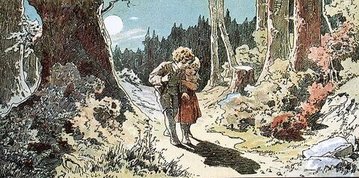
Hard by a great forest dwelt a poor wood-cutter with his wife and his two children. The boy was called Hansel and the girl Gretel. He had little to bite and to break, and once when great scarcity fell on the land, he could no longer procure daily bread. Now when he thought over this by night in his bed, and tossed about in his anxiety, he groaned and said to his wife, "What is to become of us? How are we to feed our poor children, when we no longer have anything even for ourselves?" "I'll tell you what, husband," answered the woman, "Early to-morrow morning we will take the children out into the forest to where it is the thickest, there we will light a fire for them, and give each of them one piece of bread more, and then we will go to our work and leave them alone. They will not find the way home again, and we shall be rid of them." "No, wife," said the man, "I will not do that; how can I bear to leave my children alone in the forest?—-the wild animals would soon come and tear them to pieces." "O, thou fool!" said she, "Then we must all four die of hunger, thou mayest as well plane the planks for our coffins," and she left him no peace until he consented. "But I feel very sorry for the poor children, all the same," said the man.
The two children had also not been able to sleep for hunger, and had heard what their step-mother had said to their father. Gretel wept bitter tears, and said to Hansel, "Now all is over with us." "Be quiet, Gretel," said Hansel, "do not distress thyself, I will soon find a way to help us." And when the old folks had fallen asleep, he got up, put on his little coat, opened the door below, and crept outside. The moon shone brightly, and the white pebbles which lay in front of the house glittered like real silver pennies. Hansel stooped and put as many of them in the little pocket of his coat as he could possibly get in. Then he went back and said to Gretel, "Be comforted, dear little sister, and sleep in peace, God will not forsake us," and he lay down again in his bed. When day dawned, but before the sun had risen, the woman came and awoke the two children, saying "Get up, you sluggards! we are going into the forest to fetch wood." She gave each a little piece of bread, and said, "There is something for your dinner, but do not eat it up before then, for you will get nothing else." Gretel took the bread under her apron, as Hansel had the stones in his pocket. Then they all set out together on the way to the forest. When they had walked a short time, Hansel stood still and peeped back at the house, and did so again and again. His father said, "Hansel, what art thou looking at there and staying behind for? Mind what thou art about, and do not forget how to use thy legs." "Ah, father," said Hansel, "I am looking at my little white cat, which is sitting up on the roof, and wants to say good-bye to me." The wife said, "Fool, that is not thy little cat, that is the morning sun which is shining on the chimneys." Hansel, however, had not been looking back at the cat, but had been constantly throwing one of the white pebble-stones out of his pocket on the road.
When they had reached the middle of the forest, the father said, "Now, children, pile up some wood, and I will light a fire that you may not be cold." Hansel and Gretel gathered brushwood together, as high as a little hill. The brushwood was lighted, and when the flames were burning very high, the woman said, "Now, children, lay yourselves down by the fire and rest, we will go into the forest and cut some wood. When we have done, we will come back and fetch you away."
Hansel and Gretel sat by the fire, and when noon came, each ate a little piece of bread, and as they heard the strokes of the wood-axe they believed that their father was near. It was not, however, the axe, it was a branch which he had fastened to a withered tree which the wind was blowing backwards and forwards. And as they had been sitting such a long time, their eyes shut with fatigue, and they fell fast asleep. When at last they awoke, it was already dark night. Gretel began to cry and said, "How are we to get out of the forest now?" But Hansel comforted her and said, "Just wait a little, until the moon has risen, and then we will soon find the way." And when the full moon had risen, Hansel took his little sister by the hand, and followed the pebbles which shone like newly-coined silver pieces, and showed them the way.
They walked the whole night long, and by break of day came once more to their father's house. They knocked at the door, and when the woman opened it and saw that it was Hansel and Gretel, she said, "You naughty children, why have you slept so long in the forest?—-we thought you were never coming back at all!" The father, however, rejoiced, for it had cut him to the heart to leave them behind alone.
Not long afterwards, there was once more great scarcity in all parts, and the children heard their mother saying at night to their father, "Everything is eaten again, we have one half loaf left, and after that there is an end. The children must go, we will take them farther into the wood, so that they will not find their way out again; there is no other means of saving ourselves!" The man's heart was heavy, and he thought "it would be better for thee to share the last mouthful with thy children." The woman, however, would listen to nothing that he had to say, but scolded and reproached him. He who says A must say B, likewise, and as he had yielded the first time, he had to do so a second time also.
The children were, however, still awake and had heard the conversation. When the old folks were asleep, Hansel again got up, and wanted to go out and pick up pebbles as he had done before, but the woman had locked the door, and Hansel could not get out. Nevertheless he comforted his little sister, and said, "Do not cry, Gretel, go to sleep quietly, the good God will help us."
Early in the morning came the woman, and took the children out of their beds. Their bit of bread was given to them, but it was still smaller than the time before. On the way into the forest Hansel crumbled his in his pocket, and often stood still and threw a morsel on the ground. "Hansel, why dost thou stop and look round?" said the father, "go on." "I am looking back at my little pigeon which is sitting on the roof, and wants to say good-bye to me," answered Hansel. "Simpleton!" said the woman, "that is not thy little pigeon, that is the morning sun that is shining on the chimney." Hansel, however, little by little, threw all the crumbs on the path.
The woman led the children still deeper into the forest, where they had never in their lives been before. Then a great fire was again made, and the mother said, "Just sit there, you children, and when you are tired you may sleep a little; we are going into the forest to cut wood, and in the evening when we are done, we will come and fetch you away." When it was noon, Gretel shared her piece of bread with Hansel, who had scattered his by the way. Then they fell asleep and evening came and went, but no one came to the poor children. They did not awake until it was dark night, and Hansel comforted his little sister and said, "Just wait, Gretel, until the moon rises, and then we shall see the crumbs of bread which I have strewn about, they will show us our way home again." When the moon came they set out, but they found no crumbs, for the many thousands of birds which fly about in the woods and fields had picked them all up. Hansel said to Gretel, "We shall soon find the way," but they did not find it. They walked the whole night and all the next day too from morning till evening, but they did not get out of the forest, and were very hungry, for they had nothing to eat but two or three berries, which grew on the ground. And as they were so weary that their legs would carry them no longer, they lay down beneath a tree and fell asleep.
It was now three mornings since they had left their father's house. They began to walk again, but they always got deeper into the forest, and if help did not come soon, they must die of hunger and weariness. When it was mid-day, they saw a beautiful snow-white bird sitting on a bough, which sang so delightfully that they stood still and listened to it. And when it had finished its song, it spread its wings and flew away before them, and they followed it until they reached a little house, on the roof of which it alighted; and when they came quite up to little house they saw that it was built of bread and covered with cakes, but that the windows were of clear sugar. "We will set to work on that," said Hansel, "and have a good meal. I will eat a bit of the roof, and thou, Gretel, canst eat some of the window, it will taste sweet." Hansel reached up above, and broke off a little of the roof to try how it tasted, and Gretel leant against the window and nibbled at the panes. Then a soft voice cried from the room,
"Nibble, nibble, gnaw,
Who is nibbling at my little house?"
The children answered,
"The wind, the wind,
The heaven-born wind,"
and went on eating without disturbing themselves. Hansel, who thought the roof tasted very nice, tore down a great piece of it, and Gretel pushed out the whole of one round window-pane, sat down, and enjoyed herself with it. Suddenly the door opened, and a very, very old woman, who supported herself on crutches, came creeping out. Hansel and Gretel were so terribly frightened that they let fall what they had in their hands. The old woman, however, nodded her head, and said, "Oh, you dear children, who has brought you here? Do come in, and stay with me. No harm shall happen to you." She took them both by the hand, and led them into her little house. Then good food was set before them, milk and pancakes, with sugar, apples, and nuts. Afterwards two pretty little beds were covered with clean white linen, and Hansel and Gretel lay down in them, and thought they were in heaven.
The old woman had only pretended to be so kind; she was in reality a wicked witch, who lay in wait for children, and had only built the little house of bread in order to entice them there. When a child fell into her power, she killed it, cooked and ate it, and that was a feast day with her. Witches have red eyes, and cannot see far, but they have a keen scent like the beasts, and are aware when human beings draw near. When Hansel and Gretel came into her neighborhood, she laughed maliciously, and said mockingly, "I have them, they shall not escape me again!" Early in the morning before the children were awake, she was already up, and when she saw both of them sleeping and looking so pretty, with their plump red cheeks, she muttered to herself, "That will be a dainty mouthful!" Then she seized Hansel with her shrivelled hand, carried him into a little stable, and shut him in with a grated door. He might scream as he liked, that was of no use. Then she went to Gretel, shook her till she awoke, and cried, "Get up, lazy thing, fetch some water, and cook something good for thy brother, he is in the stable outside, and is to be made fat. When he is fat, I will eat him." Gretel began to weep bitterly, but it was all in vain, she was forced to do what the wicked witch ordered her.
And now the best food was cooked for poor Hansel, but Gretel got nothing but crab-shells. Every morning the woman crept to the little stable, and cried, "Hansel, stretch out thy finger that I may feel if thou wilt soon be fat." Hansel, however, stretched out a little bone to her, and the old woman, who had dim eyes, could not see it, and thought it was Hansel's finger, and was astonished that there was no way of fattening him. When four weeks had gone by, and Hansel still continued thin, she was seized with impatience and would not wait any longer. "Hola, Gretel," she cried to the girl, "be active, and bring some water. Let Hansel be fat or lean, to-morrow I will kill him, and cook him." Ah, how the poor little sister did lament when she had to fetch the water, and how her tears did flow down over her cheeks! "Dear God, do help us," she cried. "If the wild beasts in the forest had but devoured us, we should at any rate have died together." "Just keep thy noise to thyself," said the old woman, "all that won't help thee at all."
Early in the morning, Gretel had to go out and hang up the cauldron with the water, and light the fire. "We will bake first," said the old woman, "I have already heated the oven, and kneaded the dough." She pushed poor Gretel out to the oven, from which flames of fire were already darting. "Creep in," said the witch, "and see if it is properly heated, so that we can shut the bread in." And when once Gretel was inside, she intended to shut the oven and let her bake in it, and then she would eat her, too. But Gretel saw what she had in her mind, and said, "I do not know how I am to do it; how do you get in?" "Silly goose," said the old woman, "The door is big enough; just look, I can get in myself!" and she crept up and thrust her head into the oven. Then Gretel gave her a push that drove her far into it, and shut the iron door, and fastened the bolt. Oh! then she began to howl quite horribly, but Gretel ran away, and the godless witch was miserably burnt to death.
Gretel, however, ran like lightning to Hansel, opened his little stable, and cried, "Hansel, we are saved! The old witch is dead!" Then Hansel sprang out like a bird from its cage when the door is opened for it. How they did rejoice and embrace each other, and dance about and kiss each other! And as they had no longer any need to fear her, they went into the witch's house, and in every corner there stood chests full of pearls and jewels. "These are far better than pebbles!" said Hansel, and thrust into his pockets whatever could be got in, and Gretel said, "I, too, will take something home with me," and filled her pinafore full. "But now we will go away." said Hansel, "that we may get out of the witch's forest."
When they had walked for two hours, they came to a great piece of water. "We cannot get over," said Hansel, "I see no foot-plank, and no bridge." "And no boat crosses either," answered Gretel, "but a white duck is swimming there; if I ask her, she will help us over." Then she cried,
"Little duck, little duck, dost thou see,
Hansel and Gretel are waiting for thee?
There's never a plank, or bridge in sight,
Take us across on thy back so white."
The duck came to them, and Hansel seated himself on its back, and told his sister to sit by him. "No," replied Gretel, "that will be too heavy for the little duck; she shall take us across, one after the other." The good little duck did so, and when they were once safely across and had walked for a short time, the forest seemed to be more and more familiar to them, and at length they saw from afar their father's house. Then they began to run, rushed into the parlour, and threw themselves into their father's arms. The man had not known one happy hour since he had left the children in the forest; the woman, however, was dead. Gretel emptied her pinafore until pearls and precious stones ran about the room, and Hansel threw one handful after another out of his pocket to add to them. Then all anxiety was at an end, and they lived together in perfect happiness. My tale is done, there runs a mouse, whosoever catches it, may make himself a big fur cap out of it.
Hansel and Gretel is featured in our collection of Children's Stories, Yummy Stories, and Halloween Stories for Children
Frequently Asked Questions about Hansel and Gretel
What is "Hansel and Gretel" about?
Hansel and Gretel is a fairy tale about two children abandoned in a deep forest by their father and stepmother during a famine. On their first attempt, clever Hansel leaves a trail of white pebbles and the children find their way home. On the second attempt, he can only use breadcrumbs, which are eaten by birds. Lost in the forest, the hungry children discover a house made of bread, cake, and sugar, which belongs to a cannibalistic witch who captures Hansel to fatten him up. Gretel outwits the witch by pushing her into her own oven, frees her brother, and the two escape with the witch's treasure. They find their way home to their father, whose wife has died, and the family lives happily ever after.
What is the moral of "Hansel and Gretel"?
The story carries several moral lessons. Most centrally, it teaches that courage, resourcefulness, and sibling loyalty can overcome even the most frightening dangers. Gretel's quick thinking in tricking the witch into the oven shows that cleverness is more powerful than brute strength. The tale also warns against greed and temptation — the gingerbread house that looks like salvation turns out to be a trap. On a broader level, the story suggests that selfishness is punished (the stepmother dies) while those who care for others are rewarded (the children return home with treasure).
What are the main themes in "Hansel and Gretel"?
The tale explores several powerful themes. Survival and resourcefulness drive the plot as the children use their wits — pebbles, a bone trick, and ultimately Gretel's deception — to stay alive. Abandonment and betrayal form the emotional core, as the children's own family leaves them to die in the forest. Good versus evil is dramatized through the contrast between the innocent children and the predatory witch. The story also addresses temptation and deception, embodied by the gingerbread house that conceals deadly danger behind an appealing surface. Finally, coming of age is implicit — the children who return home are no longer helpless; they have defeated evil and secured their family's future.
What does the gingerbread house symbolize in "Hansel and Gretel"?
The gingerbread house is one of the most famous symbols in fairy tale literature. On the surface, it represents temptation and deception — a beautiful, edible structure that appears to offer salvation to starving children but is actually a trap set by a cannibalistic witch. It embodies the idea that things which seem too good to be true usually are. Some scholars interpret the house as a symbol of false maternal comfort: the witch initially feeds and shelters the children, mimicking the care their stepmother refused to give. The house also contrasts with the children's own impoverished home, suggesting that true safety comes from family bonds, not material abundance.
Who wrote "Hansel and Gretel" and when was it published?
Hansel and Gretel was collected by Jacob and Wilhelm Grimm and first published in 1812 as tale number 15 in the first edition of Kinder- und Hausmärchen (Children's and Household Tales), commonly known as Grimm's Fairy Tales. The tale was told to the brothers by Dortchen Wild, a neighbor who later married Wilhelm. In the original 1812 version, it is the children's biological mother who abandons them; in later editions (by 1857), the Grimms changed her to a stepmother to soften the story. The tale has roots in European folklore traditions about famine, child abandonment, and forest dangers that predate the Grimms' collection.
How does Gretel defeat the witch in "Hansel and Gretel"?
When the witch orders Gretel to check whether the oven is hot enough for baking, Gretel realizes the witch intends to push her inside and cook her. Gretel pretends not to understand, saying she doesn't know how to get into the oven. When the impatient witch demonstrates by sticking her own head inside, Gretel gives her a hard push, shoves her all the way in, slams the iron door shut, and fastens the bolt. The witch burns to death. This moment is the story's turning point — Gretel, who began as the weaker, more fearful sibling, becomes the hero through quick thinking and decisive action.
What is the role of the stepmother in "Hansel and Gretel"?
The stepmother is the instigator of the children's abandonment. She convinces her reluctant husband to leave Hansel and Gretel in the forest, arguing that the family will starve if they keep feeding all four mouths. She represents selfishness and cruelty, placing her own survival above the lives of children. Many scholars note the parallel between the stepmother and the witch — both are female figures who deceive and endanger the children, and some interpretations see them as doubles of each other. Significantly, the stepmother dies while the children are away, suggesting a symbolic connection: when the witch is destroyed, so is the evil maternal figure who set the story in motion.
What do the white pebbles and breadcrumbs represent in "Hansel and Gretel"?
The white pebbles and breadcrumbs are Hansel's two attempts to create a trail home, and they carry symbolic weight beyond their practical function. The pebbles, which shine like silver in the moonlight and successfully guide the children home, represent reliable resourcefulness and foresight. The breadcrumbs, which are eaten by birds and leave the children truly lost, represent the fragility of human plans and the reality that the same strategy doesn't always work twice. Together, they mark the transition from a solvable problem to genuine danger — the moment when the children must face the forest's threats without a safety net.
Is "Hansel and Gretel" based on a true story?
While the tale is not based on a single true story, it reflects real historical conditions in medieval and early modern Europe. During the Great Famine of 1315–1317, widespread crop failure led to starvation across Europe, and historical records document cases of child abandonment and even cannibalism. The Grimms' fairy tales often grew from oral traditions that preserved collective memories of such hardships. Some scholars have also connected the witch figure to the persecution of elderly women during the European witch trials. The story's setting in a dark German forest and its themes of hunger and survival root it firmly in the lived anxieties of pre-industrial European life.
Save stories, build your reading list, and access all study tools — completely free.
Save Hansel and Gretel to your library — it's free!Need help with Hansel and Gretel?
Study tools to help with homework, prepare for quizzes, and deepen your understanding.
Flashcards → | Vocabulary → | Study Guide →