The Brave Little Tailor
by The Brothers Grimm
This story is also known as The Valiant Little Tailor.
One summer's morning a little tailor was sitting on his table by the window; he was in good spirits, and sewed with all his might. Then came a peasant woman down the street crying, "Good jams, cheap! Good jams, cheap!" This rang pleasantly in the tailor's ears; he stretched his delicate head out of the window, and called, "Come up here, dear woman; here you will get rid of your goods." The woman came up the three steps to the tailor with her heavy basket, and he made her unpack the whole of the pots for him. He inspected all of them, lifted them up, put his nose to them, and at length said, "The jam seems to me to be good, so weigh me out four ounces, dear woman, and if it is a quarter of a pound that is of no consequence." The woman who had hoped to find a good sale, gave him what he desired, but went away quite angry and grumbling. "Now, God bless the jam to my use," cried the little tailor, "and give me health and strength;" so he brought the bread out of the cupboard, cut himself a piece right across the loaf and spread the jam over it. "This won't taste bitter," said he, "but I will just finish the jacket before I take a bite." He laid the bread near him, sewed on, and in his joy, made bigger and bigger stitches. In the meantime the smell of the sweet jam ascended so to the wall, where the flies were sitting in great numbers, that they were attracted and descended on it in hosts. "Hola! who invited you?" said the little tailor, and drove the unbidden guests away. The flies, however, who understood no German, would not be turned away, but came back again in ever-increasing companies. The little tailor at last lost all patience, and got a bit of cloth from the hole under his work-table, and saying, "Wait, and I will give it to you," struck it mercilessly on them. When he drew it away and counted, there lay before him no fewer than seven, dead and with legs stretched out. "Art thou a fellow of that sort?" said he, and could not help admiring his own bravery. "The whole town shall know of this!" And the little tailor hastened to cut himself a girdle, stitched it, and embroidered on it in large letters, "Seven at one stroke!" "What, the town!" he continued, "The whole world shall hear of it!" and his heart wagged with joy like a lamb's tail. The tailor put on the girdle, and resolved to go forth into the world, because he thought his workshop was too small for his valour. Before he went away, he sought about in the house to see if there was anything which he could take with him; however, he found nothing but an old cheese, and that he put in his pocket. In front of the door he observed a bird which had caught itself in the thicket. It had to go into his pocket with the cheese. Now he took to the road boldly, and as he was light and nimble, he felt no fatigue. The road led him up a mountain, and when he had reached the highest point of it, there sat a powerful giant looking about him quite comfortably. The little tailor went bravely up, spoke to him, and said, "Good day, comrade, so thou art sitting there overlooking the wide-spread world! I am just on my way thither, and want to try my luck. Hast thou any inclination to go with me?" The giant looked contemptuously at the tailor, and said, "Thou ragamuffin! Thou miserable creature!"
"Oh, indeed?" answered the little tailor, and unbuttoned his coat, and showed the giant the girdle, "There mayst thou read what kind of a man I am!" The giant read, "Seven at one stroke," and thought that they had been men whom the tailor had killed, and began to feel a little respect for the tiny fellow. Nevertheless, he wished to try him first, and took a stone in his hand and squeezed it together so that water dropped out of it. "Do that likewise," said the giant, "if thou hast strength?" "Is that all?" said the tailor, "that is child's play with us!" and put his hand into his pocket, brought out the soft cheese, and pressed it until the liquid ran out of it. "Faith," said he, "that was a little better, wasn't it?" The giant did not know what to say, and could not believe it of the little man. Then the giant picked up a stone and threw it so high that the eye could scarcely follow it. "Now, little mite of a man, do that likewise." "Well thrown," said the tailor, "but after all the stone came down to earth again; I will throw you one which shall never come back at all." And he put his hand into his pocket, took out the bird, and threw it into the air. The bird, delighted with its liberty, rose, flew away and did not come back. "How does that shot please you, comrade?" asked the tailor. "Thou canst certainly throw," said the giant, "but now we will see if thou art able to carry anything properly." He took the little tailor to a mighty oak tree which lay there felled on the ground, and said, "If thou art strong enough, help me to carry the tree out of the forest." "Readily," answered the little man; "take thou the trunk on thy shoulders, and I will raise up the branches and twigs; after all, they are the heaviest." The giant took the trunk on his shoulder, but the tailor seated himself on a branch, and the giant who could not look round, had to carry away the whole tree, and the little tailor into the bargain: he behind, was quite merry and happy, and whistled the song, "Three tailors rode forth from the gate," as if carrying the tree were child's play. The giant, after he had dragged the heavy burden part of the way, could go no further, and cried, "Hark you, I shall have to let the tree fall!" The tailor sprang nimbly down, seized the tree with both arms as if he had been carrying it, and said to the giant, "Thou art such a great fellow, and yet canst not even carry the tree!"
They went on together, and as they passed a cherry-tree, the giant laid hold of the top of the tree where the ripest fruit was hanging, bent it down, gave it into the tailor's hand, and bade him eat. But the little tailor was much too weak to hold the tree, and when the giant let it go, it sprang back again, and the tailor was hurried into the air with it. When he had fallen down again without injury, the giant said, "What is this? Hast thou not strength enough to hold the weak twig?" "There is no lack of strength," answered the little tailor. "Dost thou think that could be anything to a man who has struck down seven at one blow? I leapt over the tree because the huntsmen are shooting down there in the thicket. Jump as I did, if thou canst do it." The giant made the attempt, but could not get over the tree, and remained hanging in the branches, so that in this also the tailor kept the upper hand.
The giant said, "If thou art such a valiant fellow, come with me into our cavern and spend the night with us." The little tailor was willing, and followed him. When they went into the cave, other giants were sitting there by the fire, and each of them had a roasted sheep in his hand and was eating it. The little tailor looked round and thought, "It is much more spacious here than in my workshop." The giant showed him a bed, and said he was to lie down in it and sleep. The bed, however, was too big for the little tailor; he did not lie down in it, but crept into a corner. When it was midnight, and the giant thought that the little tailor was lying in a sound sleep, he got up, took a great iron bar, cut through the bed with one blow, and thought he had given the grasshopper his finishing stroke. With the earliest dawn the giants went into the forest, and had quite forgotten the little tailor, when all at once he walked up to them quite merrily and boldly. The giants were terrified, they were afraid that he would strike them all dead, and ran away in a great hurry.
The little tailor went onwards, always following his own pointed nose. After he had walked for a long time, he came to the courtyard of a royal palace, and as he felt weary, he lay down on the grass and fell asleep. Whilst he lay there, the people came and inspected him on all sides, and read on his girdle, "Seven at one stroke." "Ah," said they, "What does the great warrior here in the midst of peace? He must be a mighty lord." They went and announced him to the King, and gave it as their opinion that if war should break out, this would be a weighty and useful man who ought on no account to be allowed to depart. The counsel pleased the King, and he sent one of his courtiers to the little tailor to offer him military service when he awoke. The ambassador remained standing by the sleeper, waited until he stretched his limbs and opened his eyes, and then conveyed to him this proposal. "For this very reason have I come here," the tailor replied, "I am ready to enter the King's service." He was therefore honorably received and a special dwelling was assigned him.
The soldiers, however, were set against the little tailor, and wished him a thousand miles away. "What is to be the end of this?" they said amongst themselves. "If we quarrel with him, and he strikes about him, seven of us will fall at every blow; not one of us can stand against him." They came therefore to a decision, betook themselves in a body to the King, and begged for their dismissal. "We are not prepared," said they, "to stay with a man who kills seven at one stroke." The King was sorry that for the sake of one he should lose all his faithful servants, wished that he had never set eyes on the tailor, and would willingly have been rid of him again. But he did not venture to give him his dismissal, for he dreaded lest he should strike him and all his people dead, and place himself on the royal throne. He thought about it for a long time, and at last found good counsel. He sent to the little tailor and caused him to be informed that as he was such a great warrior, he had one request to make to him. In a forest of his country lived two giants who caused great mischief with their robbing, murdering, ravaging, and burning, and no one could approach them without putting himself in danger of death. If the tailor conquered and killed these two giants, he would give him his only daughter to wife, and half of his kingdom as a dowry, likewise one hundred horsemen should go with him to assist him. "That would indeed be a fine thing for a man like me!" thought the little tailor. "One is not offered a beautiful princess and half a kingdom every day of one's life!" "Oh, yes," he replied, "I will soon subdue the giants, and do not require the help of the hundred horsemen to do it; he who can hit seven with one blow has no need to be afraid of two."
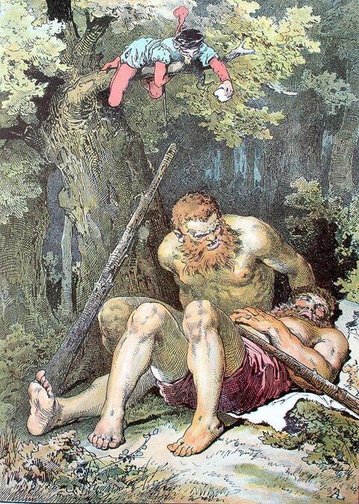
The little tailor went forth, and the hundred horsemen followed him. When he came to the outskirts of the forest, he said to his followers, "Just stay waiting here, I alone will soon finish off the giants." Then he bounded into the forest and looked about right and left. After a while he perceived both giants. They lay sleeping under a tree, and snored so that the branches waved up and down. The little tailor, not idle, gathered two pocketsful of stones, and with these climbed up the tree. When he was half-way up, he slipped down by a branch, until he sat just above the sleepers, and then let one stone after another fall on the breast of one of the giants. For a long time the giant felt nothing, but at last he awoke, pushed his comrade, and said, "Why art thou knocking me?" "Thou must be dreaming," said the other, "I am not knocking thee." They laid themselves down to sleep again, and then the tailor threw a stone down on the second. "What is the meaning of this?" cried the other. "Why art thou pelting me?" "I am not pelting thee," answered the first, growling. They disputed about it for a time, but as they were weary they let the matter rest, and their eyes closed once more. The little tailor began his game again, picked out the biggest stone, and threw it with all his might on the breast of the first giant. "That is too bad!" cried he, and sprang up like a madman, and pushed his companion against the tree until it shook. The other paid him back in the same coin, and they got into such a rage that they tore up trees and belabored each other so long, that at last they both fell down dead on the ground at the same time. Then the little tailor leapt down. "It is a lucky thing," said he, "that they did not tear up the tree on which I was sitting, or I should have had to spring on to another like a squirrel; but we tailors are nimble." He drew out his sword and gave each of them a couple of thrusts in the breast, and then went out to the horsemen and said, "The work is done; I have given both of them their finishing stroke, but it was hard work! They tore up trees in their sore need, and defended themselves with them, but all that is to no purpose when a man like myself comes, who can kill seven at one blow." "But are you not wounded?" asked the horsemen. "You need not concern yourself about that," answered the tailor, "They have not bent one hair of mine." The horsemen would not believe him, and rode into the forest; there they found the giants swimming in their blood, and all round about lay the torn-up trees.
The little tailor demanded of the King the promised reward; he, however, repented of his promise, and again bethought himself how he could get rid of the hero. "Before thou receivest my daughter, and the half of my kingdom," said he to him, "thou must perform one more heroic deed. In the forest roams a unicorn which does great harm, and thou must catch it first." "I fear one unicorn still less than two giants. Seven at one blow, is my kind of affair." He took a rope and an axe with him, went forth into the forest, and again bade those who were sent with him to wait outside. He had to seek long. The unicorn soon came towards him, and rushed directly on the tailor, as if it would spit him on his horn without more ceremony. "Softly, softly; it can't be done as quickly as that," said he, and stood still and waited until the animal was quite close, and then sprang nimbly behind the tree. The unicorn ran against the tree with all its strength, and struck its horn so fast in the trunk that it had not strength enough to draw it out again, and thus it was caught. "Now, I have got the bird," said the tailor, and came out from behind the tree and put the rope round its neck, and then with his axe he hewed the horn out of the tree, and when all was ready he led the beast away and took it to the King.
The King still would not give him the promised reward, and made a third demand. Before the wedding the tailor was to catch him a wild boar that made great havoc in the forest, and the huntsmen should give him their help. "Willingly," said the tailor, "that is child's play!" He did not take the huntsmen with him into the forest, and they were well pleased that he did not, for the wild boar had several times received them in such a manner that they had no inclination to lie in wait for him. When the boar perceived the tailor, it ran on him with foaming mouth and whetted tusks, and was about to throw him to the ground, but the active hero sprang into a chapel which was near, and up to the window at once, and in one bound out again. The boar ran in after him, but the tailor ran round outside and shut the door behind it, and then the raging beast, which was much too heavy and awkward to leap out of the window, was caught. The little tailor called the huntsmen thither that they might see the prisoner with their own eyes. The hero, however went to the King, who was now, whether he liked it or not, obliged to keep his promise, and gave him his daughter and the half of his kingdom. Had he known that it was no warlike hero, but a little tailor who was standing before him, it would have gone to his heart still more than it did. The wedding was held with great magnificence and small joy, and out of a tailor a king was made.
After some time the young Queen heard her husband say in his dreams at night, "Boy, make me the doublet, and patch the pantaloons, or else I will rap the yard-measure over thine ears." Then she discovered in what state of life the young lord had been born, and next morning complained of her wrongs to her father, and begged him to help her to get rid of her husband, who was nothing else but a tailor. The King comforted her and said, "Leave thy bed-room door open this night, and my servants shall stand outside, and when he has fallen asleep shall go in, bind him, and take him on board a ship which shall carry him into the wide world." The woman was satisfied with this; but the King's armour-bearer, who had heard all, was friendly with the young lord, and informed him of the whole plot. "I'll put a screw into that business," said the little tailor. At night he went to bed with his wife at the usual time, and when she thought that he had fallen asleep, she got up, opened the door, and then lay down again. The little tailor, who was only pretending to be asleep, began to cry out in a clear voice, "Boy, make me the doublet and patch me the pantaloons, or I will rap the yard-measure over thine ears. I smote seven at one blow. I killed two giants, I brought away one unicorn and caught a wild boar, and am I to fear those who are standing outside the room." When these men heard the tailor speaking thus, they were overcome by a great dread, and ran as if the wild huntsman were behind them, and none of them would venture anything further against him. So the little tailor was a king and remained one, to the end of his life.
Frequently Asked Questions about The Brave Little Tailor
What is "The Brave Little Tailor" about?
The Brave Little Tailor is a fairy tale by about a tailor who kills seven flies with one swat and embroiders a belt reading "Seven at one stroke." Everyone who sees it assumes he killed seven men, and the tailor rides this misunderstanding to extraordinary heights. He outsmarts giants using a soft cheese and a bird, tricks two quarrelsome giants into killing each other, captures a unicorn by luring it into a tree, and traps a wild boar in a chapel. The King, who had hoped the tailor would die attempting these tasks, is forced to honor his promise of half the kingdom and his daughter's hand in marriage. Even when the truth nearly comes out through the tailor's sleep-talking, his quick wits save him one final time.
What is the moral of "The Brave Little Tailor"?
The primary moral is that cleverness and confidence matter more than physical strength. The tailor never fights anyone directly — every victory comes from quick thinking and creative problem-solving. He uses a cheese to mimic crushing a stone, a bird to fake an impossible throw, and the giants' own tempers against them. A second moral is that self-belief can shape reality: the tailor genuinely considers himself remarkable, and that unshakable confidence convinces everyone around him. The story also carries an implicit warning about the power of perception — reputations built on misunderstanding can be just as effective as genuine accomplishments, for better or worse.
What does "Seven at one stroke" mean in "The Brave Little Tailor"?
"Seven at one stroke" (sometimes translated as "Seven at one blow") is the boast the tailor embroiders on his belt after killing seven flies with a single swat of cloth. The phrase is technically true but wildly misleading — the tailor killed seven flies, not seven men, warriors, or giants. This deliberate ambiguity becomes the engine of the entire story: the giant, the King, and the soldiers all interpret "seven at one stroke" as a fearsome military achievement. The tailor never explicitly lies about what the seven were; he simply allows the misunderstanding to stand. This makes "Seven at one stroke" one of the most famous examples of equivocation in fairy tales — a statement that is literally accurate but practically deceptive.
What are the main themes in "The Brave Little Tailor"?
The tale explores several interconnected themes. Intelligence over brute strength is the most prominent — the tailor defeats every opponent through wit, never through force. The power of reputation and perception drives the plot: the misread belt transforms a humble craftsman into a feared warrior, showing how easily appearances create reality. Social mobility is central to the rags-to-riches arc, as a common tailor rises to become king through ambition and audacity. The trickster archetype is embodied in the tailor himself — cheerful, resourceful, and morally ambiguous, never malicious but always self-serving. Finally, the corruption of power appears in the King, who repeatedly sends the tailor on suicide missions rather than honor his promises.
How does the tailor defeat the giants in "The Brave Little Tailor"?
The tailor defeats giants twice in the story, using different tricks each time. In his first encounter with a single giant, the tailor uses a soft cheese squeezed to look like a crushed stone, a bird released to mimic an impossible throw, and riding on a tree branch while pretending to carry it. The giant is so intimidated that the tailor survives the night, and when the other giants try to kill him in his sleep, he has cleverly moved to a corner of the bed. In the second encounter, the King sends the tailor to kill two giants. He finds them sleeping under a tree, climbs up, and drops stones on each giant alternately. Each blames the other, and their argument escalates until they tear up trees and beat each other to death. The tailor then claims credit for the kill.
Who wrote "The Brave Little Tailor" and when was it published?
The Brave Little Tailor was collected by Jacob and Wilhelm Grimm and published in the first edition of Kinder- und Hausmärchen (Children's and Household Tales) in 1812, where it appears as tale number 20 (KHM 20). The story has much older roots — the earliest known literary version is Der Wegkürzer ("The Road Shortener") by Martinus Montanus, published around 1557. The tale type, classified as ATU 1640 ("The Brave Tailor"), has variants across Europe, Asia, and the Middle East. The story has been adapted extensively, including a famous 1938 Disney cartoon featuring Mickey Mouse as the tailor.
What literary devices are used in "The Brave Little Tailor"?
The tale employs a rich array of literary techniques. Dramatic irony is the story's backbone — readers know the "seven" were flies while every character in the tale believes they were men. The rule of three structures the narrative: the King assigns three challenges (two giants, a unicorn, a wild boar), and the tailor faces three tests from the first giant (squeezing a stone, throwing a stone, carrying a tree). Equivocation — saying something technically true but deliberately misleading — is the tailor's signature device. Contrast between the tiny tailor and his enormous opponents creates both comedy and tension throughout. Escalation drives the plot forward as each challenge grows larger in scale, from a workshop to a mountain to a forest to a royal palace. The tale also uses embedded songs and rhymes, like the tailor's self-congratulatory declarations.
What does the tailor's belt symbolize in "The Brave Little Tailor"?
The belt embroidered with "Seven at one stroke" is the tale's most potent symbol. On one level, it represents the power of self-branding and reputation — a simple piece of cloth transforms a nobody into a feared warrior. On another level, it symbolizes the gap between appearance and reality: the belt tells a literally true story that communicates a completely false impression. The tailor creates the belt in a moment of genuine pride, but it quickly becomes a strategic tool for social advancement. Some literary scholars see the belt as a commentary on social class in 19th-century Germany — the idea that a commoner could rise to power not through birthright or genuine martial prowess, but through clever self-presentation. The belt functions as the tailor's personal coat of arms, a homemade credential that proves as effective as any noble title.
Is the tailor a hero or a trickster in "The Brave Little Tailor"?
The Brave Little Tailor is one of the clearest examples of the trickster archetype in European fairy tales. Unlike traditional heroes who win through strength, courage, or moral virtue, the tailor succeeds entirely through cunning, bluff, and creative deception. He never directly fights anyone — every victory comes from misdirection. However, he is not a villain: his tricks are cheerful rather than malicious, and his opponents are often worse than he is (the greedy King, the bullying giants). The tailor occupies a moral gray area that makes him appealing — he's an underdog who uses the only weapons available to him: his wits and his confidence. This places him in the company of other beloved fairy-tale tricksters like Puss in Boots and Jack the Giant Killer, characters who bend rules without breaking the reader's sympathy.
What three challenges does the King give the tailor in "The Brave Little Tailor"?
The King, wanting to be rid of the tailor without appearing to break his promises, assigns three supposedly impossible tasks. First, the tailor must kill two giants terrorizing a forest — he tricks them into fighting each other by dropping stones on them while they sleep. Second, he must capture a unicorn — he stands before a tree and dodges at the last moment, causing the unicorn to impale its horn in the trunk. Third, he must catch a wild boar — he lures it into a chapel and slams the door shut behind it. Each task follows the same pattern: the King expects death, the tailor uses the environment rather than force, and the reward is postponed until the next challenge. Only after all three does the King reluctantly grant the tailor his daughter and half the kingdom.
Save stories, build your reading list, and access all study tools — completely free.
Save The Brave Little Tailor to your library — it's free!Need help with The Brave Little Tailor?
Study tools to help with homework, prepare for quizzes, and deepen your understanding.
Flashcards → | Vocabulary → | Study Guide →