The Golden Goose
by The Brothers Grimm
This prophetic Brothers Grimm fairytale is about the supposedly dimmest and youngest of three brothers, who due to an act of kindness, is gifted a golden goose by an old man. The parable is about not being greedy-- trying to pluck a golden feather will only get you stuck in a parade of shame. The boy wins over the princess after many saves by the old man, and of course, they live happily ever after. Do not confuse this story with the far more iconic parable, The Goose That Laid the Golden Eggs (that's a different lesson about greed). The Golden Goose was published in Grimm's collection, Children's and Household Tales (1812).
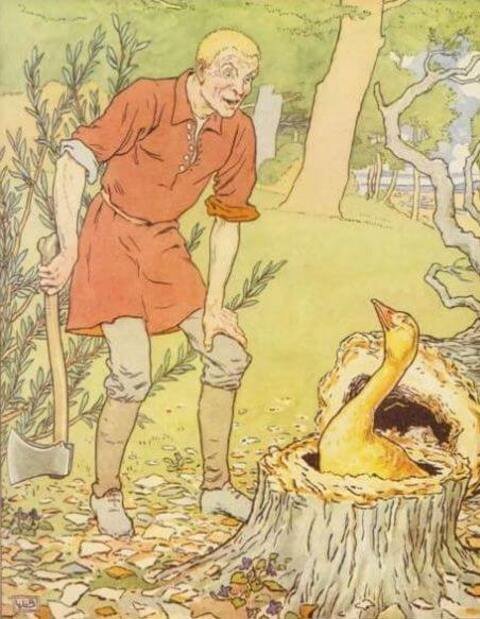
There was a man who had three sons, the youngest of whom was called
Dummling, and was despised, mocked, and put down on every occasion.
It happened that the eldest wanted to go into the forest to hew wood, and before he went his mother gave him a beautiful sweet cake and a bottle of wine in order that he might not suffer from hunger or thirst.
When he entered the forest there met him a little grey-haired old man who bade him good-day, and said, "Do give me a piece of cake out of your pocket, and let me have a draught of your wine; I am so hungry and thirsty." But the prudent youth answered, "If I give you my cake and wine, I shall have none for myself; be off with you," and he left the little man standing and went on.
But when he began to hew down a tree, it was not long before he made a false stroke, and the axe cut him in the arm, so that he had to go home and have it bound up. And this was the little grey man's doing.
After this the second son went into the forest, and his mother gave him, like the eldest, a cake and a bottle of wine. The little old grey man met him likewise, and asked him for a piece of cake and a drink of wine. But the second son, too, said with much reason, "What I give you will be taken away from myself; be off!" and he left the little man standing and went on. His punishment, however, was not delayed; when he had made a few strokes at the tree he struck himself in the leg, so that he had to be carried home.
Then Dummling said, "Father, do let me go and cut wood." The father answered, "Your brothers have hurt themselves with it, leave it alone, you do not understand anything about it." But Dummling begged so long that at last he said, "Just go then, you will get wiser by hurting yourself." His mother gave him a cake made with water and baked in the cinders, and with it a bottle of sour beer.
When he came to the forest the little old grey man met him likewise, and greeting him, said, "Give me a piece of your cake and a drink out of your bottle; I am so hungry and thirsty." Dummling answered, "I have only cinder-cake and sour beer; if that pleases you, we will sit down and eat." So they sat down, and when Dummling pulled out his cinder-cake, it was a fine sweet cake, and the sour beer had become good wine. So they ate and drank, and after that the little man said, "Since you have a good heart, and are willing to divide what you have, I will give you good luck. There stands an old tree, cut it down, and you will find something at the roots." Then the little man took leave of him.
Dummling went and cut down the tree, and when it fell there was a goose sitting in the roots with feathers of pure gold. He lifted her up, and taking her with him, went to an inn where he thought he would stay the night. Now the host had three daughters, who saw the goose and were curious to know what such a wonderful bird might be, and would have liked to have one of its golden feathers.
The eldest thought, "I shall soon find an opportunity of pulling out a feather," and as soon as Dummling had gone out she seized the goose by the wing, but her finger and hand remained sticking fast to it.
The second came soon afterwards, thinking only of how she might get a feather for herself, but she had scarcely touched her sister than she was held fast.
At last the third also came with the like intent, and the others screamed out, "Keep away; for goodness' sake keep away!" But she did not understand why she was to keep away. "The others are there," she thought, "I may as well be there too," and ran to them; but as soon as she had touched her sister, she remained sticking fast to her. So they had to spend the night with the goose.
The next morning Dummling took the goose under his arm and set out, without troubling himself about the three girls who were hanging on to it. They were obliged to run after him continually, now left, now right, just as he was inclined to go.
In the middle of the fields the parson met them, and when he saw the procession he said, "For shame, you good-for-nothing girls, why are you running across the fields after this young man? is that seemly?" At the same time he seized the youngest by the hand in order to pull her away, but as soon as he touched her he likewise stuck fast, and was himself obliged to run behind.
Before long the sexton came by and saw his master, the parson, running behind three girls. He was astonished at this and called out, "Hi, your reverence, whither away so quickly? do not forget that we have a christening to-day!" and running after him he took him by the sleeve, but was also held fast to it.
Whilst the five were trotting thus one behind the other, two labourers came with their hoes from the fields; the parson called out to them and begged that they would set him and the sexton free. But they had scarcely touched the sexton when they were held fast, and now there were seven of them running behind Dummling and the goose.
Soon afterwards he came to a city, where a king ruled who had a daughter who was so serious that no one could make her laugh. So he had put forth a decree that whosoever should be able to make her laugh should marry her. When Dummling heard this, he went with his goose and all her train before the King's daughter, and as soon as she saw the seven people running on and on, one behind the other, she began to laugh quite loudly, and as if she would never leave off. Thereupon Dummling asked to have her for his wife, and the wedding was celebrated. After the King's death, Dummling inherited the kingdom and lived a long time contentedly with his wife.
Frequently Asked Questions about The Golden Goose
What is "The Golden Goose" about?
The Golden Goose is a fairy tale by about Dummling, the youngest and most underestimated of three brothers. When his two older brothers refuse to share their food with a mysterious little grey man in the forest, they are each punished with injuries. Dummling, given only a cinder-cake and sour beer by his mother, willingly shares with the old man — and his poor food is magically transformed into fine cake and wine. As a reward, the old man directs him to a tree containing a goose with feathers of pure gold. Anyone who touches the goose becomes magically stuck to it, and Dummling soon trails a comical procession of seven people through the countryside. The absurd parade makes a perpetually solemn princess laugh, and Dummling wins her hand in marriage and eventually the kingdom.
What is the moral of "The Golden Goose"?
The primary moral is that kindness and generosity are rewarded, while selfishness brings misfortune. The two older brothers refuse to share their fine food with the old man and suffer injuries as a result. Dummling, who has almost nothing, shares willingly — and his generosity triggers every good thing that follows. A second moral is that those who are underestimated can achieve the greatest things: Dummling is mocked as a fool by his family, yet he is the one who wins a princess and a kingdom. The story also warns against greed — the innkeeper's daughters try to pluck golden feathers for themselves and end up stuck fast, as do the parson and sexton who interfere. Every character who acts out of self-interest gets trapped, while Dummling, who never grasps at the goose's gold, benefits from it freely.
What are the main themes in "The Golden Goose"?
Several themes interweave through this deceptively simple tale. Kindness rewarded is the central engine — Dummling's willingness to share his meager food with a stranger sets everything in motion. The triumph of the underdog drives the narrative arc: the character everyone dismisses as a fool becomes king. Greed and its consequences provide the comic and cautionary elements — anyone who tries to take from the goose without earning it becomes stuck. Appearance versus reality runs throughout: the cinder-cake becomes fine cake, the simpleton becomes king, and a golden goose becomes a trap. Finally, the tale explores joy and laughter as transformative forces — the princess's inability to laugh represents a broken kingdom, and Dummling's absurd procession heals it.
Who is Dummling in "The Golden Goose"?
Dummling (German: Dummling, meaning "little fool" or "simpleton") is the youngest of three brothers and the tale's protagonist. He is "despised, mocked, and put down on every occasion" by his family, who consider him stupid and useless. His mother gives him only a cake baked in cinders and sour beer — the worst provisions — when he goes into the forest. Yet Dummling is the only brother with a genuinely good heart. He shares his food without hesitation, treats the mysterious old man with respect, and walks through the world without grasping at wealth or status. He represents a common figure in Grimm fairy tales: the youngest simpleton who succeeds not through intelligence or strength but through innate goodness and open-heartedness. The name itself has become a German literary term for this type of character.
Why do people get stuck to the golden goose?
The golden goose has a magical property: anyone who touches it — or touches someone already stuck to it — becomes permanently attached. This creates a growing chain of people trailing behind Dummling as he walks. The first to get stuck are the innkeeper's three daughters, who each try to pluck a golden feather while Dummling is away. Then a parson grabs the youngest daughter's hand to "rescue" her, a sexton grabs the parson's sleeve, and two laborers touch the sexton. The sticking serves both a comic function — the growing, stumbling procession is what makes the solemn princess laugh — and a moral function. Every person who gets stuck acts out of greed, nosiness, or self-righteousness. The magic punishes those who try to take what isn't theirs or interfere with what they don't understand.
Who wrote "The Golden Goose" and when was it published?
The Golden Goose was collected by Jacob and Wilhelm Grimm and first published in the second edition of Kinder- und Hausmärchen (Children's and Household Tales) in 1819, where it appears as tale number 64 (KHM 64). The German title is Die goldene Gans. The tale belongs to the international story type ATU 571 ("All Stick Together"), which has variants across Europe. The Grimms gathered it from oral tradition, and the story combines two classic fairy-tale patterns: the kind youngest child rewarded by a magical helper, and the contest to make a princess laugh. The tale has been adapted into picture books, animated films, and stage productions worldwide.
What does the golden goose symbolize?
The golden goose operates as a multilayered symbol. Most directly, it represents the unexpected rewards of generosity — Dummling receives it not because he sought treasure but because he shared his food with a stranger. The gold feathers symbolize abundance and divine favor, hidden in the roots of an ordinary tree and accessible only to the pure of heart. The goose's sticky property symbolizes the trap of greed: those who try to take the gold for themselves become prisoners. Some folklorists read the goose as a symbol of natural fortune — wealth that flows freely to the generous but ensnares the grasping. The absurd procession it creates can be read as a metaphor for how greed spreads through a community, with each new person pulled in by the one before them.
What literary devices are used in "The Golden Goose"?
The tale employs several classic fairy-tale devices with particular skill. The rule of three structures the entire story: three brothers, three attempts in the forest, three innkeeper's daughters, and a cascading chain of stuck characters. Repetition with variation drives the opening — each brother goes to the forest, meets the old man, and either refuses or accepts, with the stakes shifting each time. Irony pervades the narrative: the "fool" is the wisest, the cinder-cake becomes the best food, and a goose is worth more than gold. Escalation builds the comic centerpiece as one person after another joins the stuck procession. Magical realism blends seamlessly into the everyday — there is no spell announced, no incantation; the food simply transforms and the goose simply sticks. The tale also uses contrast between Dummling's humility and everyone else's greed to drive its moral argument.
How is "The Golden Goose" different from "The Goose That Laid the Golden Eggs"?
These are two entirely different stories that are frequently confused because of their similar names. Aesop's fable The Goose That Laid the Golden Eggs is about a farmer who kills his magical goose to get all the gold at once, only to find nothing inside — its moral is "don't destroy the source of your wealth through greed." The Grimms' The Golden Goose features a goose with golden feathers that magically sticks to anyone who touches it, creating a comic procession that makes a princess laugh. The Aesop fable is a cautionary tale about short-sighted greed; the Grimm fairy tale is a story about kindness rewarded and greed punished. They share the motif of a golden goose, but the plots, morals, characters, and traditions behind them are completely different.
Why can't the princess laugh in "The Golden Goose"?
The tale states simply that the King's daughter "was so serious that no one could make her laugh" — no explanation is given for her condition. This is a common fairy-tale motif known as the "laughless princess" (or in folklore classification, the "princess who cannot laugh" motif). Her solemnity functions as a problem that only the right person can solve, similar to other fairy tales where a princess cannot sleep, cannot speak, or cannot be made to smile. The cure — the absurd sight of seven people stumbling helplessly behind Dummling and his goose — suggests that what the kingdom needs is not power or wisdom but genuine, unforced comedy. Dummling doesn't try to be funny; the laughter comes naturally from an impossible situation. This makes his success feel earned rather than calculated, reinforcing the tale's message about the value of authenticity.
Save stories, build your reading list, and access all study tools — completely free.
Save The Golden Goose to your library — it's free!Need help with The Golden Goose?
Study tools to help with homework, prepare for quizzes, and deepen your understanding.
Flashcards → | Vocabulary → | Study Guide →