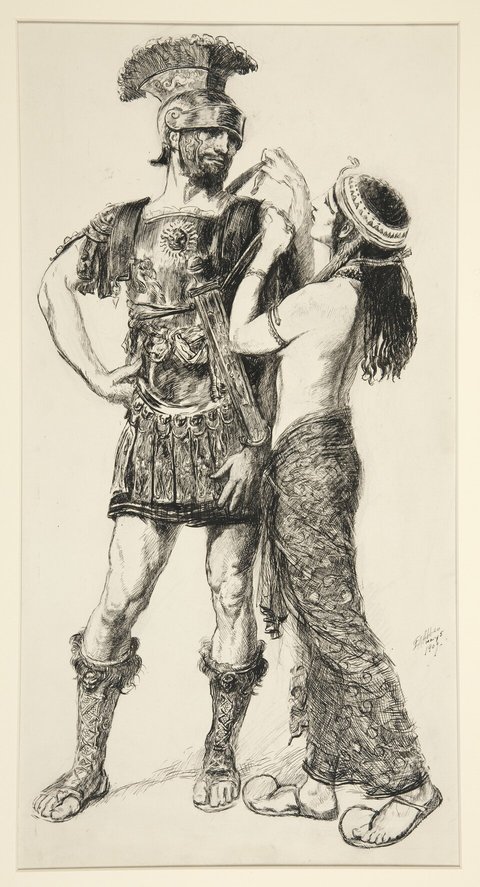
Antony and Cleopatra
Antony and Cleopatra, written around 1607, is one of Shakespeare's most ambitious Roman tragedies. The play dramatizes the turbulent relationship between Mark Antony, one of the three rulers of the Roman Republic, and Cleopatra, the Queen of Egypt. Torn between his political duties in Rome and his passionate devotion to Cleopatra in Alexandria, Antony finds himself increasingly at odds with the cold, calculating Octavius Caesar. The play spans the vast geography of the ancient Mediterranean world, shifting rapidly between Rome, Egypt, and the battlefields that decide the fate of empires.
At its heart, the play explores the tension between public duty and private desire, between the stern Roman virtues of discipline and honor and the sensual, extravagant world of the Egyptian court. Antony's vacillation between these two poles ultimately leads to his military defeat at the Battle of Actium and his death. Cleopatra, refusing to be paraded as a trophy in Caesar's triumph, takes her own life in one of the most iconic scenes in all of Shakespeare. Their love, however ruinous, is presented as genuinely transcendent, a force that rivals and perhaps exceeds the power of empire itself.
The play is remarkable for its sweeping scope, its richly poetic language, and its complex portrayal of both lovers. Cleopatra is one of Shakespeare's most vivid and multifaceted characters, by turns imperious, playful, jealous, and magnificent. Antony and Cleopatra remains a powerful meditation on the costs of ambition, the nature of power, and the destructive grandeur of love.