The Call of the Wild
Study Guide for Jack London's Classic Adventure Novel

You don't have to love dogs to appreciate that Jack London's The Call of the Wild (1903) is one of the best American novels.
Set during the Klondike Gold Rush, this powerful adventure novel tells the story of Buck, a domesticated dog who is thrust into the brutal world of the Yukon and must rediscover his primal instincts to survive.
This comprehensive study guide helps teachers and students understand the nuances of the story and its significance in American Literature, exploring themes of survival, the relationship between man and nature, and the thin line between civilization and the wild.
Read the Novel
Before diving into the analysis, read the complete novel:
Character Analysis & Summary

Characters
Buck - The 140-pound Saint Bernard and Scotch Shepherd mix dog, who is the narrator of the story.
Judge Miller - Buck's first owner who raised him in a big house in the "sun-kissed" Santa Clara Valley, before Buck was abducted to the Yukon Territory to become a sled dog.
John Thornton - The first kind-hearted owner Buck has ever had in the Yukon, leading his team of sled dogs, which he treats humanely, compared to other men.
Perrault, Francois, Curly - French Canadian miners assembling their dog teams to find gold. Buck didn't like them, but respected them as a new kind of men. Perrault, in particular, knew dogs, recognizing Buck as "one in ten thousand."
The man in the red sweater - The man who bought Buck, beats dogs; not even worth naming, he's so cruel.
Spitz - The dog who challenges Buck for the leadership position of the pack, losing a "fight to the death."
Yeehat Indians - The fictional tribe Jack London invented for the story, who are responsible for attacking Thornton's camp and murdering him (and his friends). Buck got his revenge by killing some, so they fear him as an evil spirit, a "Ghost Dog" they fear who dwells in the valley they will not enter.
Plot Summary

The story is told by a dog named Buck, a 140 pound Saint Bernard-Shepherd mix, who is abducted from his comfortable life as a pet to endure the cruel, chaotic, and harsh conditions as a working sled dog during the Klondike Gold Rush in the 1890s. Buck is mistreated by many owners before he ends up in the kindly hands of John Thornton, after enduring a severe beating for refusing to make an unsafe river crossing. Buck lets Thornton nurse him back to health.
Thornton recognizes the dog's intelligence, strength, and assumed leadership of the pack as they endure many hardships in their quest to find gold. Their circumstances reduce their goal to mere survival, as both cannot ever fully recover from the cruelty of other men. Their enduring friendship becomes the defining feature of their survival.
Yeehat Indians attack Thornton's camp, killing Thornton, Hans, Pete and the dogs Skeet and Nig. Buck attacks the chief and rips his throat, the others try to shoot Buck, but hit their friends instead. Buck is regarded as an Evil Spirit, the Ghost Dog who kills hunters and warriors in the valley they refuse to enter. Buck provided his instinct and hardened heart; he is now truly wild. But he'll never forget the enduring love from one man, proven better than one in ten thousand.
Symbolism
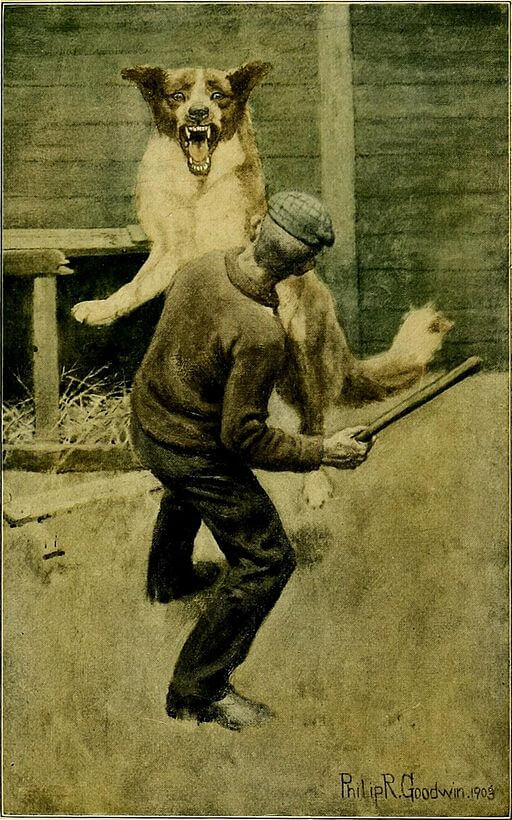
London employs a number of symbols in the story that impart a number of lessons (for both man and beast):
The Club - The symbol of domination and submission under its rule. It represents man's undisputed total domination over the dogs; there's no ambiguity in its power.
The Fang - Represents the dogs' social hierarchy of established dominance, and their forced cooperative working relationship as a team subject to man's domination. It also represents the dogs' instinct for survival, work, and focus-on-mission, and their utter contrast to domestic dogs as pets.
Red - The color represents blood, death, and the cruelty capable of all men. The "man in the red sweater" whom Buck never forgot, is the symbol of all things cruel and hateful about man.
Genre & Themes
Genre
London's story is in the genre of adventure fiction, though with a realistic historical setting; sub-genre is survival.
Primary Themes
Survival - Man/Dog vs. nature, Man vs. man, Man vs. dog, Dog vs. dog
The Law of Club and Fang - The brutal rules that govern survival in the wild
Secondary Themes
Authority Hierarchies - The concept of the "dominant primordial beast"
Permanent Scars - Some wounds, both physical and emotional, never fully heal
Instinct Rules - Kill what you eat, trust your reflexes, trust no one, you might survive
Comparative Themes
- Discipline with compassion (Thornton) vs. violence (other men)
- Conform vs. fight
- Brains vs. brawn (Buck has both)
- Trust (Buck lets Thornton heal him) vs. distrust (Buck endures a beating rather than make an unsafe river crossing)
Chapter Headings
London's chapter titles reveal the story:
- Into the Primitive
- The Law of Club and Fang
- The Dominant Primordial Beast
- Who Has Won to Mastership
- The Toil of Trace and Trail
- For the Love of a Man
- The Sounding of the Call
Important Quotes

Explain what the following quotes mean and how they relate to the story:
"Old longings nomadic leap,
Chafing at custom's chain;
Again from its brumal sleep
Wakens the ferine strain."
Chapter 1 epigraph - Sets the tone for Buck's awakening primal instincts.
"During the four years since his puppyhood he had lived the life of a sated aristocrat; he had a fine pride in himself, was even a trifle egotistical, as country gentlemen sometimes become because of their insular situation."
Chapter 1 - Buck's comfortable life before his abduction.
"They were new dogs, utterly transformed by the harness...the toil of the traces seemed the supreme expression of their being, and all that they lived for and the only thing in which they took delight."
Chapter 2 - The transformation that work brings to the dogs.
"Buck was in open revolt. He wanted, not to escape a clubbing, but to have the leadership. It was his by right. He had earned it, and he would not be content with less."
Chapter 4 - Buck's rise to dominance.
"Far more potent were the memories of his heredity that gave things he had never seen before a seeming familiarity; the instincts (which were but the memories of his ancestors become habits) which had lapsed in later days, and still later, in him, quickened and became alive again."
Chapter 4 - The awakening of Buck's primal instincts.
"There was no power of recuperation left, no reserve strength to call upon. It had been all used, the last least bit of it."
Chapter 5 - The brutal exhaustion of the trail.
"But especially he loved to run in the dim twilight of the summer midnights, listening to the subdued and sleepy murmurs of the forest, reading signs and sounds as a man may read a book, and seeking for the mysterious something that called -- called, waking or sleeping, at all times, for him to come."
Chapter 7 - The call of the wild beckoning Buck.
"His cunning was wolf cunning, and wild cunning; his intelligence, shepherd intelligence and St. Bernard intelligence; and all this, plus an experience gained in the fiercest of schools, made him as formidable a creature as any that roamed the wild."
Chapter 7 - Buck's complete transformation into a wild creature.
"The Yeehats tell of a Ghost Dog that runs at the head of the pack. They are afraid of this Ghost Dog, for it has cunning greater than they, stealing from their camps in the fierce winters, robbing their traps, slaying their dogs, and defying their bravest hunters."
Chapter 7 - Buck's legendary status as the Ghost Dog.
Discussion Questions

Why does London have Buck narrate the story?
Discuss the story's survival theme, particularly the meaning of "the law of club and fang."
Describe Buck's character and how he establishes his dominance of the pack. Compare his innate abilities (his breed and instincts) versus his learned behaviors (he was a pet who learned how to be a dominant Yukon dog).
Discuss London's use of anthropomorphism (giving human qualities to animals). Discuss the dog and human thoughts and behaviors.
Provide textual evidence how London reveals the strong emotional connection between John Thornton and Buck, and how both have been forever damaged by the cruelty of other men.
Describe Thornton's relationship with all the dogs, compared to Buck in particular.
Contrast specific behaviors of working sled dogs in this story (how they eat, fight, work together, relate to humans) versus domestic house dogs.
Identify and discuss the use of symbols in the novel (start with the club, fang, red, food).
Is this story considered "historical fiction"-- a realistic portrayal of the Yukon and the Klondike Gold Rush of the 1890s? Can you find any inaccuracies? Here's an Overview of the Klondike Gold Rush
Explain the legend of the "Ghost Dog."
Explain the idiom, "It's a dog-eat-dog world" as it relates to this story.
Read about Jack London's life, including his year in the Yukon where he "found himself." How does his own story influence this one?
Watch the 1935 movie, (yes, this is the old one in black & white), The Call of the Wild (1935), starring Clark Gable and Loretta Young, shot on Mt. Baker, Washington, where the cast endured real cruel winter conditions. Complete two columns contrasting book vs. movie adaptation (really, a female love interest?)
Write a story of your own using anthropomorphism narrating your pet's story. What stories would he/she tell about living with you?
Paired Reading Suggestions

Compare another story's plot, setting, symbols, writing style, and relationships with The Call of the Wild:
White Fang by Jack London - Considered its sequel. Which novel do you like better and why?
The Luck of Roaring Camp by Bret Harte - A short story about an unexpected baby's arrival to a mining camp.
A Dark Brown Dog by Stephen Crane - Anthropomorphizing an alienated dog, set in the Jim Crow South during Reconstruction. What does the dog symbolize?
Holding Her Down by Jack London - About hobos riding the Canadian Pacific rail lines.
To Build a Fire by Jack London - Our all-time favorite Jack London story about a man who slowly freezes to death; his dog knows better.
A Piece of Steak by Jack London - A lesser-known story about an aging boxer; compare both stories' themes of survival and the high stakes of a potential life-or-death fight.
Inscription on the Monument of a Newfoundland Dog by Lord Byron - A tribute poem to his beloved dog, Boatswain.
The Star Rover by Jack London - A brutal story about a professor serving a life sentence for murder at San Quentin, San Francisco Bay.
Daybreak by Jack London - Not known for his poetry, this is a touching departure from London's survival genre, about unrequited love (requiring a different type of survival skills).
You choose: Select another author's survival story you like. Can the protagonist die and still fit this genre?
Useful Links

External Resources
- The Call of the Wild lesson plans & capstone project ideas
- Anthropomorphism in The Call of the Wild
- The Call of the Wild summary & background
- History of the Klondike Gold Rush, 1896-1899
- Sled Dogs: An Alaskan Epic
- Indian Tribes of North America by region
Related Content on American Literature
Historical Context

Jack London's story is set during the Klondike Gold Rush, in which an estimated 100,000 prospectors came to the Yukon, Canada after gold was discovered by local miners and reported to Seattle, triggering a stampede of wanna-be prospectors between 1896-1899. Most went home poor, but had plenty of stories to tell.
The trip required passage from Southeast Alaska over Chilkoot Pass to the Yukon River, descending to the Klondike. Between the hazards of elevation and extreme weather conditions, many did not survive or abandoned their quest. By 1899, folks lost interest and the goldfields were abandoned for the most part, though gold mining activity continued until 1903, the same year London published his most famous book.
Note: The Yeehat Indian tribe is fictionalized. No such North American tribe exists. London made it up, along with their legend of the "Ghost Dog."
Try Our Interactive Study Guides!
Test your knowledge with our gamified study guides
Active Learning
Engage with content through interactive exercises, not passive reading
Quick Sessions
Complete guides in 7-10 minutes, perfect for busy schedules
Track Progress
See your improvement with scores