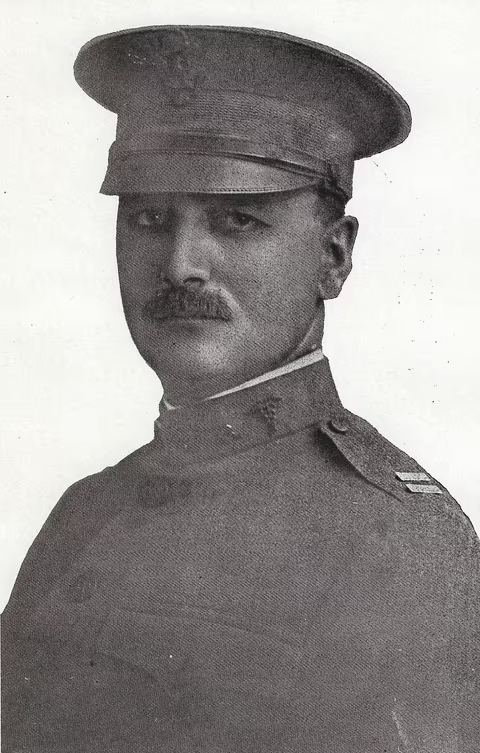
David H. Keller, as depicted in Science Wonder Stories, July 1929
Quick Facts
David Henry Keller
Pen Name: Henry Cecil, Monk Smith, Matthew Smith, Amy Worth, Cecilia Henry, Jacobus Hubelaire
Born: December 23, 1880
Died: July 13, 1966
Nationality: American
Genres: Science Fiction, Horror, Fantasy
Notable Works: The Thing in the Cellar, The Revolt of the Pedestrians, The Human Termites, The Psychophonic Nurse, The Rat Racket
👶 Early Life and Education
David Henry Keller was born on December 23, 1880, in Philadelphia, Pennsylvania, and raised at Kellersville, his family's ancestral home in the Pocono Mountains. He graduated from the University of Pennsylvania School of Medicine in 1903 and went on to specialize in neuropsychiatry, becoming the first psychiatrist to write science fiction—a distinction noted by genre historians ever since.
⚕️ Military and Medical Career
Keller served as a neuropsychiatrist in the United States Army Medical Corps during both World Wars, reaching the rank of lieutenant colonel before retiring in 1945. His specialty was treating soldiers suffering from “shell shock”—what we now recognize as post-traumatic stress disorder—and this experience gave his stories a psychological depth unusual for the pulp era. Between the wars, he served as Assistant Superintendent of the Louisiana State Mental Hospital at Pineville until political upheaval under Governor Huey Long cost him the position in 1928.
📖 Career and Literary Contributions
That same year proved pivotal for his literary career. Hugo Gernsback published Keller's first science fiction story, “The Revolt of the Pedestrians,” in the February 1928 issue of Amazing Stories. The story—a darkly prophetic tale of a society so dependent on automobiles that walking becomes illegal—established Keller's signature approach: examining the human and emotional consequences of technological change rather than celebrating technology for its own sake. Gernsback was so impressed that he offered Keller a contract for twelve stories at sixty dollars each and coined the term “Keller yarns” for his distinctive blend of psychology and speculation. Keller also served as Associate Science Editor of Science Wonder Stories and later edited Gernsback's magazine Sexology from 1934 to 1938.
Over the following decades, Keller published more than sixty stories across Amazing Stories, Weird Tales, Science Wonder Stories, and other pulp magazines. He wrote under several pseudonyms, including Henry Cecil, Monk Smith, Matthew Smith, Amy Worth, Cecilia Henry, and Jacobus Hubelaire—an unusually large number for the era, reflecting his prolific range across genres.
🌟 Notable Works
Among his most acclaimed works are The Rat Racket (1931), which draws on the legend of the Pied Piper of Hamelin; “The Thing in the Cellar” (1932), a horror tale that has been reprinted in at least fourteen anthologies and remains his single most famous story; and The Psychophonic Nurse (1928), a prescient exploration of automated childcare that was later adapted for television. His novel The Human Termites (1929) explores the unsettling concept of a hive mind controlling humanity and caused considerable excitement among early science fiction readers.
🎨 Writing Style
Unlike many of his contemporaries in the pulp magazines, Keller was less interested in gadgets and space travel than in the emotional and psychological consequences of change. His psychiatric training informed stories that probed fear, obsession, and the fragility of human sanity. Critics have noted that his character-driven, psychologically grounded approach anticipated the concerns of science fiction's later Golden Age by a full decade. His horror fiction, particularly for Weird Tales, often derived its power from what remained unseen rather than from explicit description.
✨ Legacy and Significance
In his later years, Keller became an early scholar of H. P. Lovecraft, publishing critical works on Lovecraft from 1948 to 1965. His personal papers are held in archival collections at Syracuse University, Georgia Tech, and Swarthmore College—a testament to his enduring significance in the history of speculative fiction. Two major posthumous collections, Tales from Underwood (1952) and The Folsom Flint and Other Curious Tales (1969), were published by Arkham House and ensured that his best work remained available to new generations of readers.
Keller died on July 13, 1966, in Stroudsburg, Pennsylvania, not far from the family home in the Pocono Mountains where he had grown up.
Frequently Asked Questions about David H. Keller
Where can I find study guides for David H. Keller's stories?
We offer free interactive study guides for the following David H. Keller stories:
- The Rat Racket — comprehension questions, vocabulary review, and discussion prompts