Little Red-Cap
by The Brothers Grimm
Stories involving "Little Red" may have originated in Italy and throughout Europe as early as the fourteen century, though they may have been wildly different from Grimm's version. The fairy tale is best known as Little Red Riding Hood. Grimm's story was published in their collection, "Kinder-und Hausmärchen" (Children's and Household Tales) (1812). It has changed very little stylistically in the many renditions since.
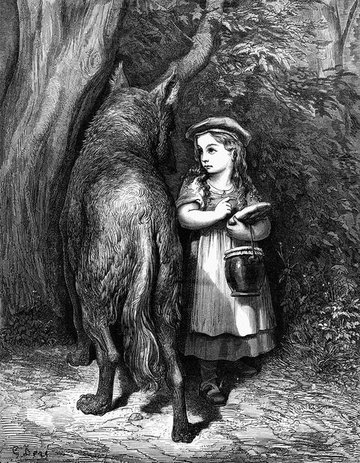
Once upon a time there was a dear little girl who was loved by every one who looked at her, but most of all by her grandmother, and there was nothing that she would not have given to the child. Once she gave her a little cap of red velvet, which suited her so well that she would never wear anything else; so she was always called "Little Red-Cap."
One day her mother said to her, "Come, Little Red-Cap, here is a piece of cake and a bottle of wine; take them to your grandmother, she is ill and weak, and they will do her good. Set out before it gets hot, and when you are going, walk nicely and quietly and do not run off the path, or you may fall and break the bottle, and then your grandmother will get nothing; and when you go into her room, don't forget to say, 'Good-morning,' and don't peep into every corner before you do it."
"I will take great care," said Little Red-Cap to her mother, and gave her hand on it.
The grandmother lived out in the wood, half a league from the village, and just as Little Red-Cap entered the wood, a wolf met her. Red-Cap did not know what a wicked creature he was, and was not at all afraid of him.
"Good-day, Little Red-Cap," said he.
"Thank you kindly, wolf."
"Whither away so early, Little Red-Cap?"
"To my grandmother's."
"What have you got in your apron?"
"Cake and wine; yesterday was baking-day, so poor sick grandmother is to have something good, to make her stronger."
"Where does your grandmother live, Little Red-Cap?"
"A good quarter of a league farther on in the wood; her house stands under the three large oak-trees, the nut-trees are just below; you surely must know it," replied Little Red-Cap.
The wolf thought to himself, "What a tender young creature! what a nice plump mouthful—-she will be better to eat than the old woman. I must act craftily, so as to catch both." So he walked for a short time by the side of Little Red-Cap, and then he said, "See Little Red-Cap, how pretty the flowers are about here—-why do you not look round? I believe, too, that you do not hear how sweetly the little birds are singing; you walk gravely along as if you were going to school, while everything else out here in the wood is merry."
Little Red-Cap raised her eyes, and when she saw the sunbeams dancing here and there through the trees, and pretty flowers growing everywhere, she thought, "Suppose I take grandmother a fresh nosegay; that would please her too. It is so early in the day that I shall still get there in good time;" and so she ran from the path into the wood to look for flowers. And whenever she had picked one, she fancied that she saw a still prettier one farther on, and ran after it, and so got deeper and deeper into the wood.
Meanwhile the wolf ran straight to the grandmother's house and knocked at the door.
"Who is there?"
"Little Red-Cap," replied the wolf. "She is bringing cake and wine; open the door."
"Lift the latch," called out the grandmother, "I am too weak, and cannot get up."
The wolf lifted the latch, the door flew open, and without saying a word he went straight to the grandmother's bed, and devoured her. Then he put on her clothes, dressed himself in her cap, laid himself in bed and drew the curtains.
Little Red-Cap, however, had been running about picking flowers, and when she had gathered so many that she could carry no more, she remembered her grandmother, and set out on the way to her.
She was surprised to find the cottage-door standing open, and when she went into the room, she had such a strange feeling that she said to herself, "Oh dear! how uneasy I feel to-day, and at other times I like being with grandmother so much." She called out, "Good morning," but received no answer; so she went to the bed and drew back the curtains. There lay her grandmother with her cap pulled far over her face, and looking very strange.
"Oh! grandmother," she said, "what big ears you have!"
"The better to hear you with, my child," was the reply.
"But, grandmother, what big eyes you have!" she said.
"The better to see you with, my dear."
"But, grandmother, what large hands you have!"
"The better to hug you with."
"Oh! but, grandmother, what a terrible big mouth you have!"
"The better to eat you with!"
And scarcely had the wolf said this, than with one bound he was out of bed and swallowed up Red-Cap.
When the wolf had appeased his appetite, he lay down again in the bed, fell asleep and began to snore very loud. The huntsman was just passing the house, and thought to himself, "How the old woman is snoring! I must just see if she wants anything." So he went into the room, and when he came to the bed, he saw that the wolf was lying in it. "Do I find thee here, thou old sinner!" said he. "I have long sought thee!" Then just as he was going to fire at him, it occurred to him that the wolf might have devoured the grandmother, and that she might still be saved, so he did not fire, but took a pair of scissors, and began to cut open the stomach of the sleeping wolf. When he had made two snips, he saw the little Red-Cap shining, and then he made two snips more, and the little girl sprang out, crying, "Ah, how frightened I have been! How dark it was inside the wolf;" and after that the aged grandmother came out alive also, but scarcely able to breathe. Red-Cap, however, quickly fetched great stones with which they filled the wolf's body, and when he awoke, he wanted to run away, but the stones were so heavy that he fell down at once, and fell dead.
Then all three were delighted. The huntsman drew off the wolf's skin and went home with it; the grandmother ate the cake and drank the wine which Red-Cap had brought, and revived, but Red-Cap thought to herself, "As long as I live, I will never by myself leave the path, to run into the wood, when my mother has forbidden me to do so."
* * * * * * *
It is also related that once when Red-Cap was again taking cakes to the old grandmother, another wolf spoke to her, and tried to entice her from the path. Red-Cap, however, was on her guard, and went straight forward on her way, and told her grandmother that she had met the wolf, and that he had said "good-morning" to her, but with such a wicked look in his eyes, that if they had not been on the public road she was certain he would have eaten her up. "Well," said the grandmother, "we will shut the door, that he may not come in." Soon afterwards the wolf knocked, and cried, "Open the door, grandmother, I am little Red-Cap, and am fetching you some cakes." But they did not speak, or open the door, so the grey-beard stole twice or thrice round the house, and at last jumped on the roof, intending to wait until Red-Cap went home in the evening, and then to steal after her and devour her in the darkness. But the grandmother saw what was in his thoughts. In front of the house was a great stone trough, so she said to the child, "Take the pail, Red-Cap; I made some sausages yesterday, so carry the water in which I boiled them to the trough." Red-Cap carried until the great trough was quite full. Then the smell of the sausages reached the wolf, and he sniffed and peeped down, and at last stretched out his neck so far that he could no longer keep his footing and began to slip, and slipped down from the roof straight into the great trough, and was drowned. But Red-Cap went joyously home, and never did anything to harm any one.
You may also enjoy our collection of Favorite Fairy Tales.
Frequently Asked Questions about Little Red-Cap
What is "Little Red-Cap" about?
Little Red-Cap tells the story of a young girl, beloved by everyone but especially her grandmother, who gives her a red velvet cap she always wears. One day her mother sends her through the forest to bring cake and wine to her sick grandmother. Along the way, a cunning wolf learns her destination and distracts her by pointing out beautiful flowers. While Red-Cap picks flowers, the wolf races ahead, devours the grandmother, disguises himself in her clothing, and waits in bed. When Red-Cap arrives and notices her grandmother's strangely large ears, eyes, hands, and mouth, the wolf swallows her too. A passing huntsman hears the wolf snoring, cuts open his stomach, and frees both Red-Cap and her grandmother alive. They fill the wolf's belly with heavy stones, and he dies when he tries to flee. The tale concludes with a second episode in which Red-Cap, having learned her lesson, outwits another wolf with her grandmother's help.
What is the moral of "Little Red-Cap" by the Brothers Grimm?
The primary moral is the danger of disobeying parental warnings and trusting strangers. Red-Cap's mother explicitly tells her to stay on the path and not dawdle, yet the wolf easily persuades her to wander into the woods picking flowers. This disobedience nearly costs Red-Cap and her grandmother their lives. The tale also teaches that predators can be charming and persuasive — the wolf is polite and friendly, not openly threatening. The second episode reinforces the lesson: a wiser Red-Cap refuses to be lured off the path and, together with her grandmother, outsmarts the second wolf entirely on her own.
What are the main themes in "Little Red-Cap"?
The central themes include innocence versus danger, as Red-Cap's trusting nature makes her vulnerable to the wolf's deception. The story explores obedience and disobedience — straying from the mother's prescribed path leads directly to catastrophe. There is also a strong theme of deception and disguise, embodied in the wolf dressing as the grandmother and mimicking her voice. The tale touches on growing up and gaining wisdom: after her ordeal, Red-Cap vows never to leave the path again, and in the second episode she proves she has internalized the lesson. Finally, the forest itself represents the unknown and its dangers, a space beyond parental protection where children must learn to navigate threats on their own.
What does the red cap symbolize in the story?
The red velvet cap is the story's most discussed symbol. On the surface, it marks the girl's identity — she is so attached to it that she is known by no other name. Many scholars interpret the red cap as a symbol of childhood and the transition toward maturity. The color red has been associated with coming-of-age, vitality, and danger across European folk traditions. Some psychoanalytic readings, particularly those following Bruno Bettelheim's The Uses of Enchantment, argue the red cap represents the onset of puberty and sexual awareness. The grandmother's gift of the cap can be read as an inheritance of femininity that simultaneously attracts the wolf's predatory attention, linking beauty and desirability to vulnerability.
What does the wolf represent in "Little Red-Cap"?
The wolf functions on multiple symbolic levels. Most directly, he represents predatory strangers who use charm and cunning to exploit the naive. He is polite and conversational, asking seemingly innocent questions while calculating how to devour both Red-Cap and her grandmother. In the earlier French version by Charles Perrault, the moral explicitly equates the wolf with seductive and dangerous men. In the Grimm version, the wolf also embodies unchecked appetite and the chaos of nature — he is a creature of the wild forest who infiltrates the domestic space of the grandmother's cottage. Psychoanalytic interpretations view the wolf as the id, representing suppressed desires and impulses that threaten to overwhelm innocence.
How is "Little Red-Cap" different from Perrault's "Little Red Riding Hood"?
The most significant difference is the ending. In Charles Perrault's 1697 French version, the story ends tragically — the wolf eats both the grandmother and the girl, and there is no rescue. Perrault appends an explicit moral warning young women about charming predators. The , writing in 1812, added a happy ending by introducing the huntsman who cuts open the wolf and saves both victims. The Grimm version also includes a second episode in which Red-Cap encounters another wolf but resists temptation and outwits him. Additionally, Perrault's heroine wears a red riding hood (a type of cloak), while the Grimm version specifies a red velvet cap, giving the story its German title Rotkäppchen. The Grimm version emphasizes the mother's explicit warning to stay on the path, which is absent in Perrault.
What literary devices are used in "Little Red-Cap"?
Little Red-Cap employs several distinctive literary devices. The most memorable is the repetition and escalation in the famous bedside dialogue — "what big ears you have," "what big eyes you have," "what large hands you have," "what a terrible big mouth you have" — each exchange building suspense toward the wolf's attack. The story uses dramatic irony throughout: the reader knows the wolf's intentions long before Red-Cap does, creating tension as she innocently reveals her grandmother's location. Foreshadowing appears in the mother's warning not to stray from the path, which hints at the danger ahead. The personification of the wolf, who speaks, reasons, and disguises himself, transforms a natural predator into a complex antagonist. The entire tale functions as an allegory for the dangers children face when venturing beyond parental guidance.
Who is the huntsman in "Little Red-Cap" and what role does he play?
The huntsman (sometimes translated as "woodsman" or "woodcutter") is a figure unique to the version who does not appear in Charles Perrault's earlier telling. He passes by the grandmother's cottage and, hearing the wolf's unusually loud snoring, decides to investigate rather than simply moving on. Recognizing the wolf, he chooses not to shoot but instead cuts open the sleeping wolf's stomach with scissors, freeing Red-Cap and her grandmother alive. The huntsman represents adult protection and justice — a guardian figure who restores order after the wolf's transgression. His presence transforms the tale from a tragedy into a story of rescue and redemption, and his practical wisdom (checking on the old woman, thinking the wolf may have swallowed her) contrasts with the wolf's impulsive greed.
What is the significance of the path and the forest in "Little Red-Cap"?
The path and the forest form the story's central spatial metaphor. The path represents safety, obedience, and the known world — it is the route prescribed by the mother and connects the domestic spaces of home and grandmother's cottage. The forest represents the unknown, temptation, and danger, a wild space beyond parental control where predators lurk. When the wolf persuades Red-Cap to leave the path to pick flowers, she literally crosses from safety into peril. The forest is also seductively beautiful — sunbeams dance through the trees, birds sing, and flowers bloom — suggesting that danger often comes disguised as pleasure. This symbolism resonates across many Brothers Grimm fairy tales, including Hansel and Gretel, where the forest similarly tests children who have strayed from parental protection.
When was "Little Red-Cap" published and what are its origins?
Little Red-Cap (Rotkäppchen) was published by in their 1812 collection Kinder- und Hausmärchen (Children's and Household Tales), where it appears as tale number 26. The story's roots, however, go back much further. The earliest known literary version is Charles Perrault's Le Petit Chaperon Rouge, published in France in 1697. Oral versions of the tale may date to the 10th century or earlier, with variants found across Europe — including Italian stories where the girl encounters an ogress rather than a wolf. The Grimm brothers drew primarily from Perrault's version but adapted it with a happy ending and the addition of the huntsman figure, reflecting their project of collecting and reshaping European folk tales for a German audience. The story has since become one of the most widely recognized fairy tales in the world.
Save stories, build your reading list, and access all study tools — completely free.
Save Little Red-Cap to your library — it's free!Need help with Little Red-Cap?
Study tools to help with homework, prepare for quizzes, and deepen your understanding.
Flashcards → | Vocabulary → | Study Guide →