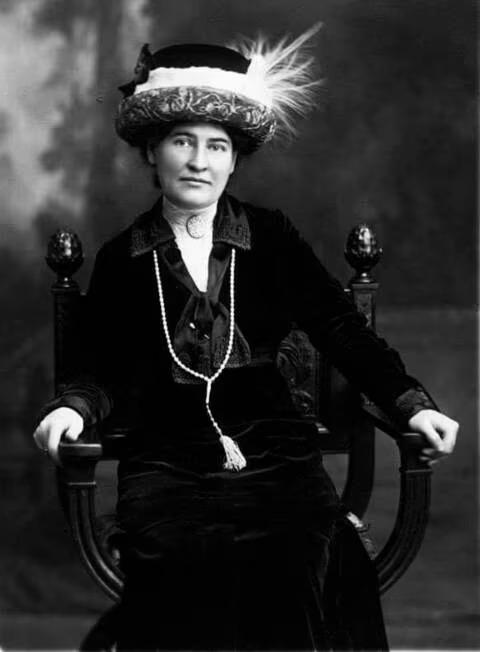
Quick Facts
Willa Sibert Cather
Born: December 7, 1873
Died: April 24, 1947
Nationality: American
Genres: Realism, Regional Fiction, Modernism
Notable Works: My Antonia, O Pioneers!, Death Comes for the Archbishop, A Lost Lady, The Song of the Lark
Willa Cather (1873–1947)
Willa Sibert Cather (December 7, 1873–April 24, 1947) was one of America's greatest novelists, celebrated for her spare, luminous prose and her portraits of immigrant life on the Great Plains. She won the Pulitzer Prize in 1923 for One of Ours, and her novels My Ántonia and Death Comes for the Archbishop are cornerstones of the American literary canon.
🌱 Early Life and the Nebraska Prairie
Cather was born in Back Creek Valley, Virginia, on a small farm that had been in her family for six generations. In 1883, the family moved to Nebraska, settling in the town of Red Cloud the following year. The vast prairie landscape and the Bohemian, Scandinavian, and German immigrant families who farmed it made an indelible impression on the girl. Red Cloud would later appear, thinly disguised, in novel after novel—as Black Hawk in My Ántonia, as Hanover in O Pioneers!, and as Moonstone in The Song of the Lark.
Cather insisted on attending college, and her family borrowed money to send her to the University of Nebraska–Lincoln, where she began publishing stories and sharp theater criticism in local papers. After graduating in 1895, she moved to Pittsburgh to edit a women's magazine and teach high school English, then to New York City in 1906 to join the staff of McClure's Magazine, where she rose to managing editor.
📖 Career and Literary Contributions
Cather's early fiction, collected in The Troll Garden (1905), showed the influence of Henry James and her admiration for artists who sacrifice everything for their work. Stories like “Paul's Case” and “The Sculptor's Funeral” announced a major talent. But it was Sarah Orne Jewett who advised Cather to stop imitating James and write from her own experience. The result was O Pioneers! (1913), her first great novel, followed by The Song of the Lark (1915) and the masterpiece My Ántonia (1918)—a luminous portrait of a Bohemian immigrant girl on the Nebraska prairie that many consider the finest American novel of the twentieth century.
Her later work ranged widely: A Lost Lady (1923) is a devastating portrait of a small-town beauty; The Professor's House (1925) meditates on a scholar's midlife disillusionment; My Mortal Enemy (1926) compresses a lifetime of romantic betrayal into a spare novella; and Death Comes for the Archbishop (1927), set in nineteenth-century New Mexico, is included in Modern Library's list of the hundred best English-language novels of the twentieth century.
The stories of Youth and the Bright Medusa (1920)—including “Coming, Aphrodite!”, “The Diamond Mine”, and “A Gold Slipper”—explore the world of artists and performers with characteristic insight, while later stories like “Neighbour Rosicky” (1928) return to the Nebraska farmland with warmth and autumnal grace.
✍️ Notable Works
- O Pioneers! (1913)—her breakthrough novel of Swedish immigrant Alexandra Bergson taming the Nebraska Divide
- The Song of the Lark (1915)—the coming-of-age of Thea Kronborg, from small-town Colorado to the Metropolitan Opera
- My Ántonia (1918)—her masterpiece, a lyrical memoir of Ántonia Shimerda and the Nebraska prairie
- One of Ours (1922)—Pulitzer Prize winner, the story of a Nebraska farm boy who finds purpose in World War I
- A Lost Lady (1923)—a brief, devastating portrait of Marian Forrester and the decline of the pioneer era
- Death Comes for the Archbishop (1927)—two French priests building the Catholic Church in the New Mexico Territory
- “Paul's Case” (1905)—her most anthologized story, a boy's desperate flight from the dreariness of ordinary life
- “Neighbour Rosicky” (1928)—a warm portrait of a Bohemian farmer with a bad heart and a good life
❤️ Personal Life and Legacy
Cather was an intensely private person who often destroyed her drafts, personal papers, and letters. When she died, her will instructed that her nearly completed novel Hard Punishments be destroyed and restricted scholars from quoting her surviving correspondence. While at the University of Nebraska, she sometimes wore men's clothing and used the name “William.” Her primary relationships were with women; she lived with the editor Edith Lewis from 1912 until her death in 1947. Scholars continue to explore the role of female relationships in her work and life.
Cather was admired by her contemporaries. H. L. Mencken championed her writing, and when Sinclair Lewis accepted the Nobel Prize in Literature in 1930, he told the audience that Cather deserved it more than he did. She was elected to the American Academy of Arts and Letters in 1938. Today she is recognized as one of the supreme American novelists, her prose style—clean, restrained, and deeply felt—a model for generations of writers who followed.
We feature Cather in our collections of Pulitzer Prize Winners and Short Stories.
⭐ Interesting Facts
- Cather's childhood home in Red Cloud, Nebraska, is now a National Historic Landmark, and the Willa Cather Foundation maintains several historic sites in the town.
- She originally published “Coming, Aphrodite!” under the title “Coming, Eden Bower!” in The Smart Set magazine.
- My Ántonia was based on Annie Sadilek Pavelka, a Bohemian immigrant Cather knew in Red Cloud.
- She won the Prix Femina Américain for A Lost Lady in 1933, a French literary prize for the best American novel.
- Cather is one of the few American novelists to have two works on the Modern Library's 100 Best Novels list: My Ántonia and Death Comes for the Archbishop.
Frequently Asked Questions about Willa Cather
Where can I find study guides for Willa Cather's stories?
We offer free interactive study guides for the following Willa Cather stories:
- A Wagner Matinee — comprehension questions, vocabulary review, and discussion prompts
- Neighbour Rosicky — comprehension questions, vocabulary review, and discussion prompts
- Paul's Case — comprehension questions, vocabulary review, and discussion prompts