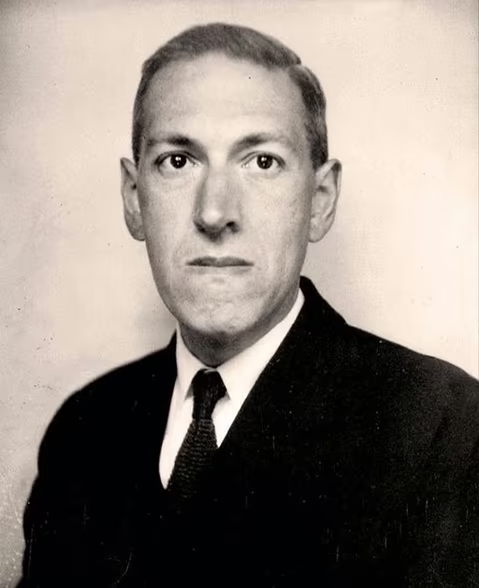
Quick Facts
Howard Phillips Lovecraft
Pen Name: H.P. Lovecraft
Born: August 20, 1890
Died: March 15, 1937
Nationality: American
Genres: Horror, Gothic, Science Fiction
Notable Works: The Call of Cthulhu, At the Mountains of Madness, The Dunwich Horror, The Shadow over Innsmouth, The Colour Out of Space
👶 Early Life and Education
Howard Phillips Lovecraft was born on August 20, 1890, in Providence, Rhode Island. His father, Winfield Scott Lovecraft, a traveling salesman, was institutionalized at Butler Hospital in 1893 after a psychotic episode and died there in 1898. Raised by his mother, Sarah Susan Phillips Lovecraft, his two aunts, and his maternal grandfather, Whipple Van Buren Phillips, Lovecraft grew up sheltered and frequently ill, missing so much school that he was largely self-educated through voracious reading.
A precocious child, Lovecraft was reciting poetry by age two and reading by three. His grandfather's vast library sparked an early obsession with Edgar Allan Poe, Lord Dunsany, and Arthur Machen — writers whose influence would shape his mature fiction. He also developed a passion for astronomy and chemistry, publishing amateur scientific journals as a teenager. He published under several pen names throughout his career, including Lewis Theobald, Humphrey Littlewit, Ward Phillips, and Edward Softly.
📖 Career and Literary Contributions
Lovecraft began his writing career with poetry and essays for the United Amateur Press Association in 1914. His first published story, Dagon (1919), appeared in The Vagrant, and he soon became a regular contributor to Weird Tales, the iconic pulp magazine that published most of his major fiction. He died unknown and in poverty, yet achieved extraordinary acclaim after his death — a transformation unmatched in American horror literature.
His early work drew on the dreamlike fantasy of Lord Dunsany, producing lyrical tales such as The Doom That Came to Sarnath, Celephäis, and The Cats of Ulthar. His middle period intensified the horror, with stories such as The Rats in the Walls, The Festival, and Cool Air. His late masterworks — The Call of Cthulhu, At the Mountains of Madness, The Colour Out of Space, and The Shadow Out of Time — represent the pinnacle of cosmic horror fiction.
🌌 The Cthulhu Mythos
Lovecraft's most enduring creation is the Cthulhu Mythos, a shared fictional universe of ancient, indifferent cosmic entities — Cthulhu, Nyarlathotep, Azathoth, and others — who existed long before humanity and regard it with supreme indifference. Central to these stories is the fictional grimoire The Necronomicon, an evil book of forbidden knowledge that recurs throughout his fiction. The Mythos was expanded by his circle of correspondents, including Clark Ashton Smith, Robert E. Howard, and August Derleth, and it continues to inspire writers, filmmakers, and game designers today.
🌏 Writing Style and Philosophy
Lovecraft rejected traditional supernatural horror in favor of what he called "cosmic horror" — the idea that humanity is insignificant in a vast, indifferent universe filled with forces beyond comprehension. This philosophical framework, known as cosmicism, grew from his lifelong atheism and his deep engagement with science. His essay Supernatural Horror in Literature (1927) remains one of the most important critical works on the horror genre.
His prose style is deliberately ornate and archaic, employing a dense vocabulary and long, hypnotic sentences to create an atmosphere of mounting dread. Stories such as The Music of Erich Zann, The Outsider, and Pickman's Model exemplify his ability to build suspense through suggestion rather than explicit violence.
✈️ Notable Works
Lovecraft's best-known works include the novellas At the Mountains of Madness (1936), The Shadow over Innsmouth (1936), and The Whisperer in Darkness (1937); and the short stories The Call of Cthulhu (1928), The Colour Out of Space (1927), The Rats in the Walls (1924), Herbert West: Reanimator (1922), and The Outsider (1926). He also wrote poetry, such as A Cycle of Verse, featuring verses with his characteristic flair for the dark side of nature.
🏡 Personal Life
Lovecraft married Sonia Haft Greene, a Ukrainian-born businesswoman seven years his senior, in 1924. The couple moved to Brooklyn, New York, but Lovecraft was deeply unhappy in the city and the marriage quickly deteriorated. They separated in 1926 and divorced in 1929. Lovecraft returned to his beloved Providence, where he spent the rest of his life in genteel poverty, living with his aunt and sustained by a meager income from ghostwriting and revision work.
✨ Death and Legacy
Lovecraft was diagnosed with intestinal cancer in early 1937 and died on March 15 at the age of 46, nearly penniless and largely unknown outside the readership of Weird Tales. His friend August Derleth co-founded Arkham House specifically to preserve and publish Lovecraft's work, ensuring its survival.
The scholarly revival of Lovecraft's fiction began in the 1970s and has accelerated ever since. He is now regarded as one of the most influential horror writers of the twentieth century, with the term "Lovecraftian" entering the language to describe cosmic dread and the insignificance of humanity. His work has inspired countless adaptations in film, television, board games, and video games. Lovecraft is featured in our Gothic Literature Study Guide, and his stories appear in our collections of Gothic, Ghost, Horror & Weird Fiction and Halloween Stories.
Frequently Asked Questions about H. P. Lovecraft
Where can I find study guides for H. P. Lovecraft's stories?
We offer free interactive study guides for the following H. P. Lovecraft stories:
- Dagon — comprehension questions, vocabulary review, and discussion prompts
- Herbert West: Reanimator — comprehension questions, vocabulary review, and discussion prompts
- The Call of Cthulhu — comprehension questions, vocabulary review, and discussion prompts
- The Colour Out of Space — comprehension questions, vocabulary review, and discussion prompts
- The Dunwich Horror — comprehension questions, vocabulary review, and discussion prompts
- The Outsider — comprehension questions, vocabulary review, and discussion prompts
- The Rats in the Walls — comprehension questions, vocabulary review, and discussion prompts