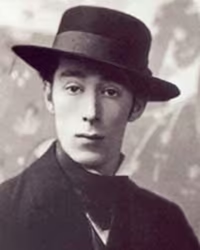
Quick Facts
Hector Hugh Munro
Pen Name: Saki
Born: 18 December 1870
Died: 13 November 1916
Nationality: British
Genres: Short Stories, Satire, Humor, Dark Comedy
Notable Works: The Open Window, The Interlopers, Sredni Vashtar, Tobermory, The Lumber Room
👶 Early Life and Education
Hector Hugh Munro was born on December 18, 1870, in Akyab, Burma (now Sittwe, Myanmar), where his father served as an Inspector General for the Indian Imperial Police. Tragedy struck the family in 1872 when his mother Mary was charged by a cow while on a trip to England. She suffered a miscarriage, never recovered, and died when Munro was only two years old. After her death, the Munro children were sent from Burma back to England, where they were raised by their grandmother and two strict, puritanical aunts in Barnstaple, Devon. This repressive childhood profoundly shaped Munro's writing — the tyrannical aunts who appear throughout his stories are drawn directly from this experience.
Munro was educated at Exmouth and then at Bedford School. His father, Colonel Charles Augustus Munro, retired in 1888 and took the children on travels across Europe, exposing the young Hector to Continental culture and languages. In 1893, Munro followed his father into the Burma Police but contracted malaria and was forced to return to England in 1895, ending his brief colonial career.
📖 Career and Literary Contributions
Back in London, Munro turned to writing. He published his first work of non-fiction, The Rise of the Russian Empire (1900), modeled on Gibbon's Decline and Fall. He then moved into political satire with The Westminster Alice (1902), a series of parodies of Lewis Carroll's Wonderland that skewered British politicians — his first use of the pen name "Saki." The inspiration for the name remains debated: it may derive from the cupbearer in Omar Khayyam's Rubaiyat, or from the South American saki monkey. Given Munro's intellect and mischievous nature, it's possible it was based on both simultaneously.
From 1902 to 1908, Munro worked as a foreign correspondent for the Morning Post, reporting from the Balkans, Warsaw, St. Petersburg, and Paris. These travels sharpened his political observations and provided material for stories set in Eastern European courts and diplomatic circles. Upon returning to London, he devoted himself fully to fiction, producing the short story collections that would secure his reputation: Reginald (1904), Reginald in Russia (1910), The Chronicles of Clovis (1911), and Beasts and Super-Beasts (1914). He also wrote two novels: The Unbearable Bassington (1912) and When William Came (1913), a prophetic tale of German-occupied London that reads eerily in light of subsequent history.
🌿 Writing Style and Themes
Saki is considered a master of the short story and is often compared to O. Henry and Dorothy Parker for his razor-sharp wit and surprise endings. E.F. Benson shares his sardonic style. Munro had a penchant for mocking the popular customs and manners of Edwardian England. He often did so by depicting characters in a setting that would contrast their behavior with the natural world, demonstrating that the simple and straightforward rules of nature would always trump the vanities of men.
His stories feature recurring characters — the irreverent Clovis Sangrail and the languid Reginald — who serve as vehicles for devastating social commentary. Animals frequently appear as agents of chaos or divine justice: a talking cat exposes dinner party hypocrisy in Tobermory, a ferret becomes an instrument of a child's revenge in Sredni Vashtar, and wolves deliver final judgment on feuding landowners in The Interlopers. His prose combines Edwardian elegance with a dark, sometimes macabre undercurrent that anticipates Roald Dahl.
✏️ Notable Works
Among Saki's most celebrated stories:
- The Open Window — a young girl's elaborate prank on a nervous visitor, one of the most anthologized short stories in the English language.
- The Interlopers — two feuding landowners are trapped together under a fallen tree, only to discover that nature has the last word.
- Sredni Vashtar — a sickly boy worships a fierce ferret as a god, with darkly satisfying results.
- Tobermory — a cat learns to speak and wreaks havoc at a country house party by revealing the guests' secrets.
- The Storyteller — a bachelor captivates three children on a train with a deliciously improper tale.
- The Lumber Room — a clever boy outsmarts his repressive aunt with wit far beyond her grasp.
- The Schartz-Metterklume Method — a woman mistaken for a governess wreaks gleeful comic havoc with her unconventional teaching methods.
🏡 Personal Life
Munro never married. He lived a private, cosmopolitan life in London, frequenting the gentlemen's clubs and country house weekends that provided settings for his fiction. His sister Ethel served as his closest companion and, after his death, became the custodian of his literary legacy — though she unfortunately destroyed many of his personal papers before writing her own account of their childhood.
✨ Death and Legacy
When World War I broke out in 1914, Munro refused a commission and enlisted as a regular trooper in the 22nd Battalion of the Royal Fusiliers, determined to see combat despite being 43 years old. He was promoted to lance-sergeant and served on the Western Front. On November 14, 1916, during the Battle of the Ancre near Beaumont-Hamel, France, Munro was killed by a German sniper. His last words were reported as: "Put that bloody cigarette out!" — a final flash of the sardonic wit that defined both his life and his art.
Two posthumous collections, The Toys of Peace (1919) and The Square Egg (1924), were published after his death. Saki's influence extends far beyond his era: his stories are staples of school curricula worldwide, and his mastery of the twist ending, dark humor, and social satire has influenced writers from Roald Dahl to P.G. Wodehouse to Noël Coward. His novel When William Came is featured in World War I Literature.
⭐ Interesting Facts
- Saki wrote most of his stories in London's Covent Garden area, often composing at a desk in the British Museum reading room.
- Despite being well past enlistment age, he twice refused a commission, preferring to serve alongside ordinary soldiers.
- His stories have been adapted for television, including Alfred Hitchcock's program and Roald Dahl's Tales of the Unexpected.
- The name "Saki" appears as the cupbearer who serves wine in the final stanza of Omar Khayyam's Rubaiyat, translated by Edward FitzGerald.
- Ambrose Bierce and Guy de Maupassant are often cited alongside Saki as masters of the short story form with sharp, surprising endings.
Frequently Asked Questions about H.H. Munro (SAKI)
Where can I find study guides for H.H. Munro (SAKI)'s stories?
We offer free interactive study guides for the following H.H. Munro (SAKI) stories:
- Sredni Vashtar — comprehension questions, vocabulary review, and discussion prompts
- The Interlopers — comprehension questions, vocabulary review, and discussion prompts
- The Open Window — comprehension questions, vocabulary review, and discussion prompts
- Tobermory — comprehension questions, vocabulary review, and discussion prompts